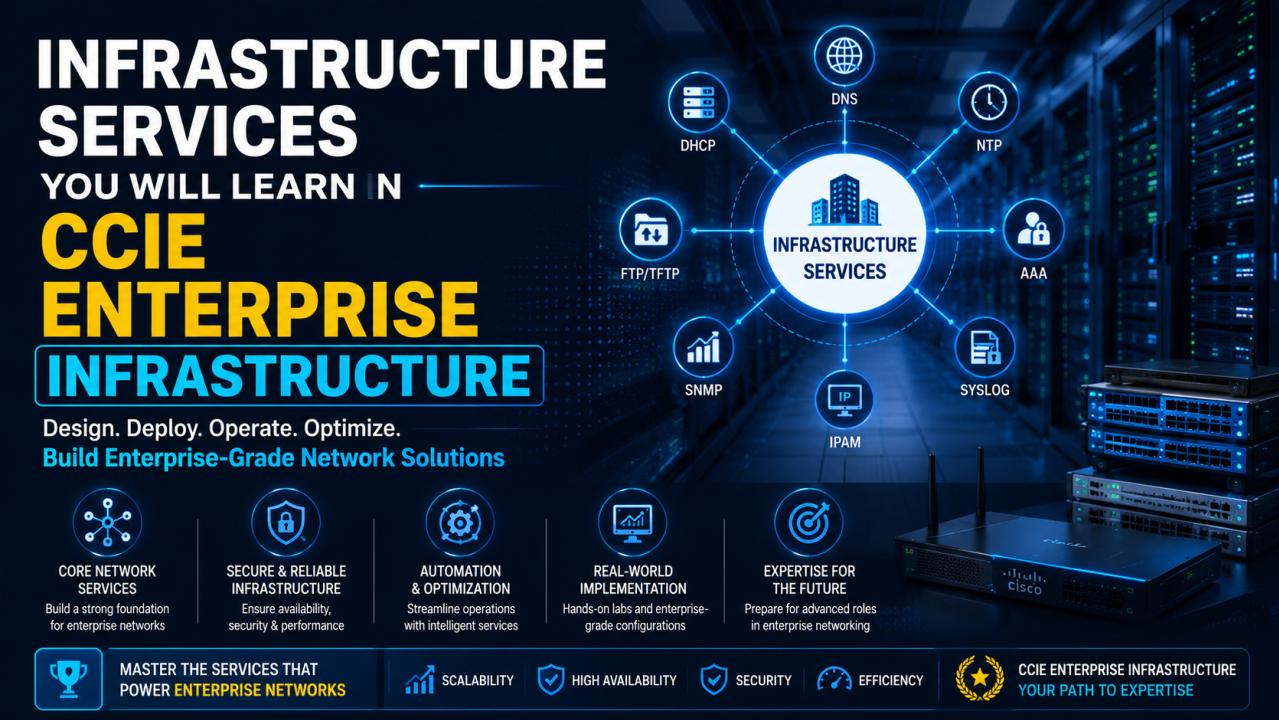
Modern enterprise networks rely on a wide range of infrastructure services to ensure secure communication, seamless connectivity, and efficient network management. CCIE Enterprise Infrastructure certification is designed to help networking professionals master these essential services while developing the advanced skills required to manage complex enterprise environments. From IP addressing and routing services to network security, quality of service, and automation, the certification prepares candidates to build, maintain, and troubleshoot enterprise-grade networks that meet modern business requirements.
Why Infrastructure Services Matter in Enterprise Networks
Infrastructure services are the foundation of every enterprise network. They enable devices, applications, and users to communicate efficiently while ensuring security, scalability, and reliability.
Organizations depend on infrastructure services to:
Provide uninterrupted network connectivity
Support business-critical applications
Improve network performance
Enhance security
Simplify network management
Ensure business continuity
Enable cloud and hybrid networking
Professionals who understand these services are highly valued because they help organizations maintain stable and secure IT environments.
Understanding Infrastructure Services in CCIE Enterprise Infrastructure
Infrastructure services refer to the technologies and protocols that support enterprise networking operations. The certification focuses on configuring, managing, optimizing, and troubleshooting these services in real-world enterprise environments.
Candidates gain practical knowledge of:
IP addressing
Dynamic Host Configuration Protocol (DHCP)
Domain Name System (DNS)
Network Time Protocol (NTP)
First Hop Redundancy Protocols (FHRPs)
Network Address Translation (NAT)
Quality of Service (QoS)
Multicast services
Network security services
Automation and programmability
These technologies work together to create reliable and scalable enterprise infrastructures.
Dynamic Host Configuration Protocol (DHCP)
DHCP automates IP address assignment across enterprise networks.
Why DHCP Is Important
Without DHCP, administrators would need to manually assign IP addresses to every device, increasing administrative effort and the likelihood of configuration errors.
Skills Covered
Candidates learn how to:
Configure DHCP servers
Configure DHCP relay
Manage IP address pools
Troubleshoot DHCP issues
Optimize address allocation
Understanding DHCP helps ensure efficient device connectivity across enterprise environments.
Domain Name System (DNS)
DNS translates domain names into IP addresses, allowing users to access applications and websites without remembering numerical addresses.
Topics Covered
DNS architecture
Name resolution
DNS forwarding
DNS troubleshooting
High availability for DNS services
Reliable DNS services are essential for business operations and application accessibility.
Network Time Protocol (NTP)
Accurate time synchronization is critical for enterprise networks.
Importance of NTP
Consistent system time supports:
Security logging
Authentication
Event correlation
Compliance reporting
Network troubleshooting
Candidates learn to configure and manage NTP across enterprise devices to maintain synchronization throughout the network.
Network Address Translation (NAT)
NAT enables organizations to conserve public IP addresses while improving security.
Key Learning Areas
Candidates gain practical experience with:
Static NAT
Dynamic NAT
Port Address Translation (PAT)
NAT troubleshooting
Enterprise deployment scenarios
Understanding NAT is essential for connecting private enterprise networks to the internet securely.
First Hop Redundancy Protocols (FHRPs)
Enterprise networks require high availability to minimize downtime.
Common FHRPs Covered
Hot Standby Router Protocol (HSRP)
Virtual Router Redundancy Protocol (VRRP)
Gateway Load Balancing Protocol (GLBP)
Benefits
These protocols provide:
Gateway redundancy
Improved availability
Automatic failover
Enhanced network resilience
Candidates learn how to configure and troubleshoot redundancy solutions that support business continuity.
Quality of Service (QoS)
Not all network traffic has the same priority. Business-critical applications require guaranteed performance.
QoS Objectives
Candidates learn how to:
Classify traffic
Mark packets
Prioritize applications
Manage bandwidth
Reduce latency
Prevent packet loss
QoS is particularly important for voice, video, and real-time collaboration applications.
IP Multicast Services
Multicast improves bandwidth efficiency by delivering data to multiple recipients simultaneously.
Applications
Common multicast use cases include:
Best Practices for Learning Infrastructure Services
Build Strong Networking Fundamentals
Understanding routing, switching, and IP networking creates a strong foundation for advanced infrastructure services.
Practice in Enterprise Lab Environments
Hands-on labs help candidates understand real-world deployments and troubleshooting techniques.
Learn Through Practical Scenarios
Simulating enterprise environments improves confidence and technical expertise.
Stay Updated with Cisco Technologies
Enterprise networking continues to evolve, making continuous learning essential for career growth.
Develop Automation Skills
Combining infrastructure knowledge with automation capabilities increases efficiency and employability.
Why Infrastructure Services Are Essential for Enterprise Networking
Infrastructure services form the backbone of modern enterprise networks. They ensure reliable communication, support business applications, strengthen security, and improve operational efficiency. Organizations depend on skilled professionals who understand how these services interact to maintain resilient, scalable, and secure network environments.
Conclusion
Infrastructure services are fundamental to the successful operation of modern enterprise networks, making them an essential part of CCIE Enterprise Infrastructure certification. By mastering technologies such as DHCP, DNS, NTP, NAT, First Hop Redundancy Protocols, Quality of Service, multicast, wireless services, security, automation, and infrastructure monitoring, professionals gain the expertise needed to manage complex enterprise environments with confidence. These skills prepare candidates for real-world networking challenges, improve troubleshooting capabilities, and enhance career opportunities across industries. Enrolling in CCIE Enterprise Training provides the practical knowledge, hands-on experience, and advanced technical skills required to build, manage, and optimize enterprise infrastructure while supporting long-term professional growth in today's evolving networking landscape.