I Turned a Few Tests I Like Into a Website
Lately, I've been working on a small website built around simple online tests.
There wasn't much of a plan in the beginning. I had been looking at different test sites and noticed that a lot of them had something in common: the rules are simple, you can start immediately, and you get a result within seconds.
I like that kind of thing.
Reaction time tests are probably the best example. The screen changes color, you click, and you get a result somewhere around a couple hundred milliseconds.
That's technically the end of the test.
But then you see the number.
You try again.
The second run is a little faster, so naturally you want to do one more.
That feels different from a lot of online tools. You don't just use them and leave. The result itself gives you a reason to try again.
At some point I thought: maybe I should just build a site around these.
First, I needed a name
Naming it took me longer than I expected.
I looked through a lot of domains with test in them. Most of the obvious good ones were long gone. The rest were either too long, awkward to say, or sounded like a brand without giving any clue what the site was actually about.
Eventually I bought PickTests.com.
Pick a test.
Nothing clever about it.
It just fit.
Once I had the domain, I made a pretty long list of things I could build: reaction time, clicking speed, typing speed, aim, memory, and a few others.
My thinking was simple.
If it's a test website, just keep adding tests.
Five is better than three. Ten is better than five. Twenty is better than ten.
At least that was how I looked at it in the beginning.
Once I actually started building, that changed a bit.
Somewhere along the way, I stopped caring so much about quantity
Looking back, I was still measuring the site by the number of pages it had.
More tests meant a bigger site, and a bigger site felt like progress.
But when you're the one actually building them, you start noticing that adding another page isn't the hard part.
The harder question is whether the new thing adds anything at all.
Reaction time tests have been around forever.
So have sequence memory tests and number memory tests.
I could reproduce the familiar version of each one, move on, and eventually end up with a site containing dozens of tests.
But I didn't feel much attachment to that.
So I stopped following the original list.
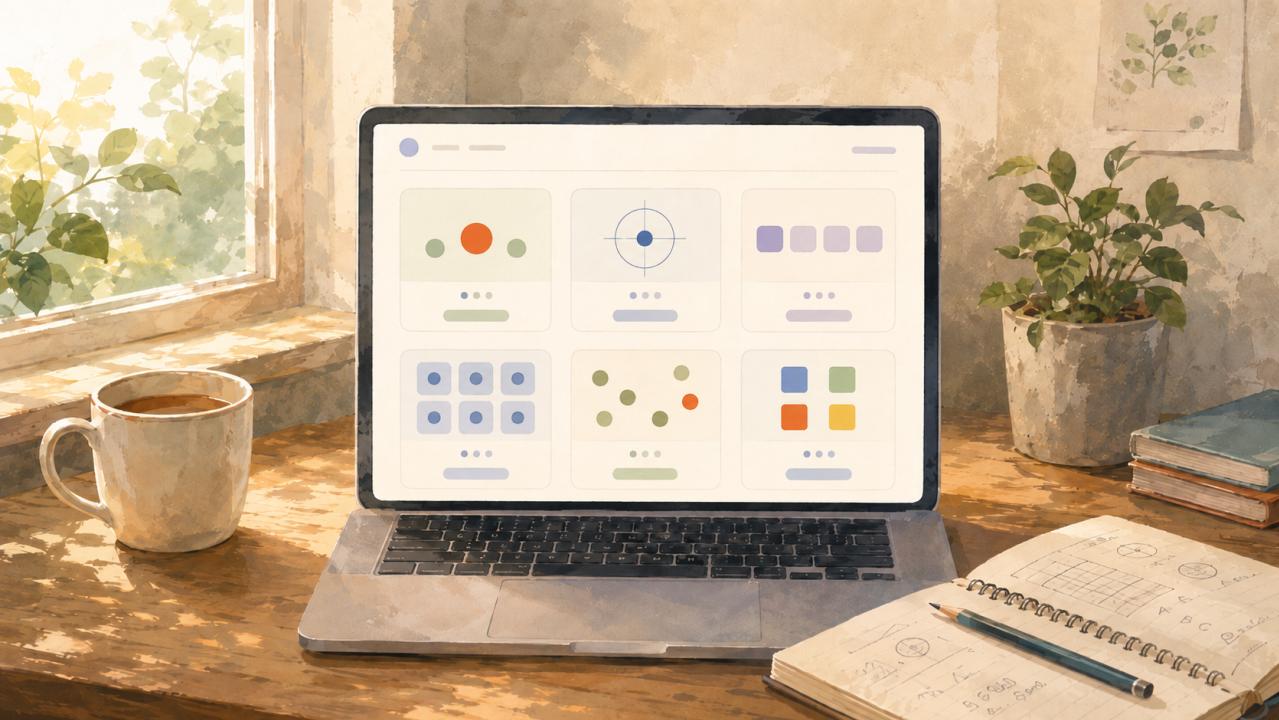
Right now, the site has six tests: reaction time, aim, sequence memory, number memory, multiple-object tracking, and a color interference test.
A few things I originally planned to build still aren't there.
There wasn't really a big turning point.
It was more that every time I finished a test and played it a few more times, small questions started showing up.
Is this part too fast?
Does the randomness feel strange?
Did the difficulty jump too much here?
Should a score tell you anything beyond one number?
Then I'd change something and play again.
And change something else.
The multiple-object tracking test ended up taking much longer than I expected for exactly this reason.
The idea itself is simple: remember a few targets, watch them move among other objects, and pick them out again at the end.
But once it was running in a browser, small changes to the number of objects, speed, or movement time made a huge difference.
One round could feel almost too easy, while the next suddenly felt impossible to follow.
Even something as basic as movement time took a lot of back and forth. Three seconds could feel too easy. Five seconds could be long enough for you to lose track and get frustrated.
I ended up adjusting several things together until it felt closer to that point where losing makes you want to try again instead of close the page.
A surprising amount of time went into things like that.
Nothing especially difficult from a technical point of view.
Just lots of small details.
A while ago, I probably would have looked at some of them and said, "good enough."
Now I seem to spend more time getting stuck on exactly what "good enough" means.
A few things I decided not to build
Leaderboards were one of them.
They're an obvious fit for this kind of site.
Who has the fastest reaction time?
Who can remember the longest number?
I thought about it.
But once you add a leaderboard, the next questions arrive pretty quickly: accounts, a database, score validation, cheating, and so on.
In the end, I left it out.
For now, scores stay in the browser.
There's no account and no login.
You can see your latest result, your personal best, and your recent attempts.
That's enough for what the site is right now.
The technical side has stayed simple as well: HTML, CSS, and vanilla JavaScript.
No backend, and no heavy framework just for the sake of having one.
These are small tests that should open quickly and be playable right away, so I prefer keeping the rest of the site fairly light too.
The current version has reaction, memory, aim, tracking, and attention-related online tests that you can play directly in the browser.
I'm taking it slowly for now
The site has ended up a little different from what I imagined at the start.
There aren't that many tests yet, and I haven't tried to turn it into something more complicated than it needs to be.
There's still plenty I could add.
I'm just not in much of a hurry anymore.
For now, I'd rather keep working on the ones that are already there.
If I come across another test that I genuinely find interesting and would want to play more than once, I'll probably add it.
I don't know whether that eventually means ten tests, twenty, or roughly the same number I have now.
I'll keep building and see where it goes.