Market Overview
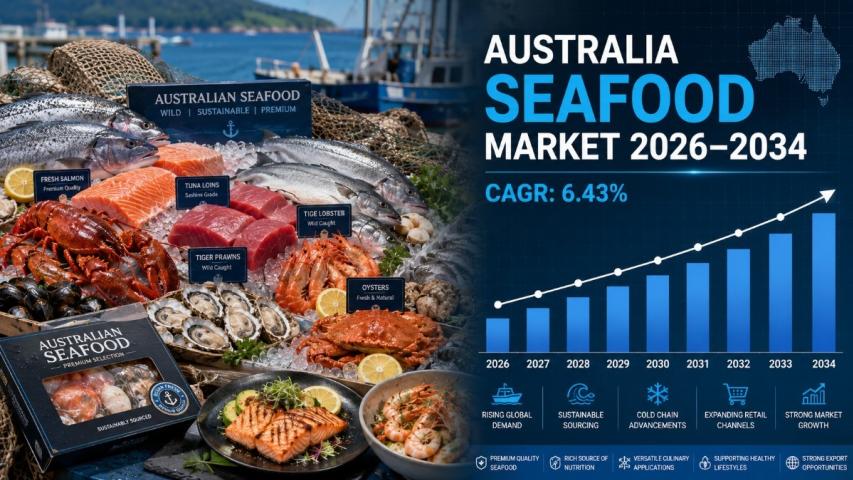
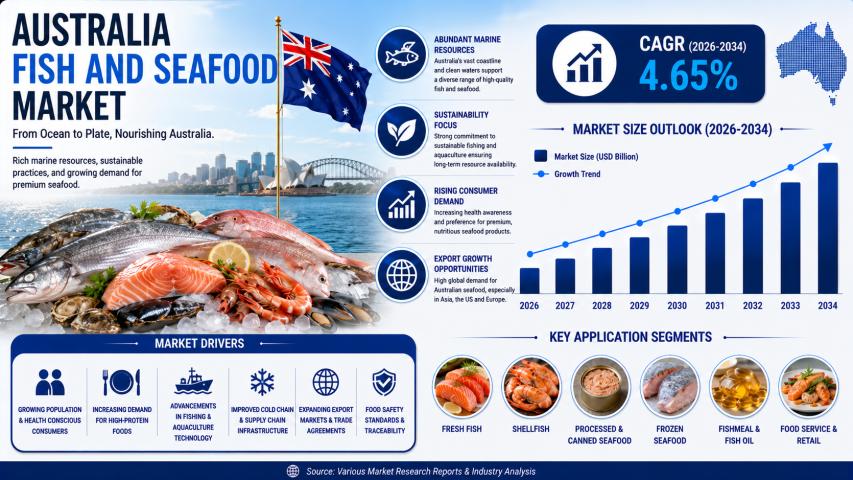
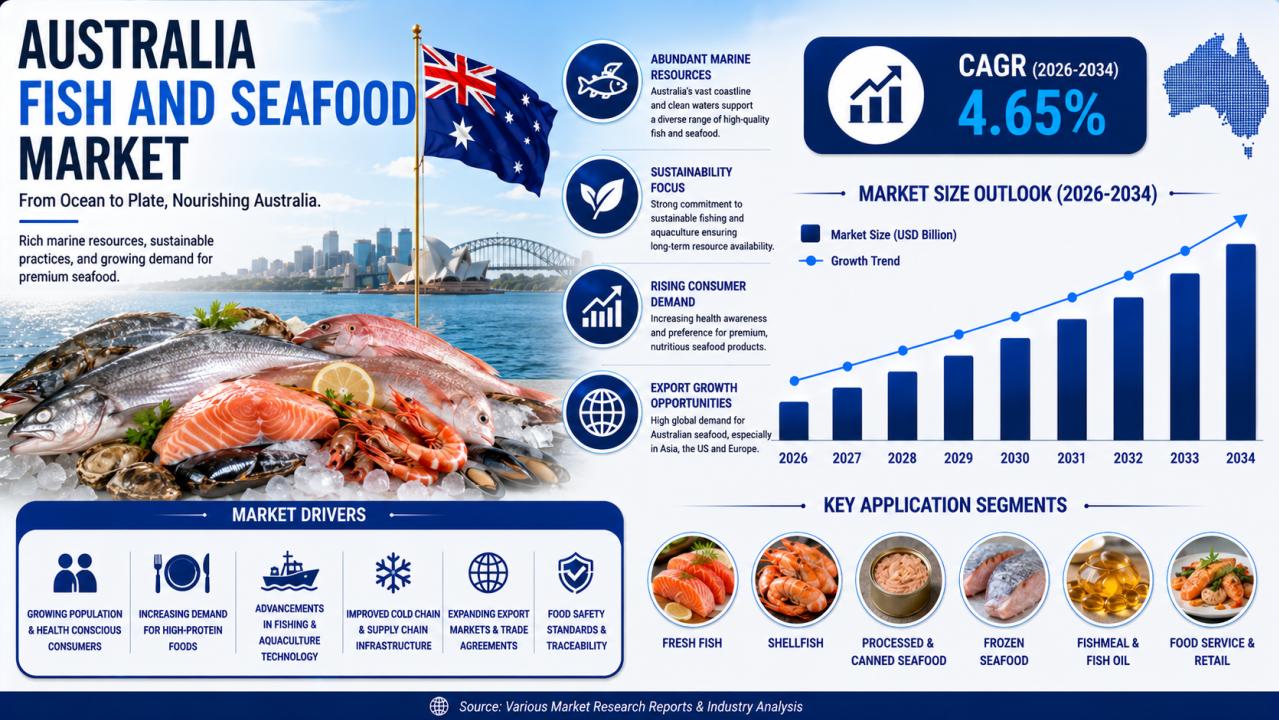
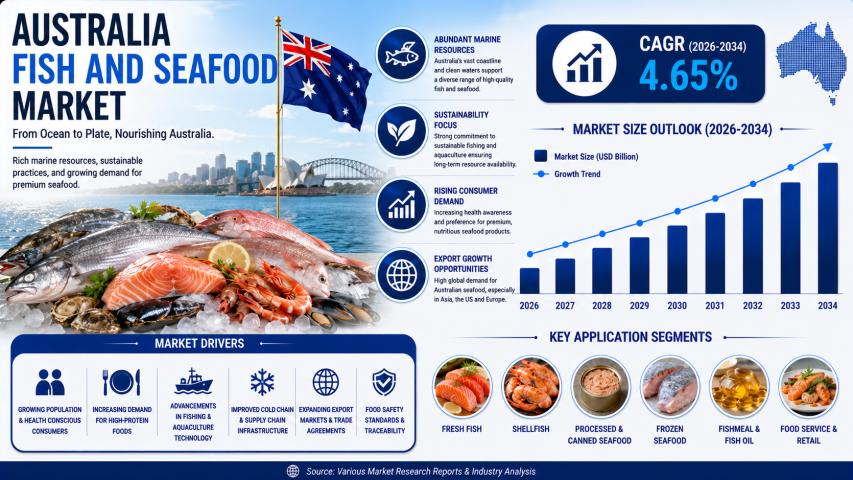
The Australia fish and seafood market size reached USD
4.1 Billion in 2025 and is projected to reach USD 6.1 Billion
by 2034, growing at a compound annual growth rate (CAGR) of 4.65% from
2026 to 2034. The market is growing steadily, fueled by evolving consumer
preferences for nutritious and sustainably sourced products. Advancements in
aquaculture, strong export demand, and government support for sustainable
fishing practices are further propelling the market. Moreover, innovation in
seafood alternatives and convenience-driven products supports expansion in
domestic and international markets.
Request a Sample Report for In-Depth Market Insights:
https://www.imarcgroup.com/australia-fish-seafood-market/requestsample
Australia Fish and Seafood Market Summary
- The
Australia fish and seafood market encompasses a range of products (fresh
fish, fresh seafood) and forms (fresh, frozen, canned, cured), distributed
through offline and online channels, serving diverse consumer needs.
- These
products are valued for their role in providing high-quality protein,
essential nutrients (omega-3 fatty acids), and supporting healthy diets,
while also contributing to economic activity through domestic consumption
and exports.
- The
ecosystem includes commercial fishers, aquaculture producers, processors,
distributors, retailers (supermarkets, fishmongers), foodservice
operators, and consumers.
- Major
segments identified in the market include product (fresh fish, fresh
seafood), form (fresh, frozen, canned, cured), distribution channel
(offline, online), and region.
- The
market is benefiting from growing demand for sustainable and certified
seafood, rising exports to Asian markets, and increased adoption of
technology in aquaculture.
- The
competitive landscape features a mix of large-scale seafood companies,
regional fishers, and aquaculture enterprises, with increasing focus on
sustainability, traceability, and advanced processing technologies.
PORTER'S FIVE FORCES ANALYSIS
- Competitive
Rivalry: Moderate. The market includes large-scale seafood
companies, regional fishers, and aquaculture enterprises competing on
quality, sustainability, and price. Differentiation through certification
and traceability is key. Business implication: Companies
must invest in sustainability and technology.
- Supplier
Power: Low. Suppliers of fishing and aquaculture inputs are
numerous, limiting individual power. However, sustainable sourcing can
provide some leverage. Business implication: Maintain
diverse supplier relationships.
- Buyer
Power: Moderate. Consumers have increasing choice across product
types and forms, with growing awareness of sustainability. However, brand
and quality perceptions provide some balance. Business
implication: Focus on quality, sustainability, and traceability.
- Threat
of Substitutes: Moderate. Alternative protein sources (meat,
poultry, plant-based) compete, but the unique nutritional benefits and
culinary appeal of seafood support its position. Business
implication: Emphasize health benefits, sustainability, and
quality.
- Threat of New Entrants: Moderate. Capital investment and regulatory requirements create barriers, but niche and technology-focused entrants can compete. Business implication: Build brand equity and sustainable sourcing.
MARKET GROWTH DRIVERS
Growing Demand for Sustainable and Certified Seafood
Australia fish and seafood market is experiencing
increased consumer demand for sustainably sourced and certified products. This
shift is driven by heightened awareness of environmental issues and
overfishing. In November 2023, state and territory consumer affairs ministers
announced an agreement for limited seafood labeling in restaurants, cafes, and
clubs, effective in 2025. Under the new policy, seafood will be labeled as
Australian, imported, or mixed origin, aligning eateries with seafood
retailers. This focus aligns with global trends, ensuring Australia remains
competitive in the premium seafood segment while supporting the long-term
health of marine ecosystems.
Rising Exports to Asian Markets
The Australian fish and seafood market is benefitting from
rising exports to Asian markets, driven by high demand for premium-quality
products such as tuna, lobster, and abalone. Countries like Japan, China, and
South Korea view Australian seafood as a luxury item due to its freshness,
sustainability, and stringent quality standards. In September 2024, the
Australian Government launched the NEXDOC system to simplify seafood export
documentation, supporting the USD 1.8 billion trade. The digital platform streamlines
permits and certifications, reducing costs and manual processes, and
strengthening Australia's reputation in global markets.
Increased Adoption of Technology in Aquaculture
Technology adoption is transforming Australia's aquaculture
industry. Advanced systems like automated feeding, real-time water quality
monitoring, and data analytics are improving productivity and sustainability.
The use of recirculating aquaculture systems (RAS) is also gaining momentum. In
July 2024, Huon Aquaculture announced an investment of $110 million to expand
its freshwater Atlantic salmon nursery at Whale Point, Tasmania, using RAS to
grow larger fish on land and reduce marine time. These innovations are
enhancing yields, reducing costs, and ensuring consistent supply to both
domestic and international markets.
AUSTRALIA FISH AND SEAFOOD MARKET SEGMENTATION
Product Insights
- Fresh
Fish
- Fresh
Seafood
Form Insights
- Fresh
- Frozen
- Canned
- Cured
Distribution Channel Insights
- Offline
- Online
Regional Insights
- Australia
Capital Territory & New South Wales
- Victoria
& Tasmania
- Queensland
- Northern
Territory & Southern Australia
- Western
Australia
COMPETITIVE LANDSCAPE
The competitive landscape of the Australia fish and seafood
market is characterized by a mix of large-scale seafood companies, regional
fishers, and aquaculture enterprises. Key players focus on sustainable
sourcing, advanced processing technologies, and strong distribution networks to
maintain market share. Retail giants and specialty seafood stores compete for
domestic market dominance, while the foodservice industry fuels demand for
premium and fresh seafood products. Collaboration between stakeholders ensures
adherence to sustainability standards, further enhancing market
competitiveness.
Key players mentioned in the report context include:
- Genics,
an Australian biotech firm, launched Shrimp MultiPath2.0 in January 2024,
a cutting-edge technology for early detection of shrimp diseases,
identifying 18 pathogens in a single test, enhancing precision and
efficiency.
- Clean
Seas Seafoods received an automatic feeder barge, "Eyre
Spirit," valued at USD 6 million, in July 2024, supporting yellowtail
kingfish farming near Port Lincoln by improving efficiency, reducing
waste, and enabling remote feeding.
- Huon
Aquaculture announced an investment of $110 million in July 2024
to expand its freshwater Atlantic salmon nursery in Tasmania using
recirculating aquaculture systems (RAS).
- Other
major players include large-scale seafood companies, regional
fishers, and aquaculture enterprises.
REGIONAL ANALYSIS
- Australia
Capital Territory & New South Wales: A significant market
driven by strong demand in urban centers like Sydney, diverse fishing
industry, and focus on sustainable practices and high-quality products.
- Victoria
& Tasmania: Crucial players with Tasmania renowned for
premium seafood (Atlantic salmon, oysters, abalone) and advanced
aquaculture, and Victoria benefiting from a vibrant seafood sector and
culinary culture.
- Queensland: A
significant player driven by its vast coastline, major producer of prawns,
tuna, and reef fish, with a focus on sustainability and traceability.
- Western
Australia: A crucial role with a strong presence in both
wild-caught and aquaculture sectors, major exporter of rock lobster,
abalone, and prawns, with a focus on sustainability.
- Northern
Territory & Southern Australia: Contribute through unique
aquatic ecosystems and specialized fisheries, including barramundi, mud
crab, abalone, tuna, and kingfish.
RECENT INDUSTRY DEVELOPMENTS
August 2026: New South Wales announced stronger
fisheries-protection measures targeting illegal catches of valuable seafood
such as abalone, lobster and mud crab. The reforms include expanded
compliance powers for Fisheries Officers and a new “fit and proper person”
standard for commercial fishing licences. The NSW Government also announced
financial and practical support for the state's abalone sector as it transitions
toward a more sustainable operating model.
August 2026: Australia's seafood industry continued
facing supply and sustainability pressures from environmental events. In South
Australia, the commercial fishing closure in the Gulf St Vincent was
extended until May 2027 after an algal bloom severely affected species
including southern calamari, King George whiting and garfish. The closure
affects around 50 fishing businesses operating in the region.
August 2026: The Gulf St Vincent fisheries
restrictions were also affecting seafood prices. Seafood Industry SA reported
reduced supplies and price increases for some locally caught species, including
King George whiting, calamari and garfish. The Gulf normally accounts
for approximately 50% of South Australia's marine-scalefish production,
making the prolonged closure significant for regional seafood supply.
January 2026: Sydney opened its new A$800 million
Sydney Fish Market, a 26,000-square-metre waterfront facility
designed to strengthen Australia's seafood retail, wholesale and food-service
ecosystem. The market contains 42 retailers and 19 seafood wholesalers
and is expected to attract more than 6 million visitors annually,
compared with around 3 million at the previous facility.
2026: Aquaculture and fisheries sustainability
remained central to Australia's seafood supply strategy, with investment
continuing in aquaculture infrastructure and fisheries management. The industry
is increasingly focused on expanding domestic production while maintaining
sustainable wild-capture fisheries and strengthening cold-chain and processing
capabilities.
Key Aspects Required for the Australia Fish and Seafood
Market
- Market
Performance: USD 4.1 Billion in 2025, with a projected trajectory
to USD 6.1 Billion by 2034.
- Market
Outlook: A 4.65% CAGR through 2034 indicates steady growth across
products, forms, and distribution channels, driven by sustainability,
exports, and technology.
- Growth
Drivers: Growing demand for sustainable and certified seafood;
rising exports to Asian markets; increased adoption of technology in
aquaculture; consumer health awareness; and government support for
sustainable practices.
- Competitive
Landscape: A competitive market with large companies, regional
fishers, and aquaculture enterprises. Differentiation occurs through
sustainability, traceability, technology, and quality.
- Value
Chain Analysis: From fishing and aquaculture through processing,
distribution, and retail to end-use by consumers and foodservice, with
sustainability and technology trends shaping market dynamics.
- Industry
Trends: Growing demand for sustainable and certified seafood;
rising exports to Asian markets; increased adoption of technology in
aquaculture; focus on traceability and origin labeling; and innovation in
processing and packaging.
- Strategic
Recommendations: Invest in sustainable and certified seafood
sourcing; adopt advanced aquaculture technologies (RAS, automated
systems); expand export capabilities to Asian markets; enhance
traceability and origin labeling; innovate in processing and packaging;
and build strong brand reputation for quality and sustainability.
Note: If you need any specific information that is not
currently covered within the scope of the report, we will provide the same as a
part of customization.
Speak to an analyst: https://www.imarcgroup.com/request?type=report&id=21975&flag=C
Report Format, Delivery, and Customization Details
- Report
Format Mode: PDF and Excel (Editable version in PPT/Word format
available on special request)
- Report
Delivery Mode: Online Delivery, Physical Delivery
- Report
Delivery Time: report delivered over email within 24 to 48 hours.
If requested by the client, a physical copy will be delivered within three
to ten days.
- Report
Confirmation Mode: Yes, via email
- Report
Customization Mode: Yes, via Email / Call
- Report
Table of Content: Yes
- Report
List of Figures: Yes
- Report
Methodology Mode: Yes
- Request
For Sample Report: Yes
About Us
IMARC Group is a global management consulting firm that
helps the world's most ambitious changemakers to create a lasting impact. The
company provides a comprehensive suite of market entry and expansion services.
IMARC offerings include thorough market assessment, feasibility studies,
company incorporation assistance, factory setup support, regulatory approvals
and licensing navigation, branding, marketing and sales strategies, competitive
landscape and benchmarking analyses, pricing and cost research, and procurement
research.
Contact Us
IMARC Group
134 N 4th St., Brooklyn, NY 11249, USA
Email: sales@imarcgroup.com
Tel No: (D) +91 120 433 0800
United States: +1-201-971-6302