Market Overview
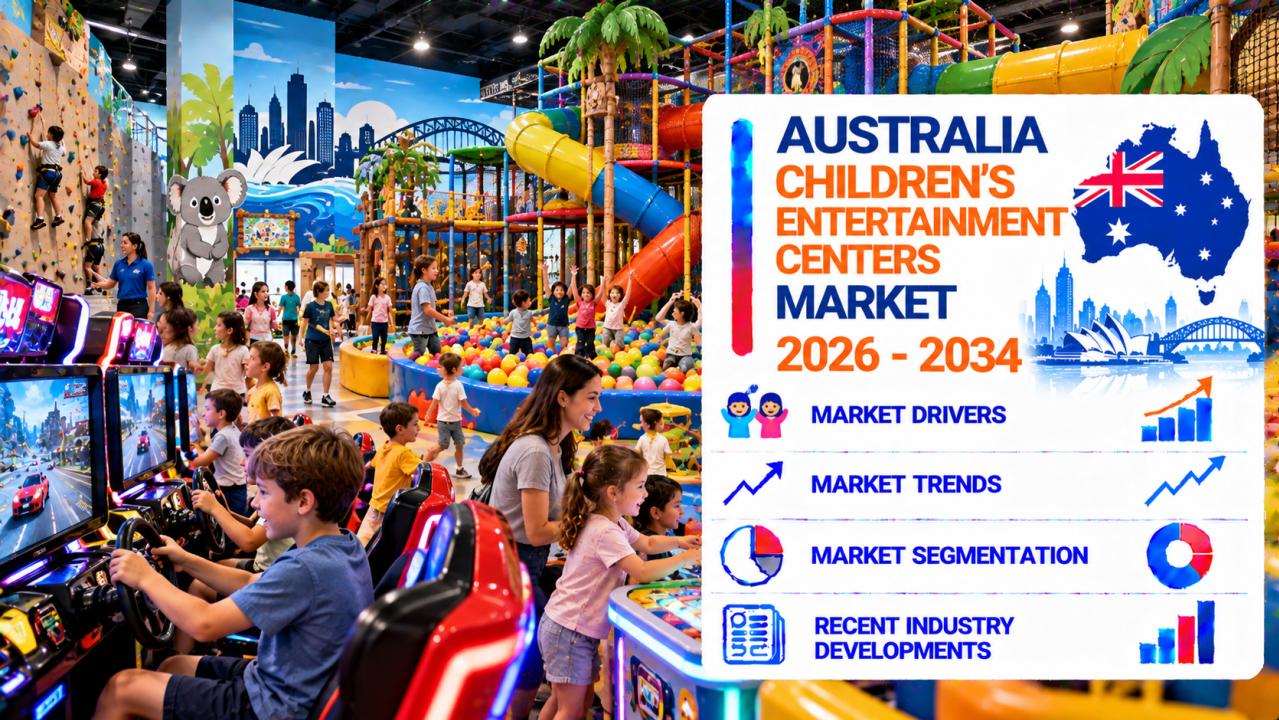
The Australia
children's entertainment centers market size increased from USD
385.8 Million in 2025 to USD 418.7 Million in 2026 and is projected
to reach USD 701.3 Million by 2034, growing at a compound annual growth
rate (CAGR) of 6.66% from 2026 to 2034. The market is driven by rising
disposable incomes among families, growing demand for experiential and indoor
entertainment, increasing urbanization limiting outdoor play space, rising
parental focus on developmental play, and the expansion of family entertainment
center formats across metropolitan and regional Australia.
Australia Children's Entertainment Centers Market Summary
- The
Australia children's entertainment centers market encompasses a range of
facilities, including indoor play centers, family entertainment centers
(FECs), arcade and gaming centers, trampoline parks, soft play centers,
and edutainment venues, serving children across age groups from toddlers
to pre-teens along with accompanying adults.
- These
venues are valued for their role in providing safe, supervised, and
engaging play experiences, supporting physical and cognitive development,
hosting birthday parties and group events, and offering family-oriented
leisure activities across urban and regional settings.
- The
ecosystem includes venue operators, franchise groups, play equipment
manufacturers, food and beverage providers, booking platforms, landlords,
and regulatory bodies across New South Wales, Victoria, Queensland, and
other states and territories.
- Major
segments identified in the market include venue type (indoor play centers,
family entertainment centers, arcade and gaming centers, trampoline parks,
edutainment venues, others), age group (toddlers, pre-schoolers,
school-age children), end user (individual admissions, birthday parties
and group events, school and community programs), and region (Australian
Capital Territory & New South Wales, Victoria & Tasmania,
Queensland, Northern Territory & Southern Australia, Western
Australia).
- The
market is benefiting from rising demand for experiential family leisure,
growth in birthday party and event hosting, increasing adoption of digital
booking and loyalty platforms, and expansion of edutainment and STEM-based
play concepts.
- The
market is also supported by ongoing investment in new venue formats,
premium play equipment, and integrated food and beverage offerings that
extend dwell time and increase average spend per visit.
Request a Sample Report for In-Depth Market Insights: https://www.imarcgroup.com/australia-childrens-entertainment-centers-market/requestsample
Porter's Five Forces Analysis
- Competitive
Rivalry: Moderate to high, with franchise chains, independent
operators, and adjacent leisure formats competing on location, equipment
quality, pricing, and party package offerings. Business implication:
Operators must differentiate through unique themes, premium equipment, and
superior customer experience.
- Supplier
Power (Play Equipment and Fitout Suppliers): Moderate. Suppliers of
soft play structures, trampolines, arcade machines, and safety surfacing
have some leverage, but the presence of multiple suppliers and the ability
of large operators to negotiate volume contracts moderates this power. Business
implication: Operators should maintain diverse supplier relationships
and explore exclusive equipment partnerships.
- Buyer
Power (Parents and Families): High. Parents have extensive choice
across venues, formats, and price points, with growing awareness of
hygiene, safety, value, and educational content. Business implication:
Operators must focus on safety standards, cleanliness, value, and
repeat-visit loyalty programs.
- Threat
of Substitutes: Moderate. Outdoor playgrounds, sports clubs, cinemas,
museums, and digital entertainment compete for family leisure spend, but
the weather-independent, supervised, and social nature of indoor
entertainment centers supports their position. Business implication:
The industry should emphasise convenience, safety, and experiential
differentiation.
- Threat
of New Entrants: Moderate. Higher barriers for established operators
(site acquisition, fitout costs, compliance, brand recognition), but lower
barriers for niche and pop-up entrants in high-traffic locations. Business
implication: Established players should build defensible positions
through brand equity, prime locations, and membership programs.
Market Growth Drivers
Rising Demand for Experiential Family Leisure
The growing preference for experiential over material
spending among Australian families is driving demand for children's
entertainment centers. Parents increasingly prioritise shared experiences that
combine play, social interaction, and family time, supporting visit frequency
and average spend. Venues offering themed environments, interactive play zones,
and integrated dining are capturing a larger share of household leisure
budgets. This shift is reinforced by the popularity of experience-based gifting,
including birthday party packages and annual memberships, which provide
operators with more predictable revenue streams.
Expansion of Birthday Party and Group Event Hosting
Birthday parties, school excursions, and community group
events represent a significant and growing revenue driver for the market.
Operators are investing in dedicated party rooms, catering packages, and
host-led activity programs to capture this high-margin segment. The convenience
of all-inclusive party packages, combined with the appeal of exclusive play
access, is increasing the share of revenue derived from group bookings. Growth
in this segment is further supported by demand from schools, childcare centres,
and community organisations seeking structured recreational activities.
Urbanization and Limited Outdoor Play Space
Rapid urbanization and the prevalence of higher-density
housing in Australian cities are constraining access to safe outdoor play
space, particularly in inner-city and apartment-heavy suburbs. This is driving
parents toward indoor venues that offer climate-controlled, supervised, and
secure environments. Weather variability, including extreme heat and
unpredictable rainfall, reinforces the appeal of indoor alternatives throughout
the year. The concentration of demand in high-density catchments supports new venue
development near residential and retail hubs.
Adoption of Digital Booking and Loyalty Platforms
Digital transformation is reshaping how children's
entertainment centers acquire and retain customers. Online booking systems,
mobile apps, and integrated point-of-sale platforms are streamlining party
reservations, ticketing, and membership management. Loyalty programs, digital
passes, and personalised offers are increasing visit frequency and customer
lifetime value. Operators are also leveraging social media and review platforms
to drive discovery among local parent communities, while data analytics support
capacity planning and dynamic pricing during peak periods.
Australia Children's Entertainment Centers Market Segmentation
Venue Type Insights:
- Indoor
Play Centers
- Family
Entertainment Centers
- Arcade
and Gaming Centers
- Trampoline
Parks
- Edutainment
Venues
- Others
Indoor play centers represent a leading segment, driven by
their broad appeal across toddler and pre-school age groups and their
suitability for high-density suburban catchments. Family entertainment centers
capture a wider age range through a combination of soft play, arcade games, and
dining. Trampoline parks and edutainment venues are among the faster-growing
formats, supported by demand for active play and STEM-oriented activities.
Age Group Insights:
- Toddlers
- Pre-Schoolers
- School-Age
Children
End User Insights:
- Individual
Admissions
- Birthday
Parties and Group Events
- School
and Community Programs
Regional Insights:
- Australian
Capital Territory & New South Wales
- Victoria
& Tasmania
- Queensland
- Northern
Territory & Southern Australia
- Western
Australia
Competitive Landscape
The Australia children's entertainment centers market
features a competitive landscape encompassing national franchise chains,
independent single-site operators, and adjacent leisure and hospitality groups.
Market participants differentiate through location, theme and theming quality,
equipment investment, hygiene standards, and party package value. The
competitive analysis includes market structure, key player positioning, top
winning strategies, competitive dashboard, and company evaluation quadrant, with
detailed profiles of all major companies provided in the report.
Key players mentioned in the report context include:
- National
franchise groups and multi-site operators dominate high-traffic
metropolitan catchments, leveraging brand recognition, standardised play
formats, and centralised marketing.
- Independent
operators compete through localised service, unique themes, and community
engagement, with many expanding into party hosting and school program
offerings.
- Adjacent
leisure and hospitality groups are increasingly entering the space through
integrated family entertainment and dining formats, intensifying
competition for family leisure spend.
Regional Analysis
- ACT
& New South Wales: The dominant region, driven by Sydney's high
population density, strong family demographics, and concentration of
modern retail and leisure precincts. The region benefits from the largest
number of multi-site operators and the highest share of party and event
bookings.
- Victoria
& Tasmania: A significant market supported by Melbourne's dense
suburban catchments, growing demand for indoor play, and strong adoption
of digital booking platforms. Tasmania contributes through regional venues
serving local family communities.
- Queensland:
A growing market driven by population growth, tourism-linked family
visitation, and expanding retail and leisure development across Brisbane,
the Gold Coast, and regional centres.
- Western
Australia: A growing market supported by Perth's expanding population,
new family-oriented precincts, and rising demand for climate-controlled
indoor play formats.
- NT
& South Australia: Emerging markets with growing demand for
children's entertainment centers, supported by improving retail
infrastructure and increasing family-oriented development in Adelaide and
regional centres.
Recent Industry Developments
2026: The Australia children's entertainment centers
market continued its growth trajectory, supported by rising demand for
experiential family leisure, expansion of party and group event hosting, and
increasing adoption of digital booking and loyalty platforms.
2026: Operators continued to invest in premium play equipment, themed environments, and integrated food and beverage offerings to extend dwell time and increase average spend per visit.
2026: New venue openings and format expansions
continued across metropolitan and regional catchments, with a focus on
trampoline parks, edutainment concepts, and combined play-and-dine formats.
2026: Hygiene, safety, and compliance standards
remained central to consumer choice, with operators investing in staff
training, safety surfacing, and enhanced cleaning protocols to build parent
confidence.
Key Aspects Required for the Australia Children's Entertainment Centers Market
- Market
Performance: USD 385.8 Million in 2025, increasing to USD 418.7
Million in 2026, with a projected trajectory to USD 701.3 Million by 2034.
- Market
Outlook: A 6.66% CAGR through 2034 indicates steady growth across
venue types, age groups, end users, and regions, driven by experiential
leisure demand, party hosting, urbanization, and digital adoption.
- Growth
Drivers: Rising demand for experiential family leisure; expansion of
birthday party and group event hosting; urbanization and limited outdoor
play space; adoption of digital booking and loyalty platforms; investment
in premium play equipment and theming; and growth in edutainment and
STEM-based play concepts.
- Competitive
Landscape: A moderately competitive market with national franchise
chains, independent operators, and adjacent leisure groups.
Differentiation occurs through location, theming quality, equipment
investment, hygiene standards, and party package value.
- Value
Chain Analysis: From site acquisition and fitout through equipment
procurement, staff training, and booking management to end-use by
families, party groups, and community programs, with digitalisation and
experience differentiation shaping market dynamics.
- Industry
Trends: Growth of trampoline parks and edutainment venues; expansion
of play-and-dine formats; increasing use of membership and loyalty
programs; adoption of online booking and mobile apps; and rising emphasis
on hygiene, safety, and inclusive play.
- Strategic
Recommendations: Invest in premium theming and play equipment; expand
party and group event offerings; develop digital booking and loyalty
capabilities; secure prime locations in high-density family catchments;
and focus on safety, hygiene, and inclusive play standards.
Note: If you need any specific information that is not currently covered within the scope of the report, we will provide the same as a part of customization.
Speak to an analyst: https://www.imarcgroup.com/request?type=report&id=40270&flag=C
Report Format, Delivery, and Customization Details
- Report
Format Mode: PDF and Excel (Editable version in PPT/Word format
available on special request)
- Report
Delivery Mode: Online Delivery, Physical Delivery
- Report
Delivery Time: The report is delivered over email within 24 to 48
hours. If requested by the client, a physical copy will be delivered
within three to ten days.
- Report
Confirmation Mode: Yes, via email
- Report
Customization Mode: Yes, via Email / Call
- Report
Table of Content: Yes
- Report
List of Figures: Yes
- Report
Methodology Mode: Yes
- Request
For Sample Report: Yes