Market Overview
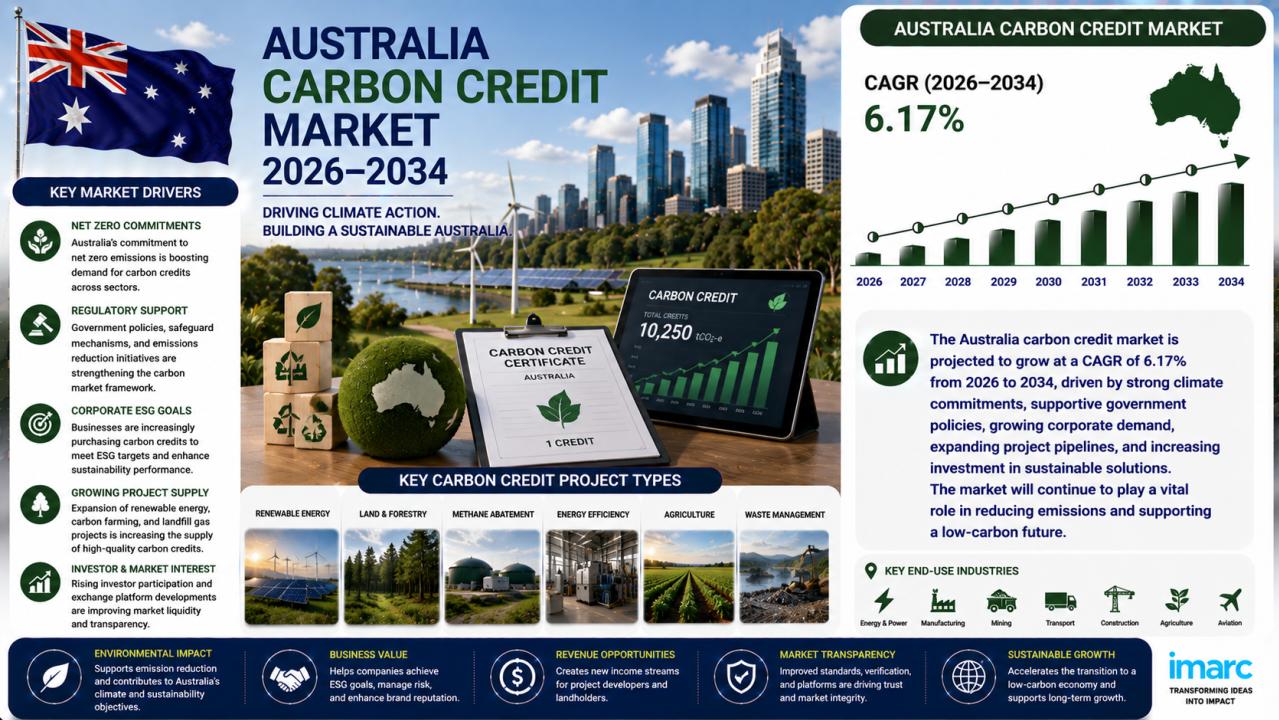
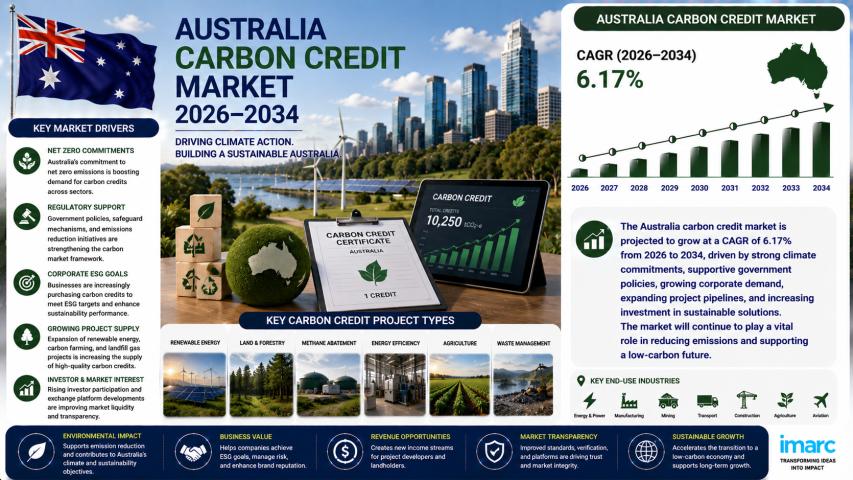
Australia carbon credit market size reached USD 19.5
Million in 2025 and is projected to reach USD 33.3 Million by
2034, growing at a CAGR of 6.17% from 2026-2034. The
market is growing owing to the reformed Safeguard Mechanism, which now mandates
annual emissions baseline reductions across large industrial facilities in
Australia's highest-emitting sectors. In 2025, total ACCU issuances reached a record
21.64 million units, a 15% year-on-year increase from 18.78 million in 2024,
reflecting the structural compliance demand surge and proliferating land-based
supply projects underpinning Australia's carbon credit market share.
Request a Sample Report for In-Depth Market Insights: https://www.imarcgroup.com/australia-carbon-credit-market/requestsample
Australia Carbon Credit Market Summary
- The
Australia carbon credit market encompasses compliance and voluntary carbon
credits, including avoidance/reduction projects and removal/sequestration
projects (nature-based and technology-based), serving diverse end-use
sectors.
- These
credits are valued for their role in enabling emissions reduction,
supporting net-zero commitments, and generating revenue from land-based
carbon projects.
- The
ecosystem includes project developers (GreenCollar, AgriProve, LMS
Energy), corporate buyers, financial institutions, government agencies
(Clean Energy Regulator), and landholders.
- Major
segments identified in the market include type (compliance, voluntary),
project type (avoidance/reduction, removal/sequestration), end-use (power,
energy, aviation, etc.), and region.
- The
market is benefiting from the reformed Safeguard Mechanism creating
structural compliance demand, corporate net-zero commitments, and
institutional capital entering the carbon farming sector.
- In
December 2023, the Clean Energy Regulator signed a contract with Trovio
Group to develop the new Unit and Certificate Register, strengthening ACCU
integrity and traceability.
PORTER'S FIVE FORCES ANALYSIS
- Competitive
Rivalry: Moderate, with specialized environmental market
developers (GreenCollar, AgriProve), energy companies (LMS Energy), and
financial intermediaries competing on project scale, methodology
expertise, and corporate relationships. Business implication: Companies
must differentiate through proprietary methodologies, large-scale land
portfolios, and institutional partnerships.
- Supplier
Power (Land and Methodology Access): Moderate. Landholders and
Indigenous communities with suitable carbon farming potential have some
leverage, but project developers provide aggregation and technical
expertise. Business implication: Developers should build
long-term partnerships and diversify project portfolios.
- Buyer
Power (Corporate Emitters): Moderate to high. Large emitters
under the Safeguard Mechanism have bargaining power through long-term
offtake agreements, but compliance obligations and limited supply create
mutual dependence. Business implication: Providers should
focus on building long-term, trusted relationships and offering
high-integrity credits.
- Threat
of Substitutes: Low. While technology-based removals offer an
alternative, nature-based ACCUs remain essential for compliance and
voluntary markets. Business implication: The industry
should emphasize the unique co-benefits and integrity of nature-based
solutions.
- Threat
of New Entrants: Moderate. Higher barriers for large-scale
project developers (capital, methodology expertise, land access), but
lower barriers for smaller, niche projects. Business implication: Established
players should build defensible positions through scale, methodology
innovation, and strong corporate relationships.
MARKET GROWTH DRIVERS
Reformed Safeguard Mechanism Creating Structural Compliance Demand
The reformed Safeguard Mechanism applies mandatory 4.9%
annual baseline decline rates to Australia's 215 largest emitters by 2030,
creating a structural and growing floor of ACCU demand. In FY2024, the first
full compliance year, 142 facilities incurred a combined liability of 9.2 Mt
CO₂-e above their assigned baselines, collectively surrendering 7.1 million
ACCUs and 1.4 million Safeguard Mechanism Credits to the Clean Energy
Regulator.
Corporate Net-Zero Commitments and ESG Reporting Pressure
Australia's major corporations are embedding ACCU
procurement into long-term climate strategies, spurred by investor scrutiny,
ESG reporting mandates, and the introduction of mandatory climate risk
disclosures for listed companies. In August 2024, Qantas, Rio Tinto, and BHP
each committed as foundation investors to the Silva Carbon Origination Fund,
collectively providing AUD 80 million toward a fund targeting AUD 250 million
to originate high-integrity nature-based ACCUs.
Institutional Capital Entering the Carbon Farming Sector
The Clean Energy Finance Corporation and La Caisse jointly
launched the AUD 250 million Meldora agricultural and carbon platform in
September 2025. This platform acquired a 15,000-hectare property in Central
Queensland for environmental plantings under the ACCU scheme. There is a
large-scale institutional investment drive redefining the carbon farming
sector, with sovereign wealth funds, superannuation funds, and corporate
investors entering long-term ACCU offtake agreements.
AUSTRALIA CARBON CREDIT MARKET SEGMENTATION
Type Insights:
- Compliance
- Voluntary
Project Type Insights:
- Avoidance/Reduction
Projects
- Removal/Sequestration
Projects
- Nature-based
- Technology-based
End-Use Insights:
- Power
- Energy
- Aviation
- Transportation
- Buildings
- Industrial
- Others
Regional Insights:
- Australia
Capital Territory & New South Wales
- Victoria
& Tasmania
- Queensland
- Northern
Territory & Southern Australia
- Western
Australia
COMPETITIVE LANDSCAPE
Australia
carbon credit market features a competitive landscape of specialized
environmental market developers, land management companies, energy sector
participants, and financial intermediaries that collectively shape ACCU supply,
pricing, and market integrity. Leading players differentiate through
proprietary project methodologies, large-scale land portfolios, institutional
capital partnerships, and established compliance relationships with major
Safeguard-covered industrial emitters.
Key players mentioned in the report context include:
- GreenCollar
Group (TerraCarbon)
- AgriProve
Pty Ltd
- LMS
Energy Pty Ltd
- Greenfleet
Australia
- Xpansiv
- Corporate
Carbon Group of Companies
- Clean
Earth Capital
- South
Pole (Australia)
- Carbon
Neutral
- Climate
Impact Partners
- APA
Group
- Santos
Limited
- (Complete
list provided in the full report)
REGIONAL ANALYSIS
- ACT
& New South Wales: Leads at 34.2% share, anchored by Sydney's
concentration of ACCU market infrastructure, legal and financial advisory
services, and the headquarters of major project developers and corporate
buyers. The northwest NSW rangelands host the highest density of
human-induced regeneration projects in the country.
- Victoria
& Tasmania: A high-value market anchored by significant
Safeguard Mechanism compliance obligations from industrial emitters in
aluminum smelting, steel, chemicals, and cement sectors, concentrated in
the Melbourne-Geelong corridor and Latrobe Valley.
- Queensland: The
most diverse market, combining savanna fire management ACCUs from the
tropical north, soil carbon and HIR projects in western rangelands, and
industrial compliance demand from minerals, LNG, and resources sectors.
The state targets a 75% emissions reduction by 2035.
- Western
Australia: Home to some of Australia's largest industrial
emitters under the Safeguard Mechanism (LNG export facilities, iron ore
operations), generating substantial compliance demand, complemented by
significant land-based ACCU supply from extensive rangelands.
- NT
& South Australia: The Northern Territory is Australia's most
significant source of savanna fire management ACCUs, with Indigenous
communities and station owners operating projects across vast tropical
rangelands. Savanna fire management accounted for 1.59 million ACCUs nationally
in 2025.
RECENT INDUSTRY DEVELOPMENTS
August 2026: Australia's carbon credit market
continued strengthening as the reformed Safeguard Mechanism created
structural demand for Australian Carbon Credit Units (ACCUs). The mechanism
applies declining emissions baselines to 215 of Australia's largest
industrial emitters, encouraging covered facilities to reduce emissions or
surrender eligible credits.
August 2026: ACCU issuance reached a record 21.64
million units in 2025, increasing 15% from 18.78 million units in 2024.
The increase reflects growing activity in land-based carbon projects as well as
continued demand from Australia's compliance market.
August 2026: Removal and sequestration projects
remained the largest project category, accounting for 48.6% of the market in
2025. Human-induced regeneration, soil-carbon projects, environmental
plantings and savanna-fire management are contributing to the expansion of
Australia's nature-based carbon-credit supply.
August 2026: Institutional investment continued
entering the carbon-farming sector. In September 2025, the Clean Energy
Finance Corporation and La Caisse launched the AUD 250 million Meldora
agricultural and carbon platform, including the acquisition of a 15,000-hectare
property in Central Queensland for environmental-planting projects under
the ACCU scheme.
Key Aspects Required for the Australia Carbon Credit Market
- Market
Performance: USD 19.5 Million in 2025, with a projected
trajectory to USD 33.3 Million by 2034.
- Market
Outlook: A 6.17% CAGR through 2034 indicates steady growth across
types and project types, driven by compliance mechanisms, corporate
commitments, and institutional investment.
- Growth
Drivers: Reformed Safeguard Mechanism creating structural
compliance demand; corporate net-zero commitments and ESG reporting
pressure; institutional capital entering the carbon farming sector;
digital registry infrastructure and market transparency; and nature-based
supply expansion across the land sector.
- Competitive
Landscape: A competitive market with specialized environmental
developers, energy companies, and financial intermediaries.
Differentiation occurs through proprietary methodologies, scale, and
institutional partnerships.
- Value
Chain Analysis: From project development and methodology approval
through ACCU issuance, trading, and retirement to end-use in compliance
and voluntary markets, with policy frameworks and market integrity shaping
dynamics.
- Industry
Trends: Digital registry infrastructure and market transparency;
institutional capital entering the carbon farming sector; nature-based
supply expansion; corporate offtake structures; Indigenous land
participation; new ACCU method development; and ESG reporting pressure.
- Strategic
Recommendations: Invest in large-scale, nature-based ACCU
projects; develop proprietary methodologies and technology; forge
long-term offtake agreements with major emitters; leverage institutional
capital partnerships; and expand into emerging project types like soil carbon
and technology-based removals.
Note: If you need any specific information that is not currently covered within the scope of the report, we will provide the same as a part of customization.
Speak to an analyst: https://www.imarcgroup.com/request?type=report&id=24733&flag=C
Report Format, Delivery, and Customization Details
- Report
Format Mode: PDF and Excel (Editable version in PPT/Word format
available on special request)
- Report
Delivery Mode: Online Delivery, Physical Delivery
- Report
Delivery Time: report delivered over email within 24 to 48 hours.
If requested by the client, a physical copy will be delivered within three
to ten days.
- Report
Confirmation Mode: Yes, via email
- Report
Customization Mode: Yes, via Email / Call
- Report
Table of Content: Yes
- Report
List of Figures: Yes
- Report
Methodology Mode: Yes
- Request
For Sample Report: Yes
About Us
IMARC Group is a global management consulting firm that
helps the world's most ambitious changemakers to create a lasting impact. The
company provides a comprehensive suite of market entry and expansion services.
IMARC offerings include thorough market assessment, feasibility studies,
company incorporation assistance, factory setup support, regulatory approvals
and licensing navigation, branding, marketing and sales strategies, competitive
landscape and benchmarking analyses, pricing and cost research, and procurement
research.
Contact Us
IMARC Group
134 N 4th St., Brooklyn, NY 11249, USA
Email: sales@imarcgroup.com
Tel No: (D) +91 120 433 0800
United States: +1-201-971-6302