Market Overview
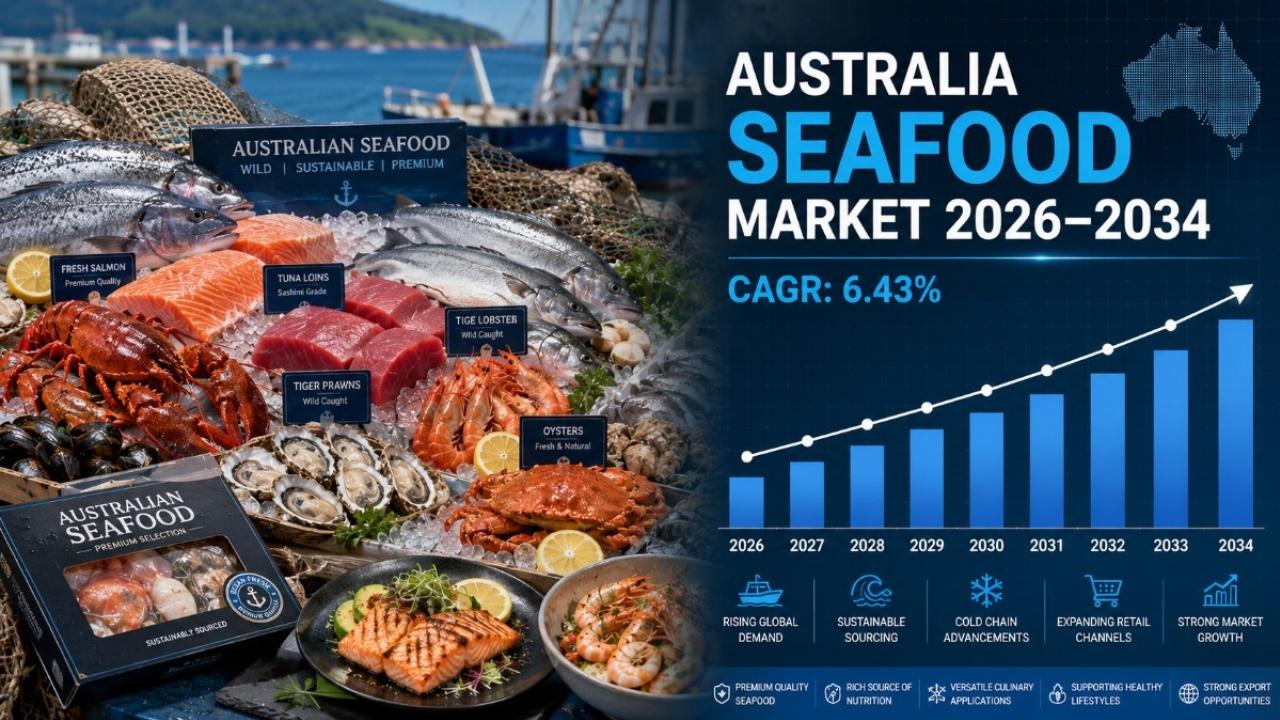
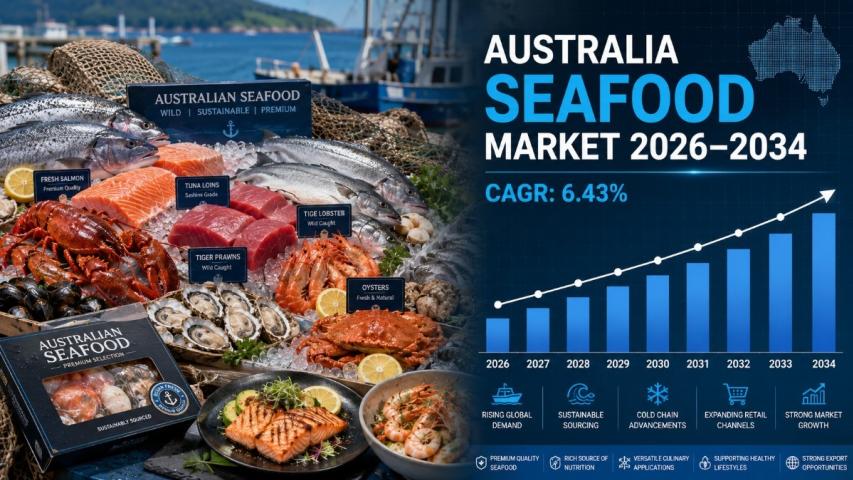
The Australia seafood market size reached USD 3.22
Billion in 2025 and is projected to reach USD 5.73 Billion by
2034, exhibiting a CAGR of 6.43% during 2026-2034. Rising
health consciousness, expanding aquaculture infrastructure, and growing export
demand are the primary growth forces shaping this market. Fish leads the type
segmentation at 58.7% in 2025, driven by widespread consumer preference for
salmon, tuna, and barramundi. Fresh/Chilled commands 36.8% form share. ACT
& New South Wales dominates the regional landscape with a 34.5% share
underpinned by large urban population centres and high per-capita seafood
expenditure.
Request a Sample Report for In-Depth Market Insights: https://www.imarcgroup.com/australia-seafood-market/requestsample
Australia Seafood Market Summary
- The
Australia seafood market encompasses fish, shrimp, and other species
(crabs, oysters, lobsters, abalone), available in fresh/chilled, frozen,
processed, and canned forms, distributed through off-trade (supermarkets,
online) and on-trade channels.
- These
products are valued for their role in providing healthy protein, omega-3
fatty acids, and essential nutrients, supporting domestic consumption and
premium export markets.
- The
ecosystem includes wild-capture fisheries, aquaculture operators,
processors, cold-chain logistics providers, retailers, and export
partners.
- Major
segments identified in the market include type (fish, shrimp, others),
form (fresh/chilled, frozen, processed, canned), distribution channel, and
region.
- The
market is benefiting from rising consumer demand for healthy protein,
expanding aquaculture infrastructure, and growing export demand via trade
agreements.
- In
August 2024, Walker Seafoods Australia announced a partnership with
renowned chef Neil Perry to launch a new line of preserved local tuna for
sale in Australian supermarkets.
PORTER'S FIVE FORCES ANALYSIS
- Competitive
Rivalry: Moderate, with integrated aquaculture companies,
wild-catch operators, and export-focused businesses competing on quality,
certification, and brand. Business implication: Companies
must differentiate through sustainability, value-added products, and brand
equity.
- Supplier
Power (Fisheries and Aquaculture): Moderate. Wild-catch quotas
and aquaculture production capacity give suppliers some leverage, but the
presence of multiple operators and import competition moderates this
power. Business implication: Processors should maintain
diverse supply relationships.
- Buyer
Power (Retailers and Exporters): Moderate to high. Large
supermarket chains and international buyers have bargaining power through
volume purchasing, but premium quality and sustainability certifications
give producers some leverage. Business implication: Producers
must focus on quality, certification, and brand differentiation.
- Threat
of Substitutes: Moderate. Poultry, meat, and plant-based proteins
compete, but seafood's unique nutritional profile supports its
position. Business implication: The industry should
emphasize the health and sustainability benefits of seafood.
- Threat
of New Entrants: Moderate. Higher barriers for large-scale
aquaculture (capital, technology, regulatory), but lower barriers for
niche and specialty entrants. Business implication: Established
players should build defensible positions through scale, certification,
and export networks.
MARKET GROWTH DRIVERS
Rising Consumer Demand for Healthy Protein
Rising awareness of omega-3 fatty acids, lean protein
benefits, and heart health advantages is driving per-capita seafood consumption
higher. Health-conscious Australians increasingly substitute red meat with fish
and shrimp, directly boosting retail and food service demand across all age
demographics. This trend is supported by government dietary guidelines
promoting seafood consumption and growing consumer interest in clean-label,
minimally processed products.
Expanding Aquaculture Infrastructure
Government investment in land-based recirculating
aquaculture systems (RAS), offshore cage aquaculture, and selective breeding
programs is expanding domestic supply capacity. Salmon farming in Tasmania and
barramundi aquaculture in Queensland is scaling rapidly to meet growing
consumer and export demand. Advances in RAS technology enable land-based fish
farming with precise water quality control, reduced disease risk, and
year-round production, supporting domestic supply independence and export
capability.
Growing Export Demand & Trade Agreements
Free trade agreements with Japan, South Korea, China, and
ASEAN nations are lowering tariff barriers for Australian seafood exports.
Premium lobster, abalone, southern bluefin tuna, and rock lobster command
strong prices in Asian markets, driving investment in processing and
export-grade cold-chain infrastructure. Growing Asian middle-class demand for
premium Australian seafood presents significant revenue opportunities, with
direct online export channels and premium packaging innovations enabling producers
to capture higher-value consumer segments.
AUSTRALIA SEAFOOD MARKET SEGMENTATION
Type Insights:
- Fish
- Shrimp
- Others
Form Insights:
- Canned
- Fresh/Chilled
- Frozen
- Processed
Distribution Channel Insights:
- Off-Trade
- Convenience
Stores
- Online
Channel
- Supermarkets
and Hypermarkets
- Others
- On-Trade
Regional Insights:
- Australia
Capital Territory & New South Wales
- Victoria
& Tasmania
- Queensland
- Northern
Territory & Southern Australia
- Western
Australia
COMPETITIVE LANDSCAPE
The Australia seafood
market is moderately fragmented, with integrated aquaculture and
processing companies, wild-capture specialist operators, and export-focused
seafood businesses competing across domestic and international channels.
Leading players leverage sustainability certification, cold-chain capabilities,
and brand equity to maintain competitive advantage. Differentiation occurs
through sustainability certification, cold-chain capabilities, and brand
equity.
Key players mentioned in the report context include:
- JBS
Foods (Huon Aquaculture)
- Walker
Seafoods Australia
- Seafarms
Group
- (Complete
list provided in the full report)
REGIONAL ANALYSIS
- ACT
& New South Wales: Dominates with 34.5% share, driven by its
position as the country's largest seafood trading hub, high urban density,
premium restaurant activity, and superior cold-chain distribution
infrastructure. Sydney Fish Market and high per-capita seafood expenditure
underpin regional leadership.
- Queensland: Holds
22.1% share, anchored by prawn aquaculture, barramundi farming, and reef
species harvesting. Strong domestic and Asian export market activity
supports regional growth.
- Victoria
& Tasmania: Represents 18.3% share, reflecting dominance in
salmon and oyster production, southern bluefin tuna processing, and
significant urban food service demand. Tasmania's aquaculture sector is a
key growth driver.
- Western
Australia: Accounts for 14.2% share, led by rock lobster and
pearl oyster export leadership, significant wild-capture fisheries, and
growing premium Asian export market demand.
- NT
& Southern Australia: Combined 10.9% share, with barramundi
aquaculture expansion, oyster production, and developing aquaculture
investment in key coastal growing regions.
RECENT INDUSTRY DEVELOPMENTS
September 2026: Australia’s seafood industry is
facing renewed debate over domestic production and import dependence after
research from James Cook University found that around 65% of seafood
consumed in Australia is imported, despite more than 63% of Australian
fish stocks being classified as sustainable. The findings are increasing
pressure for policies that strengthen domestic fisheries while maintaining
environmental standards.
August 2026: Australia’s northern seafood industry
faced further supply-side pressure as the number of trawlers operating during
the tiger prawn season fell to a record low. The decline highlights
ongoing challenges around fishing economics, regulation and fleet viability,
with potential implications for domestic seafood supply and regional fishing
communities.
July 2026: New country-of-origin labelling
requirements came into effect across Australian pubs, clubs, restaurants
and takeaway outlets, requiring seafood to be identified by its country of
origin. The policy covers the hospitality sector nationwide and is expected to
improve transparency for consumers while creating greater visibility for
Australian-produced seafood.
May 2026: Australian seafood exporters strengthened
their access to European markets at Seafood Expo Global 2026, which attracted 35,000
attendees from 85 countries. The Australia-EU Free Trade Agreement
concluded in March 2026 is set to eliminate EU tariffs of up to 26% on
Australian seafood, including tariffs of up to 15% on kingfish, 12% on
prawns and 11% on abalone, improving export competitiveness.
May 2026: Australia's seafood export diversification
gained momentum as a Western Australian cooperative expanded frozen lobster
sales through major Chinese retailers. The development follows broader industry
efforts to build international markets for premium Australian seafood, while
Australia's fisheries and aquaculture sector generates close to A$4 billion
in production value and aquaculture alone contributed approximately A$2.31
billion in 2024–25.
Key Aspects Required for the Australia Seafood Market
- Market
Performance: USD 3.22 Billion in 2025, with a projected
trajectory to USD 5.73 Billion by 2034.
- Market
Outlook: A 6.43% CAGR through 2034 indicates robust growth across
types and forms, driven by health awareness, aquaculture expansion, and
export demand.
- Growth
Drivers: Rising consumer demand for healthy protein; expanding
aquaculture infrastructure; growing export demand via trade agreements;
e-commerce and cold-chain advancement; and premiumisation and value-added
product development.
- Competitive
Landscape: A moderately fragmented market with integrated
aquaculture companies, wild-catch operators, and export-focused
businesses. Differentiation occurs through sustainability certification,
cold-chain capabilities, and brand equity.
- Value
Chain Analysis: From fishing and aquaculture harvesting through
processing, cold-chain logistics, wholesale distribution, and retail/food
service delivery to end consumers, with processing and quality control
capturing the highest value.
- Industry
Trends: Health-driven seafood consumption growth; sustainable
aquaculture and certification adoption; premiumisation and value-added
product development; digital and direct-to-consumer channel expansion; and
IoT-enabled cold-chain monitoring.
- Strategic
Recommendations: Invest in RAS aquaculture and sustainable
farming practices; develop value-added and convenience-oriented seafood
products; pursue sustainability certifications (ASC, MSC); expand digital
and direct-to-consumer channels; and target premium export markets in
Asia.
Note: If you need any specific information that is not currently covered within the scope of the report, we will provide the same as a part of customization.
Speak to an analyst: https://www.imarcgroup.com/request?type=report&id=28769&flag=C
Report Format, Delivery, and Customization Details
- Report
Format Mode: PDF and Excel (Editable version in PPT/Word format
available on special request)
- Report
Delivery Mode: Online Delivery, Physical Delivery
- Report
Delivery Time: report delivered over email within 24 to 48 hours.
If requested by the client, a physical copy will be delivered within three
to ten days.
- Report
Confirmation Mode: Yes, via email
- Report
Customization Mode: Yes, via Email / Call
- Report
Table of Content: Yes
- Report
List of Figures: Yes
- Report
Methodology Mode: Yes
- Request
For Sample Report: Yes
About Us
IMARC Group is a global management consulting firm that
helps the world's most ambitious changemakers to create a lasting impact. The
company provides a comprehensive suite of market entry and expansion services.
IMARC offerings include thorough market assessment, feasibility studies,
company incorporation assistance, factory setup support, regulatory approvals
and licensing navigation, branding, marketing and sales strategies, competitive
landscape and benchmarking analyses, pricing and cost research, and procurement
research.
Contact Us
IMARC Group
134 N 4th St., Brooklyn, NY 11249, USA
Email: sales@imarcgroup.com
Tel No: (D) +91 120 433 0800
United States: +1-201-971-6302