Market Overview
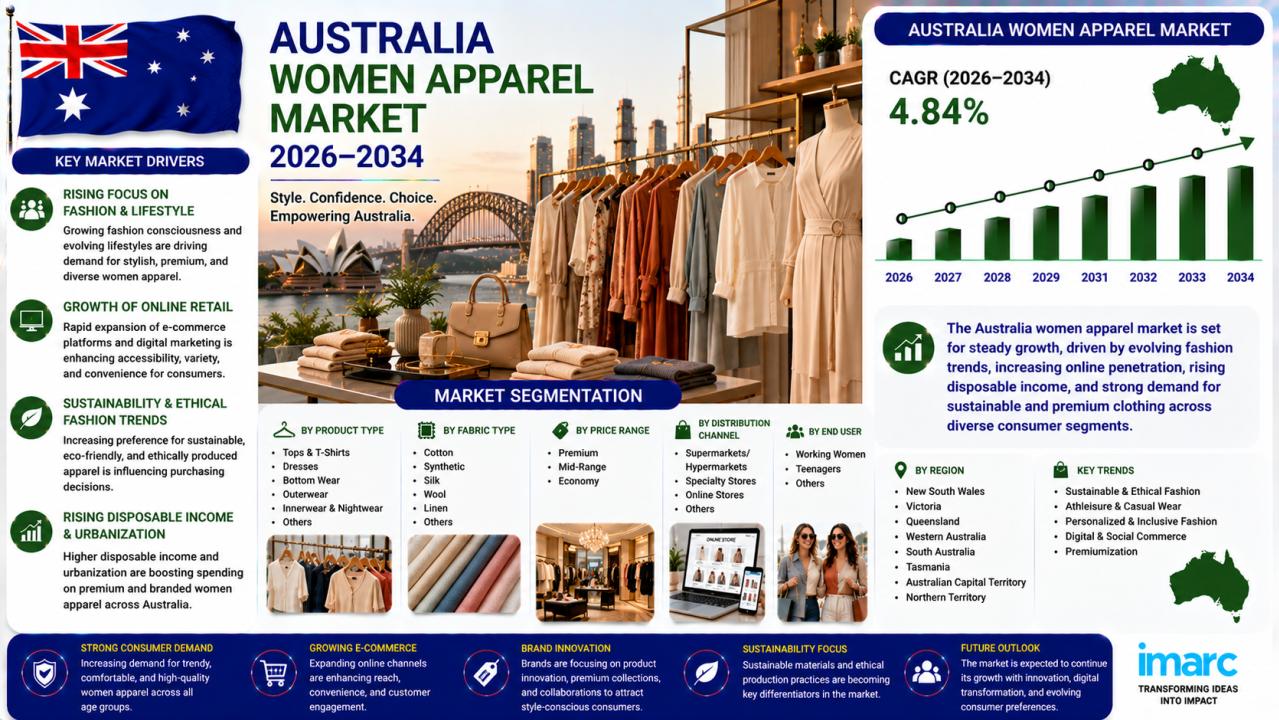
The Australia women apparel market size reached USD 12.5 Billion in 2025 and is projected to reach USD 19.4 Billion by 2034, exhibiting a CAGR of 4.84% during 2026-2034. The market is fueled by changing fashion trends, growing consumer purchasing power, and the rising need for environmentally-friendly and ethically manufactured apparel. Moreover, the impact of online retail sites and changing life>
Request a Sample Report for In-Depth Market Insights: https://www.imarcgroup.com/australia-women-apparel-market/requestsample
Australia Women Apparel Market Summary
- The
Australia women apparel market encompasses a wide range of products
including tops and dresses, bottom wear, innerwear and sleepwear, coats,
jackets and suits, and ethnic wear, serving diverse consumer preferences
across seasons.
- These products are valued for their role in personal expression, comfort, and functionality, catering to various occasions and life>
- The
ecosystem includes apparel manufacturers, designers, raw material
suppliers, distributors, retailers (exclusive stores, multi-brand outlets,
online platforms), and consumers.
- Major
segments identified in the market include product type (tops and dresses,
bottom wear, innerwear, etc.), season (summer, winter, all-season),
distribution channel (online stores, exclusive stores, multi-brand
outlets), and region.
- The
market is benefiting from the sustainability and ethical fashion movement,
the dominance of athleisure and casual wear, and changing consumer values
favoring domestic brands.
- In
October 2024, Mosaic Brands, parent company of Rivers, Millers, and
Katies, entered voluntary administration, while in February 2025, Hanes
partnered with Urban Outfitters to launch an exclusive Hanes Heritage
Capsule Collection in Australia.
PORTER'S FIVE FORCES ANALYSIS
- Competitive
Rivalry: High, with numerous international brands (Zara, H&M,
Uniqlo), domestic players, and emerging niche brands competing on price,
>Business implication: Brands
must differentiate through sustainability, design originality, and strong
brand identity.
- Supplier
Power (Raw Materials and Manufacturing): Moderate. Australia's
geographic isolation increases dependence on imported materials, but the
presence of multiple sourcing options in Asia moderates this power. Business
implication: Brands should diversify supplier relationships and
consider local manufacturing for premium segments.
- Buyer
Power (Consumers): High. Consumers have extensive choice across
brands, price points, and channels, with low switching costs and growing
awareness of sustainability and ethics. Business implication: Brands
must focus on quality, sustainability, and brand authenticity to build
loyalty.
- Threat
of Substitutes: Moderate. Second-hand clothing, rental services,
and DIY fashion compete, but the emotional connection and self-expression
of new apparel support its position. Business implication: The
industry should emphasize quality, sustainability, and unique design to
differentiate from substitutes.
- Threat
of New Entrants: Moderate. Higher barriers for established brands
(scale, distribution, brand recognition), but lower barriers for niche and
online-first entrants focusing on sustainability or cultural
authenticity. Business implication: Established players
should build defensible positions through innovation, brand equity, and
sustainability.
MARKET GROWTH DRIVERS
Sustainability and Ethical Fashion
Australia women
apparel market consumers are increasingly valuing sustainability in
their fashion purchases, driven by environmental consciousness and the need for
sustainable materials like organic cotton and recycled materials. Companies
embracing transparent supply chains, ethical working conditions, and
eco-friendly production are gaining competitive ground. The popularity of
second-hand and vintage clothing on platforms like Depop and local thrift shops
also indicates this trend toward mindful consumption. For instance, the Sydney
Global Sourcing Expo in June 2024 focused on sustainability, featuring seminars
on sustainable sourcing, circular fashion, and supply chain transparency,
further supporting market expansion.
Athleisure and Casual Wear Dominance
The athleisure trend's growth reflects a worldwide shift toward comfort and practicality for everyday wear. Consumers are influenced by life>
Changing Consumer Values and Domestic Brand Patronage
Australian consumers are demonstrating a clear inclination toward locally produced items that embody transparency, quality, and authenticity. This is driven by a need to support the local economy, particularly in response to global disruption and growing concerns about environmental effects of foreign manufacturing. Consumers are turning toward brands that embody Australian values—casual sophistication, comfort, and adaptability. Local brands highlighting natural materials, ethical working conditions, and community identity are on the rise. Regional pride and storytelling branding—like honoring coastal life>
AUSTRALIA WOMEN APPAREL MARKET SEGMENTATION
Product Type Insights:
- Tops
and Dresses
- Bottom
Wear
- Innerwear
and Sleepwear
- Coats,
Jackets and Suits
- Ethnic
Wear
- Others
Season Insights:
- Summer
Wear
- Winter
Wear
- All
Season Wear
Distribution Channel Insights:
- Supermarkets
and Hypermarkets
- Exclusive
Stores
- Multi-Brand
Retail Outlets
- Online
Stores
- Others
Regional Insights:
- Australia
Capital Territory & New South Wales
- Victoria
& Tasmania
- Queensland
- Northern
Territory & Southern Australia
- Western
Australia
COMPETITIVE LANDSCAPE
The Australia women apparel market features a competitive landscape of international fast-fashion giants, domestic brands, and emerging niche players competing on price, >
Key players mentioned in the report context include:
The report provides a comprehensive analysis of the
competitive landscape, including market structure, key player positioning, top
winning strategies, competitive dashboard, and company evaluation quadrant.
Detailed profiles of all major companies are provided in the complete report.
REGIONAL ANALYSIS
- ACT
& New South Wales: A key market driven by Sydney's high
population density, strong fashion consciousness, and high concentration
of retail outlets, with strong adoption of sustainable and premium
fashion.
- Victoria: A
significant market driven by Melbourne's vibrant fashion culture, diverse
consumer base, and strong demand for niche and sustainable apparel brands.
- Queensland: A
growing market with expansion driven by population growth, increasing
urbanization, and rising demand for climate-appropriate summer and
activewear.
- Western Australia: A growing market driven by Perth's expanding population, higher disposable incomes, and growing demand for premium and life>
- NT
& South Australia: Emerging markets with growing apparel
demand, supported by improving retail access and increasing consumer
awareness of fashion trends.
RECENT INDUSTRY DEVELOPMENTS
August 2026: Australia’s women’s apparel market
continued shifting toward comfort, athleisure and versatile everyday
clothing. IMARC highlights life>7% in 2023, outperforming the overall apparel market.
August 2026: Online fashion retail remained a
major force shaping purchasing behavior. International e-commerce platforms are
giving Australian consumers access to broader product selections and
competitive pricing, increasing pressure on domestic brands to differentiate
through design, quality, sustainability and customer experience.
August 2026: Sustainability continued gaining
importance in women's fashion. Australian consumers are showing greater
interest in environmentally friendly materials, ethical manufacturing and
conscious-fashion practices, encouraging brands to address issues such as
textile waste, supply-chain transparency and responsible production. IMARC
specifically highlights Australia's Seamless initiative and the broader
living-wage movement as developments influencing the sector.
August 2026: Competition from international fashion
retailers remained intense. Brands such as Zara, H&M and Uniqlo have
established strong positions in Australia's major cities, while overseas
e-commerce platforms allow consumers to purchase directly from international
sellers. This is increasing competitive pressure on Australian labels,
particularly smaller brands.
Key Aspects Required for the Australia Women Apparel Market
- Market
Performance: USD 12.5 Billion in 2025, with a projected
trajectory to USD 19.4 Billion by 2034.
- Market
Outlook: A 4.84% CAGR through 2034 indicates robust growth across
product types and distribution channels, driven by sustainability trends,
athleisure dominance, and changing consumer values.
- Growth Drivers: Sustainability and ethical fashion movement; athleisure and casual wear dominance; cultural and climate-driven fashion preferences; digital retail and life>
- Competitive
Landscape: A competitive market with international fast-fashion
giants, domestic brands, and niche players. Differentiation occurs through
sustainability, design originality, and brand authenticity.
- Value
Chain Analysis: From raw material sourcing and manufacturing
through distribution and retail to end-use, with sustainability and
digital retail integration shaping market dynamics.
- Industry Trends: Sustainability and ethical fashion; athleisure and casual wear dominance; digital retail and social media integration; Indigenous and culturally inspired fashion; and regional market penetration with life>
- Strategic
Recommendations: Invest in sustainable and ethically manufactured
apparel; expand athleisure and activewear collections; leverage digital
retail and social media marketing; develop culturally inspired and
Indigenous fashion collaborations; focus on regional market penetration
with climate-appropriate designs; and build strong domestic brand identity
and consumer loyalty.
Note: If you need any specific information that is not currently covered within the scope of the report, we will provide the same as a part of customization.
Speak to an analyst: https://www.imarcgroup.com/request?type=report&id=31953&flag=C
Report Format, Delivery, and Customization Details
- Report
Format Mode: PDF and Excel (Editable version in PPT/Word format
available on special request)
- Report
Delivery Mode: Online Delivery, Physical Delivery
- Report
Delivery Time: report delivered over email within 24 to 48 hours.
If requested by the client, a physical copy will be delivered within three
to ten days.
- Report
Confirmation Mode: Yes, via email
- Report
Customization Mode: Yes, via Email / Call
- Report
Table of Content: Yes
- Report
List of Figures: Yes
- Report
Methodology Mode: Yes
- Request
For Sample Report: Yes
About Us
IMARC Group is a global management consulting firm that
helps the world's most ambitious changemakers to create a lasting impact. The
company provides a comprehensive suite of market entry and expansion services.
IMARC offerings include thorough market assessment, feasibility studies,
company incorporation assistance, factory setup support, regulatory approvals
and licensing navigation, branding, marketing and sales strategies, competitive
landscape and benchmarking analyses, pricing and cost research, and procurement
research.
Contact Us
IMARC Group
134 N 4th St., Brooklyn, NY 11249, USA
Email: sales@imarcgroup.com
Tel No: (D) +91 120 433 0800
United States: +1-201-971-6302