It is vital for the success of your website to make the right choice for a hosting environment. Search Engine rankings, user experience and the engagement on your website, can all be positively impacted by using a fast and stable server. There are several different technologies of servers available, but the two that are most widely used are Apache and LiteSpeed.
The Apache web server has been providing a web hosting experience for website owners for a great many years.
Its ability to adapt to a wide variety of needs means that many websites are running on the server. LiteSpeed, however, was specifically developed to enhance modern performance, and has a keen focus on efficiency, resource usage, and speed. Here is an in-depth comparison of LiteSpeed and Apache:
The Definition of Apache and LiteSpeed
For many years Apache has been serving web pages around the world. This open-source software has had millions of web pages built upon it, and due to its versatility it can cater for various different operating systems.
Apache has gained respect from countless developers, and in part due to this, there is an active and widespread community.
The LiteSpeed web server is a proprietary software package. Essentially it was designed to function as a fast replacement of Apache, and to serve as the web host for your website. One of the advantages that LiteSpeed offers is the compatibility with Apache config files, meaning that for some users, migrating to LiteSpeed is very simple.
Other advantages are its innovative technologies which provide a boost to website speeds and overall server performance. You can host WordPress on both types of servers, however their methods of handling requests when faced with heavy traffic vary significantly.
Speed Comparison – Which is Better For Performance?
We’re all aware of the fact that page load times are integral to not only user satisfaction but search engine visibility.
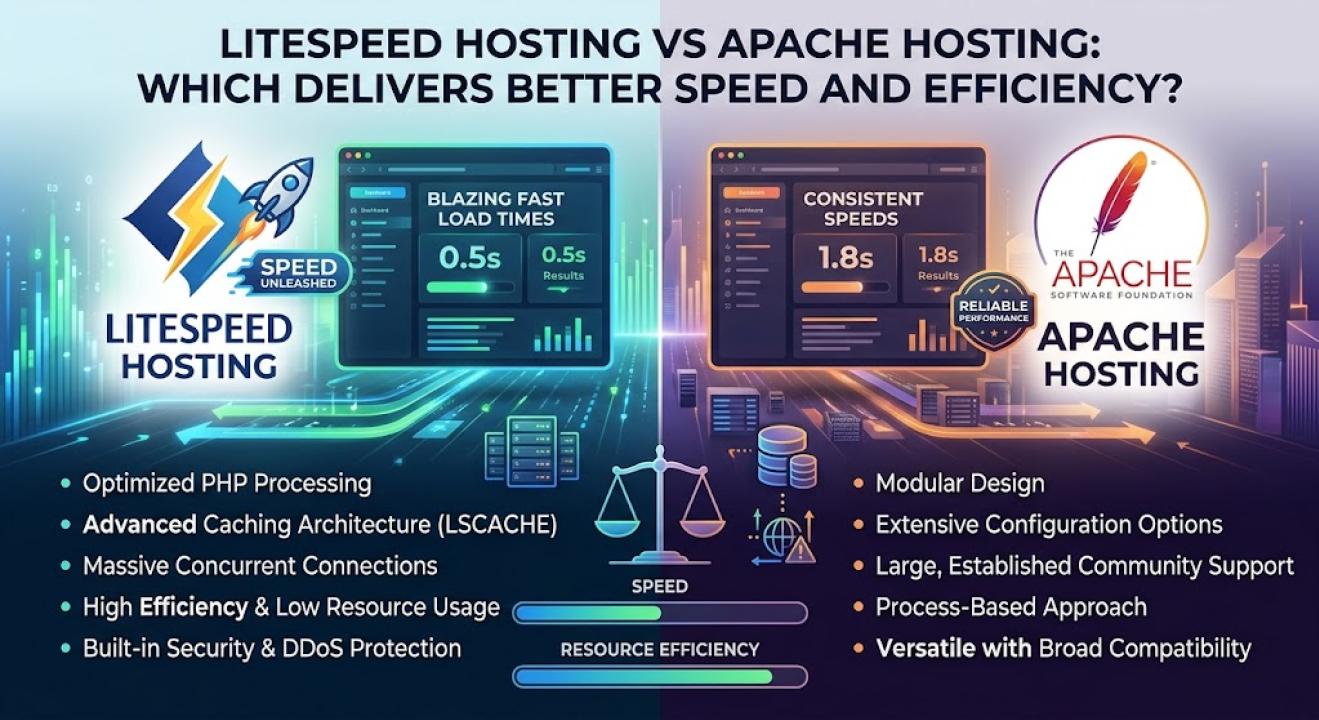
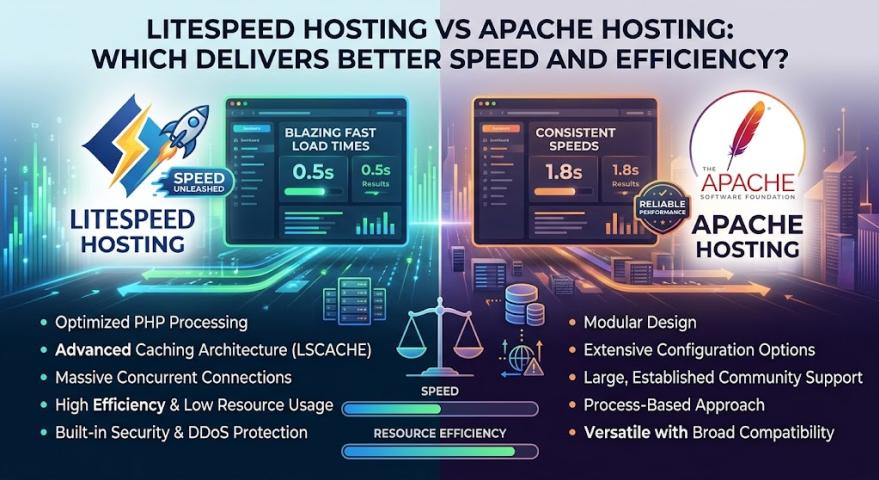
When you can’t hold the attention of a user for an instant they will more likely click back and head elsewhere, the time spent waiting for pages to load must be minimised. LiteSpeed was made to prioritize and enhance your site’s performance. This allows the servers to process website requests at a much quicker pace, and is particularly apparent when the service is used alongside a caching service at the server level. Apache also performed really well in testing; however it takes further work and optimisation to reach the speeds of LiteSpeed, and as traffic levels rise, will often consume server resources just to serve user requests.
If it is speed and efficiency that you prioritize, you can generally notice a more substantial gain using LiteSpeed.
How Efficient is Resource Usage?
In busy periods, a stable website performance requires efficient management of server resources. This helps the server manage website traffic without slowing down the response time.
LiteSpeed uses less memory and CPU resources whilst handling a high volume of traffic, and allows the server to remain stable without having to ramp up hardware costs. With high amounts of connections being processed, Apache generally uses a larger amount of resources; and, although newer configurations have improved it significantly, there is a greater tendency to need manual optimisation compared to LiteSpeed when at load. A reduction in the use of resources will also benefit your site when unexpected bursts of traffic are experienced.
Built-In Caching Advantages
The advantage of native caching LiteSpeed is that it provides in-server caching through its feature of LiteSpeed Cache.
The server directly delivers cache content to the users, rather than rely on other tools that can have a slowing effect. Some of the benefits of using LiteSpeed Cache are increased website speed, reduced workload on the server and improved user experience. Apache does not feature in-server caching built in. It requires external caching solutions in the form of plugins and other software to achieve results.
Handling High Traffic
Dealing with high traffic levels Whether a website is about to launch, has an ongoing marketing campaign or will be experiencing an influx of seasonal customers, rapid growth in website visitors can happen in an instant.
The technology of LiteSpeed is designed to deal with the largest numbers of concurrent connections at speed, thus maintaining responsive website performance under load. Whilst Apache remains a reliable solution for small to mid-size websites, it is not optimized to the same degree as LiteSpeed when dealing with large amounts of traffic. LiteSpeed also provides better scalability than Apache if you know that your website is set to increase rapidly in size.
WordPress Compatibility
Apache and LiteSpeed are both excellent hosts for WordPress websites. Apache has years of support for WordPress, so almost all available themes and plugins are compatible with this server. The same applies to LiteSpeed. It hosts all your plugins and themes with excellent compatibility and includes built in image optimization, browser caching and many more server features through LiteSpeed Cache.
Many users prefer to take the easy option of simply managing LiteSpeed from a web hosting control panel, as opposed to having to manage the configuration directly.
Security features
The security of a website is paramount for any business, blog or online shop. If the server is secure, it protects sensitive client data, helps reduce the chance of websites being taken down, and ensures everything functions as normal.
Apache has a variety of security modules installed as part of the package and as a widely-supported open source software project, is continuously updated by a vast developer community. When implemented correctly, it provides a strong layer of security for the majority of websites.
LiteSpeed also has several effective security features; it contains modules built-in to deal with common website attacks, improved connection management, as well as offering modules that help deal with traffic effectively and prevent malicious visits with the added advantage of no additional server stress.
The security benefits of both these servers are quite substantial and reliable enough for most website owners, however; when comparing they both deliver solid protection, though LiteSpeed is more effective as far as website speed is concerned.
Ease of Migration
One of the greatest fears when thinking about a change in server software is that you may need to redesign and rebuild the entire website.
The great thing about LiteSpeed is its compatibility with Apache. it supports most of the important configurations within an Apache file configuration, including common ones found within the.htaccess. This can be one of the major reasons for choosing to switch from Apache to LiteSpeed, as a lot of website owners do not need to rebuild.
LiteSpeed vs Apache at a Glance
Feature | LiteSpeed | Apache |
Page Loading Speed | Excellent | Good |
Resource Usage | Low | Moderate to High |
Built-in Caching | Yes | No |
High Traffic Performance | Excellent | Good with tuning |
WordPress Optimization | Excellent | Good |
Security | Strong | Strong |
Apache Compatibility | Yes | Native |
Scalability | Excellent | Moderate |
Which One Is Better For SEO?
Technical SEO is based on a number of things, and server performance is one. With LiteSpeed you will see improved Technical SEO due to faster pages served and reduced server response times.
Fast websites tend to create better user experiences, with lower bounce rates and better Core Web Vitals.
While Apache is also capable of delivering good SEO performance, most site owners require a server caching and optimisation solution to achieve similar results. If you're serious about building a fast and responsive site for search engines, LiteSpeed has a superior technical offering.
When Do You Want to Consider LiteSpeed?
LiteSpeed is a great option for those that are;
Running WordPress Hosting
Running WooCommerce Store
Expecting High Website Traffic
Looking to Load Pages Faster
Seeking Better Server Performance
Want the Benefit of Caching
LiteSpeed is a truly impressive package for speed, scalability, and efficiency.
When Apache Makes Sense
However, Apache still provides a reliable and capable web server solution for those that are; Happy with an existing Apache set up Need a high level of custom server set up Running older web applications.
In many instances, for smaller, moderately-trafficised websites Apache continues to offer robust and reliable performance.
Conclusion
Both LiteSpeed and Apache make perfectly capable web servers, but they're designed around very different goals. Apache gives us flexibility, a solid foundation, and the kind of widespread support webmasters have come to rely on for decades. LiteSpeed comes at it from the direction of speed and the modern web.
It aims for lightning-fast page loads, it utilizes fewer server resources, it handles traffic surges better and it comes with an in-built caching layer that benefits users just as much as the site itself.
If your goals are to host a fast and reliable website that can grow into the future,LiteSpeedis the stronger choice. Apache will always get the job done, but LiteSpeed offers a much faster path.