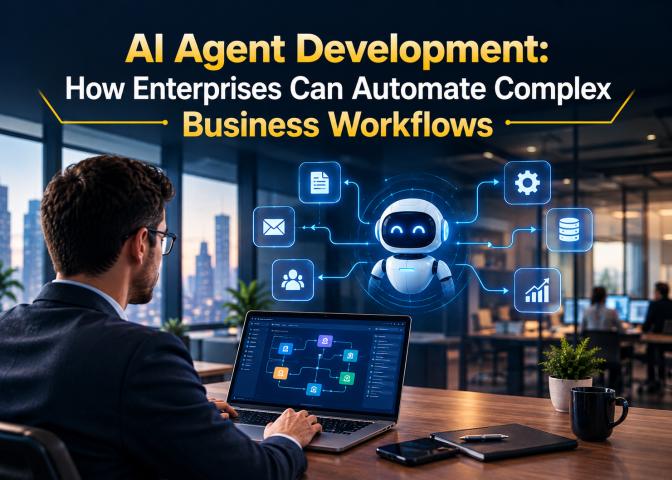
Artificial Intelligence has rapidly evolved from systems that simply respond to commands into systems that can understand goals, make decisions, plan tasks, use tools, and take actions independently.
This new generation of AI is known as Agentic AI.
Unlike traditional AI applications that usually perform a specific task based on a user prompt, Agentic AI can work toward a larger objective by breaking the problem into smaller tasks, reasoning about possible solutions, using external tools, learning from results, and adjusting its approach.
From software development and customer support to healthcare, finance, cybersecurity, and business automation, Agentic AI is becoming one of the most important areas in modern AI.
What Is Agentic AI?
Agentic AI refers to AI systems designed to operate with a degree of autonomy to achieve a defined goal.
A traditional chatbot might answer:
"What is the weather today?"
An agentic system could receive a broader objective such as:
"Plan my business trip to Chennai next week."
The system could potentially:
Understand the objective.
Identify the required tasks.
Search for relevant information.
Compare available options.
Use external tools or APIs.
Make decisions based on predefined constraints.
Create an itinerary.
Present the final result.
The important difference is that Agentic AI focuses not only on generating an answer, but also on planning and executing actions to accomplish a goal.
Traditional AI vs Agentic AI
Understanding the difference between traditional AI and Agentic AI is important.
Traditional AI | Agentic AI |
|---|---|
Responds to prompts | Works toward goals |
Usually task-specific | Can handle multi-step tasks |
Limited autonomy | Greater autonomy |
Primarily generates output | Plans and executes actions |
Often follows predefined workflows | Can dynamically determine workflows |
Limited tool usage | Can use tools, APIs and databases |
Human frequently guides each step | Human can provide a high-level objective |
For example, a traditional AI system may generate Python code when asked.
An Agentic AI coding system could potentially:
Understand requirement → create code → run tests → identify errors → modify code → run tests again → prepare final solution.
This ability to work through multiple steps is one of the defining characteristics of agentic systems.
How Does Agentic AI Work?
An Agentic AI system commonly combines several technologies.
1. Large Language Models
Large Language Models (LLMs) provide the reasoning and language capabilities behind many AI agents.
Examples include models developed by companies such as OpenAI, Google, Anthropic, and others.
An LLM can help an agent understand instructions, reason about tasks, generate content, interpret tool results, and decide what should happen next.
2. Goal Understanding
The first step is understanding what the user actually wants.
For example:
Goal:"Analyze our sales data and identify why revenue decreased."
The agent may determine that it needs to:
Access the sales dataset
Clean the data
Analyze trends
Compare periods
Identify unusual changes
Generate insights
Create a report
Instead of treating the request as one simple prompt, the agent turns it into a multi-step objective.
3. Planning
Agentic systems can break a large objective into smaller tasks.
For example:
Business analysis
→ Collect data→ Clean data→ Analyze revenue→ Identify trends→ Compare regions→ Find anomalies→ Generate recommendations
This planning capability allows AI agents to tackle more complicated problems.
4. Tool Usage
One of the most important features of Agentic AI is the ability to interact with external tools.
An agent may use:
APIs
Web search
Databases
Python
Calculators
CRM systems
Cloud platforms
Business applications
File systems
Internal enterprise software
For example, an AI agent working in a CRM environment could retrieve customer information, analyze account activity, prepare a summary, and recommend follow-up actions.
Memory in Agentic AI
Memory can help an AI agent maintain useful information across multiple interactions or steps.
There are two common concepts:
Short-Term Memory
This includes information available during the current task or conversation.
For example:
"The customer prefers email communication."
The agent can use that information while completing the current workflow.
Long-Term Memory
Long-term memory allows an agent to retain useful information for future interactions, subject to the application's privacy and data policies.
Memory can make agents more useful for personalized workflows.
Agentic AI and RAG
Retrieval-Augmented Generation (RAG) is another important technology in modern agentic systems.
RAG allows an AI system to retrieve relevant information from external knowledge sources before generating an answer.
A typical RAG workflow is:
User Question → Retrieve Information → Provide Context → LLM → Generate Answer
Agentic AI can take this further.
An agent can decide:
"I need additional information before I can complete this task."
It may then:
Search a knowledge base.
Retrieve relevant documents.
Analyze the information.
Determine whether more information is needed.
Perform another search.
Generate the final result.
This combination of AI agents + RAG + tools can be particularly powerful for enterprise applications.
Agentic AI vs Generative AI
Generative AI and Agentic AI are closely related, but they are not the same.
Generative AI focuses primarily on creating content.
Examples include:
Text
Images
Code
Audio
Video
Agentic AI focuses on achieving objectives through reasoning and action.
For example:
Generative AI
"Write a customer follow-up email."
Agentic AI
"Identify customers who haven't responded in 30 days, review their account history, determine the appropriate follow-up message, draft the emails, and prepare them for approval."
The second workflow requires multiple steps and potentially multiple tools.
Multi-Agent AI Systems
The next level of Agentic AI is the multi-agent system.
Instead of one AI agent performing every task, multiple specialized agents can work together.
For example, an e-commerce company could have:
Research AgentFinds product information.
Customer AgentHandles customer communication.
Inventory AgentChecks stock availability.
Pricing AgentAnalyzes pricing.
Order AgentHandles order processing.
These agents can communicate and coordinate to complete a larger business workflow.
A simplified architecture could look like:
User Goal
↓
Orchestrator Agent
↓
Research Agent → Data Agent → Decision Agent → Action Agent
↓
Final Result
This approach can make complex AI workflows more modular and scalable.
Real-World Applications of Agentic AI
Agentic AI has potential applications across many industries.
1. Software Development
AI agents can assist developers with:
Code generation
Debugging
Testing
Documentation
Code reviews
Dependency analysis
Deployment workflows
Instead of simply generating code, an agent can potentially participate in the complete development lifecycle.
2. Customer Support
Customer service agents can:
Understand customer questions
Search knowledge bases
Retrieve account information
Determine the appropriate response
Create support tickets
Escalate complex cases
This can reduce repetitive manual work while allowing human employees to focus on more complicated issues.
3. Healthcare
Potential applications include:
Medical research assistance
Patient information management
Appointment workflows
Documentation
Research analysis
Administrative automation
Because healthcare involves sensitive information and high-stakes decisions, strong human oversight, security, and regulatory controls are essential.
4. Finance
Financial organizations can use AI agents for:
Report analysis
Fraud investigation support
Customer service
Financial document processing
Risk analysis
Market research
Agents can bring together information from multiple systems and help employees make faster, better-informed decisions.
5. Cybersecurity
Agentic AI can assist security teams by:
Monitoring alerts
Investigating suspicious activity
Correlating security events
Analyzing logs
Prioritizing incidents
Supporting incident response
Human approval remains important for sensitive security actions.
Agentic AI in Business Automation
One of the biggest opportunities for Agentic AI is business process automation.
Consider a recruitment workflow.
A traditional automation system might follow:
Resume received → Send email → Update spreadsheet
An agentic workflow could potentially:
Resume received
↓
Extract candidate information
↓
Analyze skills
↓
Compare with job requirements
↓
Identify suitable candidates
↓
Schedule interviews
↓
Update recruitment systems
↓
Generate recruiter summary
The agent can dynamically determine which actions are necessary instead of simply following a rigid sequence.
Popular Technologies Used to Build AI Agents
Developers building Agentic AI systems may work with technologies such as:
Python
Large Language Models
APIs
RAG
Vector databases
Embeddings
LangChain
LlamaIndex
CrewAI
AutoGen
Agent orchestration frameworks
Cloud AI services
Python is particularly useful because of its extensive ecosystem for AI, machine learning, automation, APIs, and data processing.
What Is an AI Agent Architecture?
A simplified AI agent architecture can be represented as:
User
↓
AI Agent
↓
Reasoning / Planning
↓
Memory
↓
Tool Selection
↓
External Tools / APIs / Databases
↓
Observation
↓
Next Action
↓
Final Result
The important concept is the feedback loop.
The agent performs an action, observes the result, evaluates what happened, and determines what to do next.
This creates a more dynamic workflow than a simple question-and-answer system.
Challenges of Agentic AI
Although Agentic AI offers significant opportunities, it also introduces important challenges.
Reliability
An autonomous system may make incorrect decisions or misunderstand a task.
Security
Agents with access to databases, APIs, or business systems need carefully controlled permissions.
Cost
Complex agent workflows may require multiple model calls and external tools.
Privacy
Enterprise agents may process confidential business or customer information.
Hallucinations
LLMs can generate incorrect information, which becomes more problematic when an agent is capable of taking actions.
Human Oversight
High-impact decisions should generally include appropriate human review and approval.
The Future of Agentic AI
The future of AI is moving beyond systems that simply answer questions.
The next generation of AI applications will increasingly focus on systems that can:
Understand → Plan → Reason → Act → Observe → Improve
This shift could transform how people interact with software.
Instead of opening several applications and manually completing dozens of steps, users may increasingly describe the desired outcome and allow AI systems to coordinate the underlying workflow.
For businesses, this could mean more intelligent automation.
For developers, it could create new opportunities to build AI-powered applications.
For professionals, it means that understanding LLMs, RAG, Python, APIs, vector databases, automation, and AI agents is becoming increasingly valuable.
How to Start Learning Agentic AI
If you're a beginner, don't try to learn every AI framework immediately.
A practical learning path is:
Step 1: Learn Python
Understand:
Variables
Functions
Classes
Lists and dictionaries
Exception handling
APIs
JSON
Step 2: Understand Generative AI
Learn:
LLMs
Prompt engineering
Tokens
Context windows
Embeddings
Step 3: Learn RAG
Understand:
Document loading
Chunking
Embeddings
Vector databases
Retrieval
Context generation
Step 4: Learn AI Agents
Explore:
Tool calling
Planning
Memory
Agent workflows
Agent orchestration
Multi-agent systems
Step 5: Build Projects
Start with projects such as:
AI research agent
Customer support agent
Resume screening agent
SQL data analysis agent
Document analysis agent
Coding assistant
Multi-agent business automation system
Hands-on projects are one of the best ways to understand how agentic systems work in real-world scenarios.
Conclusion
Agentic AI represents a major evolution in artificial intelligence.
Generative AI showed us how machines can create content. Agentic AI takes the concept further by enabling systems to reason about goals, plan multiple steps, use tools, and perform actions.
As AI becomes increasingly integrated into software and business processes, the ability to design, develop, and manage AI agents will become an important skill for developers, data professionals, automation engineers, and AI specialists.
The future isn't just about asking AI for an answer.
It's about giving AI a goal and building systems that can intelligently work toward achieving it.