Managing increasingly complex networks
The rapid expansion of 5G, cloud computing, IoT, edge computing, and connected devices is increasing network complexity and data volumes. Traditional network management can make it difficult to continuously monitor traffic, allocate resources, and respond quickly to changing conditions.
AI-driven networking enables networks to analyze operational data, identify patterns, optimize traffic, and automate routine management tasks. This is increasing demand for AI-based network solutions across telecommunications, data centers, and enterprise environments.
Reducing network downtime
Unexpected network failures can disrupt services and increase maintenance requirements. Detecting potential problems only after they occur can also increase downtime and operational costs.
AI-powered predictive network management can identify patterns associated with potential failures and allow operators to address issues earlier. This is supporting growing adoption of predictive maintenance within the AI in Networks Market.
Improving network performance
Growing data traffic can create congestion and inefficient resource utilization. Networks need to continuously adapt to changing demand while maintaining service quality.
AI can analyze network conditions in real time and adjust traffic and resources accordingly. Network optimization accounted for 30% of the market in 2025, making it the largest application segment in Cervicorn Consulting's market analysis.
Moving from automation to autonomous networks
Rule-based automation can handle predefined tasks but may be less effective when network conditions change unexpectedly. This is encouraging the shift toward systems capable of analyzing conditions and making decisions with limited human intervention.
The market is increasingly moving toward autonomous and AI-native networks, where AI becomes part of the network architecture rather than simply an external management tool. AI agents are also being developed for network monitoring, troubleshooting, configuration, and routine operations.
Strengthening network security
The increasing number of connected devices and expanding network infrastructure are creating additional cybersecurity challenges. Identifying abnormal activity across large volumes of network data can be difficult using conventional approaches alone.
AI-powered network security can analyze activity patterns and help identify anomalies and potential threats. Network cybersecurity represented 25% of the AI in Networks Market by application in 2025, according to Cervicorn Consulting.
Supporting AI-intensive data centers
The growth of AI workloads is increasing demand for high-speed, low-latency networking infrastructure within data centers. AI applications require large volumes of data to move efficiently between computing, storage, and networking systems.
As a result, data centers are becoming an important growth area for AI networking. Cervicorn Consulting expects the data center segment to grow strongly as AI workloads increase and organizations invest in networking infrastructure capable of supporting these requirements.
Addressing network troubleshooting challenges
Network troubleshooting can require engineers to examine large amounts of operational information across increasingly complex infrastructure. Identifying the source of a problem and determining the appropriate response can therefore take considerable time.
AI and emerging generative AI and agentic networking technologies are creating new approaches to troubleshooting by helping analyze network conditions, identify potential causes, and support automated responses.
Balancing AI adoption with implementation challenges
Although AI can improve network operations, adoption can involve significant implementation costs, integration requirements, data privacy considerations, and cybersecurity risks. Legacy infrastructure can also make integration more difficult.
These factors are increasing demand for networking solutions that can integrate AI capabilities with existing infrastructure while maintaining security, control, and reliability.
Market outlook
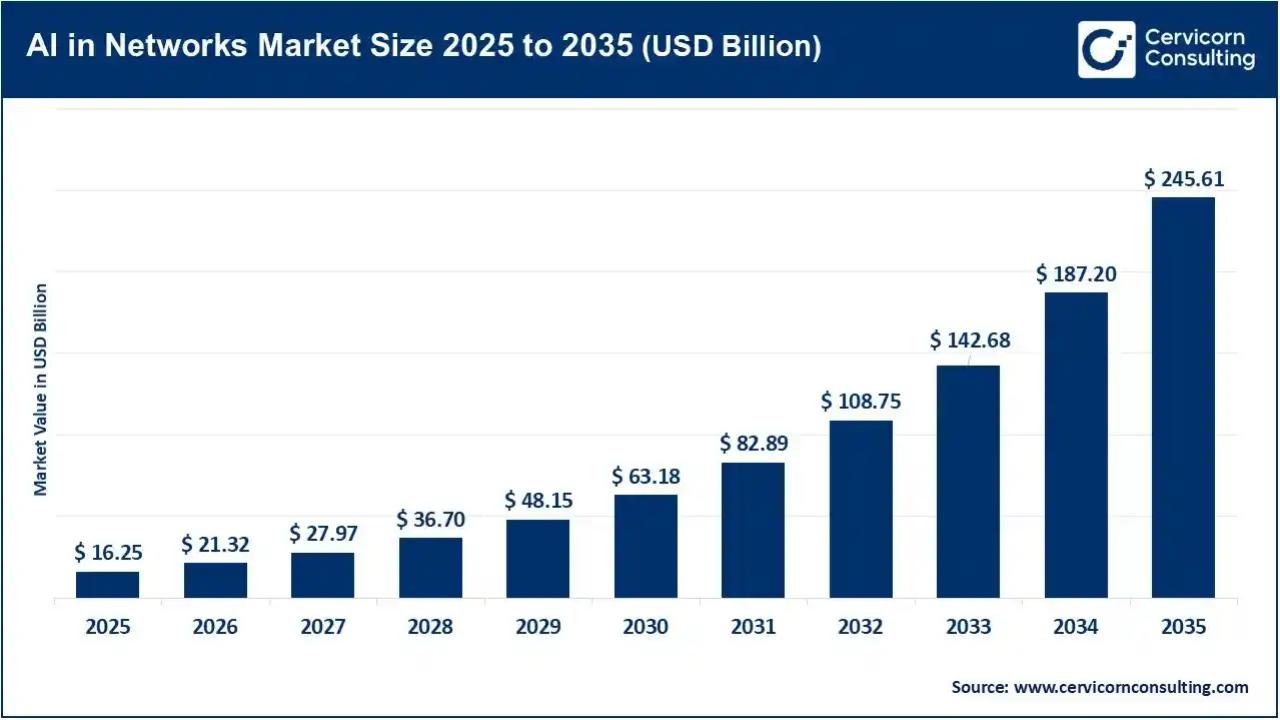
The global AI in Networks Market was valued at USD 16.25 billion in 2025 and is projected to exceed USD 245.61 billion by 2035, expanding at a 31.2% CAGR from 2026 to 2035. North America held a 42% revenue share in 2025, while Asia Pacific is expected to record strong growth as 5G deployment, digital infrastructure, data centers, and AI adoption expand.
Where AI in Networks is heading
The market is moving toward AI-native, autonomous, predictive, and agentic networks. AI is increasingly being applied not only to monitor networks but also to optimize resources, detect threats, predict failures, troubleshoot issues, and support real-time decision-making.
This shift is transforming AI from an additional network-management capability into a core component of modern networking infrastructure, creating new opportunities across telecommunications, data centers, enterprises, and other connected industries.
Additional market information: https://www.cervicornconsulting.com/sample/3032