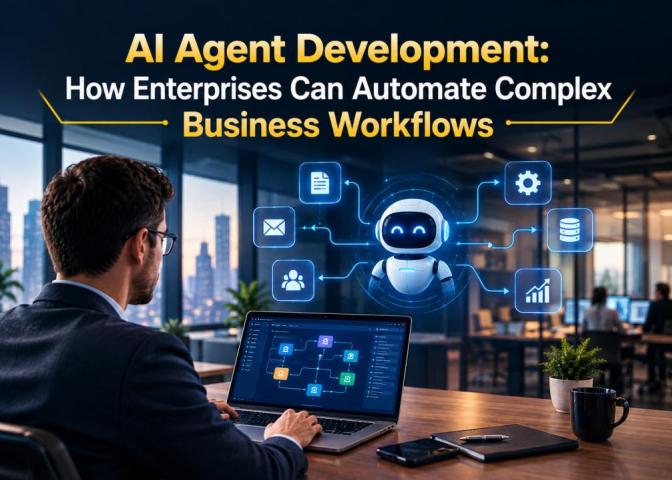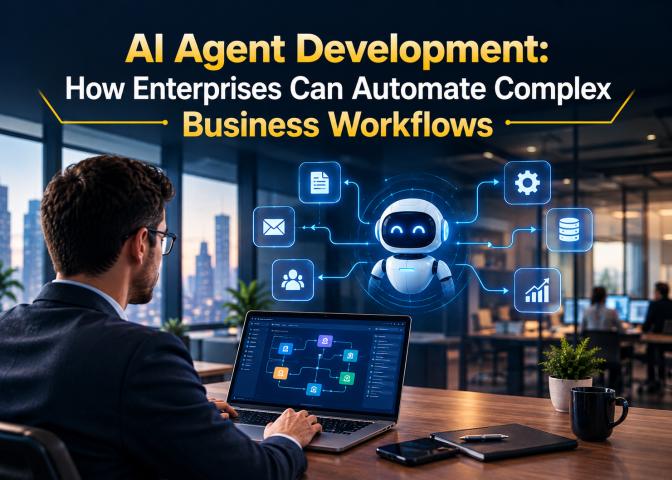
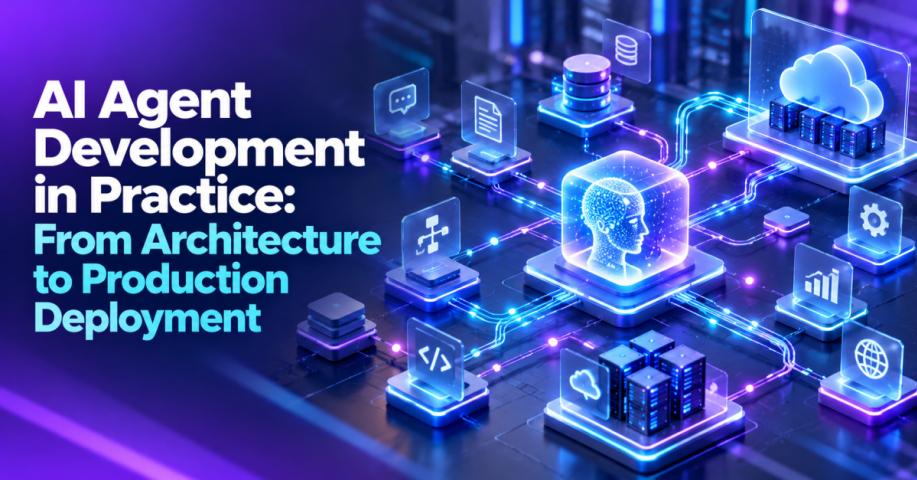
AI agents are moving beyond experimentation and becoming part of real business workflows. They can interpret information, reason through tasks, use business tools, and take action with limited human intervention. However, turning an AI agent into a reliable production system requires more than connecting an LLM to a prompt. An experienced AI agent development company can help businesses move from initial architecture and integration to testing, deployment, and continuous optimization.
What Does AI Agent Development Involve?
AI agent development involves designing intelligent systems that can understand objectives, process information, use tools, and execute multi-step tasks based on business rules.
Unlike traditional automation, AI agents can respond to changing conditions rather than simply following predefined rules. For example, a sales agent could review customer information, retrieve data from a CRM, prepare a personalized response, update the customer record, and escalate unusual cases to an employee.
A production-ready agent typically combines an AI model with memory, business data, APIs, orchestration logic, security controls, and monitoring.
Step 1: Define the AI Agent's Role and Business Objectives
The first step is to determine exactly what the agent should accomplish. Businesses should identify the workflow, repetitive tasks, required systems, decision boundaries, and measurable outcomes before development begins.
Key questions include:
What business problem will the agent solve?
Which tasks should it perform independently?
What information will it need?
Which actions require human approval?
How will success be measured?
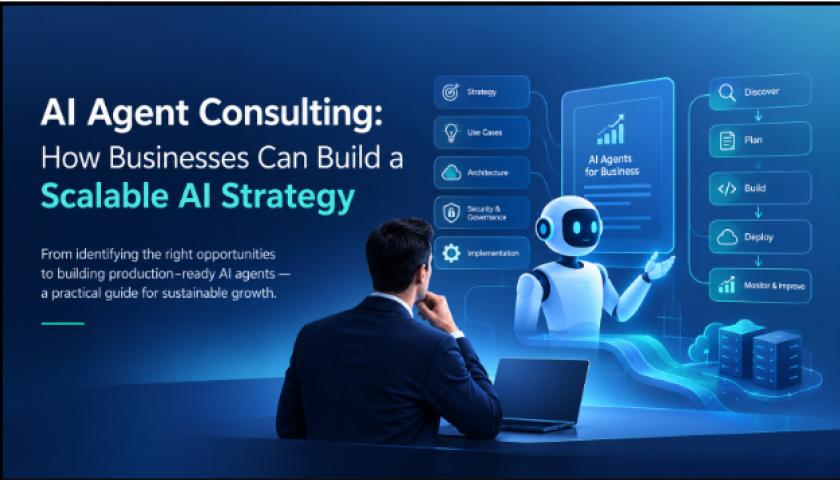
Businesses that need help identifying suitable use cases can consider AI strategy consulting to prioritize opportunities, define an AI roadmap, and align agent initiatives with business goals.
Step 2: Design the AI Agent Architecture
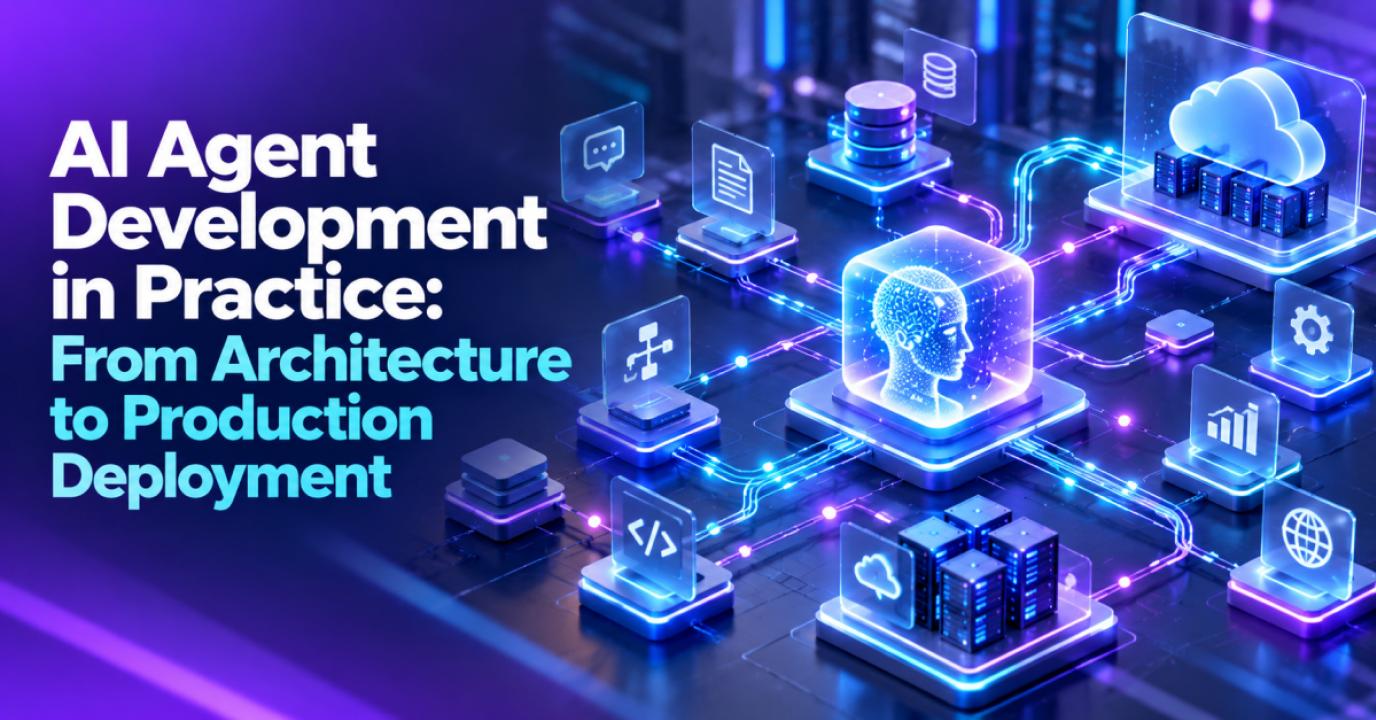
The architecture determines how an agent understands requests, reasons through tasks, retrieves information, and performs actions.
A typical architecture may include:
LLM: Provides language understanding and reasoning capabilities.
Memory: Maintains relevant context during conversations or multi-step tasks.
Tools and APIs: Allow the agent to interact with databases, applications, search systems, and external services.
Orchestration: Controls task planning, tool selection, execution, and handoffs.
Knowledge layer: Provides access to company-specific documents and trusted data.
The architecture should also account for scalability, security, observability, and future model changes.
For businesses whose requirements are primarily conversational, AI chatbot development can be a suitable approach. AI agents become more relevant when the system needs to reason across multiple steps and take actions through connected tools.
Step 3: Build and Integrate the AI Agent
An AI agent becomes significantly more valuable when it can work with the systems employees already use.
Common integrations include:
CRM and ERP platforms
Internal databases
Customer support systems
Project management tools
Communication platforms
Payment systems
Third-party APIs
For example, a customer service agent could identify a customer, review previous interactions, check order information, determine the appropriate resolution, and update the support ticket.
This is where custom AI agent development becomes important. Instead of adapting a generic agent to an existing workflow, businesses can build the system around their processes, data, permissions, and operational requirements.
Step 4: Add Security and Guardrails
Production agents can access sensitive information and potentially perform real business actions. Security therefore needs to be incorporated into the architecture from the beginning.
Important controls include:
Authentication and authorization
Role-based access
Data protection
Audit logging
Tool permissions
Human approval workflows
Failure and escalation mechanisms
Businesses should also consider risks such as prompt injection, unauthorized tool use, incorrect actions, and exposure of confidential information.
High-impact actions should have clear boundaries. For example, an agent may prepare a financial transaction but require human approval before execution.
Step 5: Test and Evaluate the AI Agent
An agent that performs well in a controlled demonstration may behave differently when exposed to real users and unexpected inputs.
Testing should evaluate:
Accuracy
Task completion
Tool selection
Hallucination handling
Edge cases
Failure recovery
Security vulnerabilities
Response consistency
Teams should test the agent against realistic scenarios rather than relying only on standard inputs.
Human evaluation is also valuable during early stages. Feedback can reveal gaps in workflows, unclear instructions, incorrect actions, or situations where the agent needs to hand control back to an employee.
Step 6: Deploy the AI Agent to Production
Production deployment introduces requirements that may not exist during development.
Businesses need to consider:
Scalable infrastructure
API reliability
Response latency
Monitoring
Logging
Cost management
Data security
Backup and recovery
A staged rollout can reduce deployment risk. For example, an organization can initially run an agent in a controlled or shadow environment, compare its decisions with the existing process, and gradually increase its level of responsibility.
Monitoring should continue after deployment. Teams can track task completion, failed actions, response quality, latency, tool usage, and operating costs.
Step 7: Continuously Optimize the AI Agent
Deployment is not the end of AI agent development.
Real-world usage generates new data and exposes scenarios that may not have appeared during testing. Businesses can use this information to improve prompts, workflows, knowledge sources, tools, guardrails, and model configurations.
Continuous evaluation also helps determine whether the agent is producing measurable business value.
For more complex environments, AI agent development services can support the full lifecycle, including architecture, integration, evaluation, deployment, and ongoing optimization.
When Should You Work With an AI Agent Development Company?
Businesses may benefit from specialized development expertise when an agent needs to interact with multiple enterprise systems, process sensitive information, execute complex workflows, or operate at scale.
An experienced development partner can help with use-case discovery, architecture design, custom development, API integrations, security, testing, deployment, and maintenance.
This is particularly useful when an organization has validated an AI use case but does not have the internal expertise to build and operate a production-grade system.
Conclusion
Building a reliable AI agent requires more than selecting an LLM. Businesses need a clear use case, scalable architecture, secure integrations, rigorous testing, controlled deployment, and continuous optimization.
A practical approach starts with defining the business objective and agent responsibilities. From there, teams can design the architecture, connect required systems, establish security controls, test real-world scenarios, and gradually move the agent into production.
When these elements work together, AI agent solutions can move beyond experimentation and become dependable components of everyday business operations.