
Market Overview
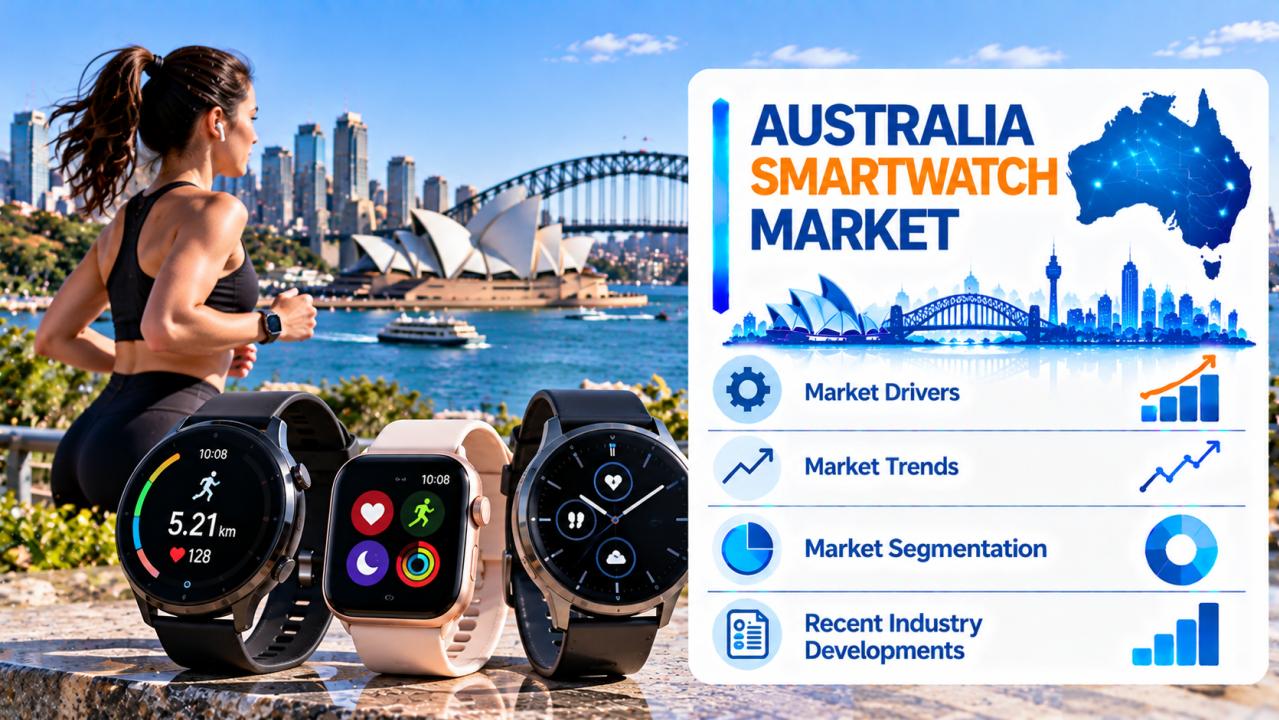
The Australia smartwatch market size reached USD 1,245.2 Million in 2025 and is projected to reach USD 5,097.7 Million by 2034, growing at a compound annual growth rate (CAGR) of 16.35% from 2026 to 2034. The market is driven by preventive health monitoring, digital ecosystem integration, and policy support for digital health.
Australia Smartwatch Market Summary
- The Australia smartwatch market covers extension, standalone, and hybrid smartwatches running WatchOS, Android, and other systems, used for healthcare and wellness, personal assistance, sports, and other purposes.
- Smartwatches are valued for health tracking such as ECG, blood oxygen, and sleep, along with notifications, payments, and connectivity.
- The ecosystem includes device makers, chip and sensor suppliers, app and health platform developers, telecom carriers, retailers, regulators such as the Therapeutic Goods Administration (TGA), and consumers.
- In 2025, IMARC puts extension smartwatches at 55.5% of the product segment, WatchOS at 48.5% of operating systems, healthcare and wellness at 52.5% of applications, offline stores at 58.5% of distribution, and ACT and New South Wales at 34.8% of the regional split.
- IMARC lists restraints: price sensitivity, data privacy and security concerns, limited differentiation and upgrade fatigue, and regional accessibility.
Request a Sample Report for In-Depth Market Insights: https://www.imarcgroup.com/australia-smartwatch-market/requestsample
Porter’s Five Forces Analysis
- Competitive Rivalry: High. Apple, Samsung, Garmin, and others compete on health features, design, and ecosystem. Business implication: Differentiate through clinically validated health features and ecosystem links.
- Supplier Power (Components and Platforms): Moderate to High. Sensors, chips, and operating systems come from a few suppliers. Business implication: Secure supply and invest in proprietary software.
- Buyer Power (Consumers): Moderate to High. Buyers compare prices and features easily, and are sensitive to premium pricing. Business implication: Offer tiered products and clear value in health benefits.
- Threat of Substitutes: Moderate. Fitness bands, smartphones, and medical devices can replace some smartwatch uses. Business implication: Stress integrated features that bands and phones lack.
- Threat of New Entrants: Moderate. Hardware entry is costly, but software and niche brands can enter. Business implication: Build ecosystem partnerships and focus on specialized segments.
Market Growth Drivers
Preventive Health Monitoring
Consumers increasingly use smartwatches for health monitoring such as ECG, blood oxygen, sleep, and sleep apnea features. IMARC cites Garmin’s ECG App, expanded in January 2025 as its first smartwatch feature categorized as a medical device in Australia, and Apple’s Watch Series 10 sleep apnea notifications as examples.
Digital Ecosystem Integration
Smartwatches are linking with smartphones, smart home devices, and payments, and eSIM support lets them connect independently. This makes the watch a central device in daily life, which raises its value for users, strengthens loyalty to ecosystems such as Apple’s, and encourages upgrades as new connected features and services are added.
Policy Support and Digital Health
IMARC says the National Digital Health Strategy 2023 to 2028 and expanding chronic care coverage encourage wearable adoption. Policy attention to digital health, remote monitoring, and preventive care builds trust in wearable data, supports health-focused use, and gives device makers a clearer path to bring regulated health features to Australian users.
Australia Smartwatch Market Segmentation
Product Insights:
- Extension (55.5% in 2025)
- Standalone
- Hybrid
Operating System Insights:
- WatchOS (48.5% in 2025)
- Android
- Others
Application Insights:
- Healthcare and Wellness (52.5% in 2025)
- Personal Assistance
- Sports
- Others
Distribution Channel Insights:
- Offline Stores (58.5% in 2025)
- Online Stores
Regional Insights:
- Australian Capital Territory and New South Wales (34.8% in 2025)
- Victoria and Tasmania
- Queensland
- Northern Territory and Southern Australia
- Western Australia
Competitive Landscape
The Australia smartwatch market includes global consumer electronics brands, sports and fitness watch makers, and hybrid and fashion watch brands, sold through offline and online channels. IMARC refers to key players in general terms in the report and names no companies or ratings in its competitive landscape section. Competition centers on health features, ecosystem, design, and price.
Key Organizations Mentioned in the Report Context Include:
- Garmin expanded its ECG App to Australian customers with compatible Venu 3 Series and fēnix 8 Series watches in January 2025, described as its first smartwatch feature categorized as a medical device in Australia.
- Apple launched the Watch Series 10 in Australia in September 2024 with sleep apnea notifications, faster charging, and enhanced water depth sensing.
Regional Analysis
- ACT and New South Wales: The leading region, at 34.8% of the market in 2025, driven by Sydney’s tech-savvy population, higher incomes, retail infrastructure, and digital health awareness.
- Victoria and Tasmania: A strong market around Melbourne, with high smartphone and fitness use.
- Queensland: Growing demand, with active, outdoor life>
- Northern Territory and Southern Australia, and Western Australia: Smaller markets, with regional and rural access cited by IMARC as a barrier. IMARC gives no shares for these regions.
Recent Industry Developments
October 2026: Australia's smartwatch market faces softer wearable sales as consumers prioritise health features. On 17 August 2026, Telsyte reported that more than 800,000 smart wrist wearables were sold in Australia during the first half of 2026, down 8% year-on-year. Smartwatches accounted for more than 70% of sales, with Apple, Samsung, and Garmin among the leading brands. Demand increasingly centres on health monitoring, fitness tracking, and integration with smartphones and digital assistants.
September 2026: Apple launches Watch Series 12 and Watch Ultra 4 in Australia. On 10 September 2026, Apple announced its latest smartwatch models, featuring upgraded health sensors, improved heart-rate tracking, and a daily readiness score based on activity, sleep, and recovery. Australian prices started at AUD 649 for Watch Series 12 and AUD 1,349 for Watch Ultra 4, with retail availability beginning on 18 September. The launch reinforces competition in the premium smartwatch segment.
Key Aspects Required for the Australia Smartwatch Market
- Market Performance: USD 1,245.2 Million in 2025, with a projected trajectory to USD 5,097.7 Million by 2034.
- Market Outlook: A 16.35% CAGR through 2034 indicates very rapid growth.
- Growth Drivers: Preventive health monitoring; digital ecosystem integration; and policy support and digital health.
- Competitive Landscape: Global electronics and sports watch brands competing on health features, ecosystem, design, and price.
- Value Chain Analysis: From sensor and chip suppliers, through device makers and software platforms, to retailers, carriers, and consumers.
- Industry Trends: Medical-grade health features; eSIM and standalone watches; sleep and blood pressure monitoring; and ecosystem lock-in.
- Strategic Recommendations: Pursue regulatory approval for health features; build ecosystem and app partnerships; target preventive health users; and address price and privacy concerns.
Note: If you need any specific information that is not currently covered within the scope of the report, we will provide the same as a part of customization.
Speak to an analyst: https://www.imarcgroup.com/request?type=report&id=33090&flag=C
Report Format, Delivery, and Customization Details
- Report Format Mode: PDF and Excel (Editable version in PPT/Word format available on special request)
- Report Delivery Mode: Online Delivery, Physical Delivery
- Report Delivery Time: report delivered over email within 24 to 48 hours. If requested by the client, a physical copy will be delivered within three to ten days.
- Report Confirmation Mode: Yes, via email
- Report Customization Mode: Yes, via Email / Call
- Report Table of Content: Yes
- Report List of Figures: Yes
- Report Methodology Mode: Yes
- Request For Sample Report: Yes