Businesses are under increasing pressure to improve operational efficiency while managing growing volumes of information, customer expectations, and complex technology environments. Traditional automation has helped organizations reduce repetitive work, but many processes still depend on employees to interpret documents, classify requests, identify exceptions, and decide what should happen next.
AI-Powered Process Automation extends conventional automation by combining artificial intelligence with business workflows, application integrations, and predefined operational rules. It enables systems to interpret information, recognize patterns, generate recommendations, and support activities that previously required significant manual effort.
In 2026, the focus is shifting from simply automating predictable tasks to building intelligent business operations. AI assistants, intelligent document processing, machine learning, and agent-based workflows are creating new possibilities. However, successful implementation requires more than adding an AI model to an existing process. Businesses need reliable data, clear decision boundaries, secure integrations, and appropriate human supervision.
The Evolution From Traditional Automation to AI-Powered Operations
Traditional automation is effective when a process follows clearly defined instructions. For example, a system can send an approval request whenever an employee submits an expense claim.
However, business information is not always structured or predictable. An incoming email may contain several requests, an invoice may use an unfamiliar format, or a customer message may describe an issue without using predefined categories.
AI can help interpret these situations and provide information that conventional workflows can use.
The following table highlights how intelligent automation is developing and the capabilities businesses may explore as they prepare for 2027.
| Automation Capability | Business Opportunity in 2026 | Potential Direction Toward 2027 |
|---|---|---|
| Intelligent document processing | Extracts and classifies business information | More context-aware document workflows |
| AI-assisted decision support | Identifies patterns and recommends actions | More adaptive operational assistance |
| Predictive analytics | Helps identify trends and potential risks | More proactive planning and monitoring |
| AI agents | Supports multi-step activities using approved tools | Greater coordination across connected workflows |
| Human-AI collaboration | Combines AI assistance with employee judgment | More clearly governed intelligent operations |
These capabilities are most valuable when they address a defined business problem and operate within appropriate organizational controls.
1. Why Businesses Are Moving Toward AI-Powered Process Automation
Organizations often have automated individual activities but still depend on employees for tasks that involve interpretation, information gathering, or exception handling.
This creates an opportunity for AI to support processes that are difficult to manage through fixed rules alone.
Growing Volumes of Unstructured Information
Businesses receive information through emails, scanned documents, PDFs, support messages, forms, and other channels.
Manually reviewing and categorizing every item can consume significant employee time.
AI-powered processing can help extract relevant information, identify document types, and prepare records for validation.
Increasing Operational Complexity
As organizations expand, business processes involve more applications, departments, customers, and decision points.
AI can support information retrieval, classification, and recommendations within these connected processes.
Demand for Faster Customer Responses
Customers expect timely and relevant responses across digital channels.
AI can help support teams summarize requests, retrieve relevant knowledge, and suggest responses while allowing employees to handle complex or sensitive situations.
Need for Better Business Insights
Traditional reporting often explains what has already happened.
Machine learning and predictive analytics can help identify patterns in historical and current data, supporting planning and risk assessment.
These insights still require appropriate interpretation before being used in important business decisions.
2. What AI-Powered Process Automation Services Include
AI-powered process automation combines several technical capabilities to improve how business activities are performed.
The implementation may include AI models, workflow engines, APIs, data pipelines, and enterprise applications.
Intelligent Document Processing
Intelligent document processing uses AI techniques to identify, extract, and classify information from documents.
Common applications include:
Invoice information extraction.
Purchase order validation.
Contract data identification.
Customer application processing.
Employee document classification.
Business form digitization.
For example, an invoice processing workflow can extract supplier details, invoice numbers, dates, and amounts before passing the information to a validation process.
If required details are missing or uncertain, the workflow can send the document to an employee for review.
Natural Language Processing
Natural language processing helps software interpret and work with human language.
Businesses can use it to classify customer messages, summarize documents, identify topics, and retrieve relevant information from internal knowledge sources.
A customer support system, for example, can identify whether an incoming message concerns billing, technical assistance, account access, or product information.
Machine Learning and Predictive Analytics
Machine learning can identify patterns in historical and current data.
Depending on data quality and the problem being addressed, businesses may use it for demand forecasting, customer behavior analysis, anomaly detection, and operational risk identification.
Predictions should be evaluated against actual outcomes and monitored as business conditions change.
AI-Assisted Workflow Automation
AI can provide information to conventional workflow systems.
For example, an AI service may classify a purchase request and extract its key details. A workflow engine can then apply established approval rules and assign the request to the appropriate employee.
This approach separates interpretation from authorization.
AI Agents and Tool-Based Automation
AI agents can use approved tools and information sources to assist with multi-step activities.
An internal operations agent might retrieve policy information, summarize a request, and prepare a response for an employee.
Organizations should define the agent's permissions, permitted actions, approval requirements, and monitoring procedures before allowing it to interact with business systems.
3. Business Functions That Can Benefit From Intelligent Automation
AI-powered automation can support several departments, particularly where employees regularly process large amounts of information or manage repetitive decisions.
Finance and Accounting
Finance teams handle invoices, expense claims, purchase orders, reconciliations, and financial documents.
AI can help extract information, identify unusual records, classify transactions, and prepare documents for review.
For example, an invoice workflow can compare extracted information with purchase order records and flag discrepancies.
Payment authorization should still follow established financial controls.
Human Resources
HR departments manage recruitment, employee documentation, onboarding, policy questions, and internal requests.
AI can help classify applications, summarize candidate information, extract details from employee documents, and retrieve relevant policy information.
Sensitive employment decisions should remain subject to appropriate human review and applicable employment policies.
Sales and Marketing
Sales and marketing teams work with customer inquiries, campaign information, lead records, and interaction histories.
AI can help summarize customer conversations, classify incoming leads, identify patterns in campaign performance, and suggest relevant follow-up activities.
These capabilities can support sales representatives without replacing their understanding of customer relationships.
Customer Support
Support teams often receive large volumes of messages that require classification, prioritization, and routing.
AI can identify common topics, retrieve relevant knowledge-base content, summarize previous interactions, and prepare response suggestions.
Requests involving complaints, account security, financial concerns, or unusual circumstances should have appropriate escalation paths.
Supply Chain and Operations
Supply chain teams manage inventory, supplier information, purchasing, production schedules, and logistics.
Machine learning can support demand forecasting and help identify patterns that may indicate supply or operational risks.
AI-generated recommendations should be evaluated alongside business rules, supplier conditions, and actual operational requirements.
4. Choosing the Right AI Technologies for Business Automation
AI-powered automation is not built around one universal technology. Different business problems require different capabilities.
| Technology | Primary Capability | Business Application |
|---|---|---|
| Natural language processing | Interprets human language | Customer request classification |
| Machine learning | Identifies patterns in data | Demand forecasting |
| Large language models | Generates and summarizes content | Document and knowledge assistance |
| Computer vision | Analyzes visual information | Document and image inspection |
| Intelligent document processing | Extracts and validates document data | Invoice processing |
| AI agents | Coordinates multi-step tasks using approved tools | Internal operations assistance |
Large Language Models
Large language models can understand and generate text, summarize information, and support conversational interfaces.
Businesses may use them for internal assistants, document analysis, knowledge retrieval, and customer service support.
Their outputs should be grounded in appropriate information sources and checked when accuracy is important.
Machine Learning Models
Machine learning is useful for identifying patterns from structured datasets.
Applications include demand forecasting, customer segmentation, fraud detection, and anomaly identification.
Model performance depends on data quality, feature selection, validation, and ongoing monitoring.
Computer Vision
Computer vision helps software analyze images and visual information.
It can support document understanding, product inspection, image classification, and certain manufacturing quality-control activities.
Retrieval-Augmented Generation
Retrieval-augmented generation, commonly known as RAG, combines information retrieval with language model responses.
A business assistant can retrieve relevant content from approved company documents and use it to prepare a response.
The quality of the result depends on document accuracy, indexing, retrieval configuration, permissions, and model behavior.
AI Agent Frameworks
Agent frameworks help developers build applications that can use tools, access approved information, and coordinate multi-step activities.
They can be useful for controlled business assistance, but agent behavior needs clear boundaries, testing, and monitoring.
5. How to Combine AI With Traditional Business Automation
AI-powered automation is generally more reliable when it works alongside conventional software rather than attempting to replace every existing process.
A practical architecture separates tasks according to their requirements.
AI for Interpretation
AI can process unstructured inputs such as emails, documents, and customer messages.
It can identify relevant details and prepare structured information for the next stage.
Business Rules for Authorization
Conventional workflow systems can enforce approval thresholds, role permissions, transaction limits, and organizational policies.
For example, AI may extract the total amount from an invoice, while the finance workflow determines which employee must approve it.
APIs for System Communication
APIs connect AI-enabled workflows with CRM, ERP, HR, accounting, and other enterprise applications.
This allows validated information to move between systems through defined interfaces.
Human Review for Important Decisions
Employees should review uncertain or high-impact outputs.
This is especially important for financial approvals, employee decisions, legal documents, access changes, and customer-impacting actions.
The objective is to use AI where interpretation adds value while retaining predictable controls for important business operations.
6. Building a Secure and Scalable AI Automation Architecture
AI-powered processes may access business documents, customer information, internal databases, and enterprise applications.
A scalable architecture must therefore address security, data management, integration, and performance from the beginning.
Data Preparation and Quality
AI systems depend on relevant and reliable information.
Organizations should identify authoritative data sources, remove unnecessary duplication, manage outdated records, and establish data validation procedures.
Model and Service Integration
AI models can be integrated through APIs, hosted services, or organization-managed infrastructure, depending on business requirements.
The selection should consider performance, cost, security, data residency, and maintenance needs.
Workflow Orchestration
An orchestration layer coordinates AI services with business applications and workflow systems.
It determines when AI should be used, what information it can access, and how its outputs are passed to the next stage.
Access Control and Data Protection
AI services should receive only the permissions required for their assigned tasks.
Organizations should also consider encryption, secure credential storage, data retention, and restrictions on sensitive information.
Monitoring and Model Evaluation
Businesses should monitor processing errors, AI output quality, response times, operating costs, and workflow completion.
AI models and prompts may need adjustment as data, business policies, and operating conditions change.
7. Responsible AI, Human Oversight, and Business Governance
Intelligent automation can introduce risks that traditional rule-based systems do not always create.
AI may generate incorrect information, misinterpret a document, or produce recommendations that are unsuitable for a particular business situation.
Organizations should establish governance before deploying AI in important processes.
Validate AI Outputs
AI-generated information should be checked against reliable sources and business requirements.
For document processing, organizations can establish confidence thresholds and route uncertain results for human review.
Protect Confidential Information
Businesses should understand how data is processed by the selected AI service.
Sensitive information should be shared only through approved systems and according to organizational policies.
Define Decision Boundaries
AI may classify, summarize, recommend, or prepare information, but not every action should be delegated to it.
Organizations should define which actions require employee approval and which can be performed automatically under established rules.
Maintain Auditability
Important AI-enabled workflows should retain appropriate records of inputs, outputs, model versions, actions, approvals, and exceptions.
This helps teams investigate unexpected behavior and demonstrate operational accountability.
Test for Bias and Reliability
Where AI influences customer, employee, or financial outcomes, businesses should evaluate whether the system performs consistently across relevant scenarios.
Testing should include unusual inputs, incomplete information, and conditions that may cause unreliable outputs.
8. A Practical Roadmap for Implementing AI-Powered Process Automation
Organizations should approach AI automation as a business improvement initiative rather than a technology experiment.
A structured implementation process helps reduce complexity and establish measurable outcomes.
Step 1: Identify a Suitable Business Problem
Look for processes involving repetitive document review, information classification, high volumes of requests, or manual interpretation.
Step 2: Establish the Current Performance Baseline
Measure processing time, error frequency, manual effort, transaction costs, and existing workflow performance.
Step 3: Evaluate Data Readiness
Review available information, data quality, access permissions, and integration requirements.
Step 4: Select the Appropriate AI Capability
Determine whether the problem requires language processing, machine learning, document extraction, computer vision, RAG, or agent-based assistance.
Step 5: Design the Workflow and Controls
Define where AI will operate, what systems it can access, how outputs will be validated, and which activities require employee approval.
Step 6: Build a Controlled Pilot
Test the solution with representative data and realistic business scenarios. Include incorrect inputs, incomplete documents, unexpected requests, and integration failures.
Step 7: Evaluate Business Results
Compare pilot performance with the original baseline. Review accuracy, processing time, operating costs, and employee feedback.
Step 8: Expand Gradually
Extend the solution only after its performance, security, and operational requirements have been validated.
Development partners such as Zignuts Technolab can support AI automation initiatives through custom AI development, workflow engineering, machine learning, and enterprise application integration. The implementation should be based on the organization's actual processes, data environment, and governance requirements.
9. Measuring the ROI of AI-Powered Process Automation
AI implementation should deliver measurable operational value.
Businesses should evaluate both the improvements achieved and the costs required to maintain the solution.
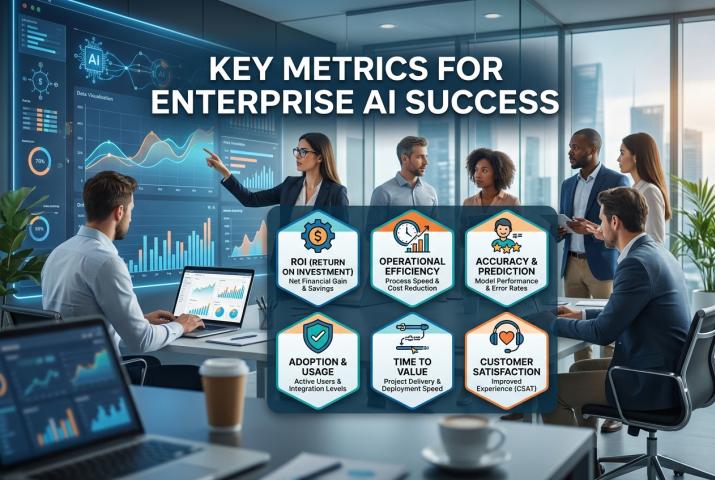
Important performance indicators include:
Processing time: How long does it take to complete the automated activity?
Extraction accuracy: How accurately does the system identify required information?
Classification quality: How reliably does AI categorize incoming requests?
Human review rate: How often must employees correct or approve AI outputs?
Exception rate: How frequently does the workflow require additional intervention?
Cost per transaction: What does it cost to process each business activity?
Workflow completion: How many processes finish successfully?
Employee capacity: How much time is released from repetitive activities?
Customer experience: Does the solution improve response quality or service consistency?
For example, a company introducing AI-powered invoice processing can compare document extraction accuracy, manual correction rates, average processing time, and total operating costs.
A complete ROI calculation should include model usage, software subscriptions, infrastructure, integration development, security controls, employee training, and ongoing monitoring.
10. Common Mistakes to Avoid When Adopting AI Automation
AI projects can become expensive or difficult to maintain when organizations introduce technology without considering the underlying business process.
Using AI Where Simple Automation Is Enough
Not every task requires a language model or machine learning system.
If a workflow follows clear conditions, conventional automation may be more predictable, affordable, and easier to maintain.
Ignoring Data Quality
Poorly maintained records and inconsistent documents can reduce the reliability of AI outputs.
Data preparation should be part of the implementation plan.
Expecting Fully Autonomous Operations
AI systems can make mistakes and may not understand every business exception.
Organizations should define appropriate human intervention and restrict high-impact actions.
Skipping Real-World Testing
A solution that performs well with a few demonstration examples may behave differently with actual business data.
Testing should cover normal cases, unusual inputs, incomplete information, and failure scenarios.
Failing to Monitor Performance
AI quality and business requirements can change over time.
Regular evaluation helps identify declining accuracy, unexpected costs, and workflow problems before they affect larger operations.
Frequently Asked Questions
1. What is AI-powered process automation?
AI-powered process automation combines artificial intelligence with business workflows and software integrations to help interpret information, classify requests, extract data, identify patterns, and support operational activities.
2. How is AI-powered automation different from traditional automation?
Traditional automation primarily follows predefined rules and instructions. AI-powered automation can also interpret unstructured information, recognize patterns, generate summaries, and recommend actions. Both approaches can work together in one business process.
3. Which business processes can use AI automation?
Common applications include invoice processing, customer support classification, employee document management, lead qualification assistance, contract information extraction, demand forecasting, and internal knowledge retrieval.
4. Can AI-powered automation integrate with existing business software?
Yes. AI services can connect with CRM, ERP, HR, accounting, and other enterprise applications through APIs, middleware, and workflow orchestration platforms. Integration requirements depend on the systems involved.
5. Does AI-powered process automation eliminate the need for employees?
No. It can reduce repetitive work and support information-heavy activities, but employees remain important for judgment, approvals, exception handling, customer relationships, and accountability.
6. How can businesses ensure AI automation is reliable?
Businesses should use relevant data, validate outputs, test realistic scenarios, define access permissions, monitor performance, and maintain human review for important decisions.
7. Is AI-powered process automation suitable for small and medium-sized businesses?
Yes. Small and medium-sized businesses can begin with focused use cases such as document extraction, customer inquiry classification, internal knowledge assistance, and invoice processing before expanding into more complex workflows.
Conclusion
AI-powered process automation is changing how businesses manage information, coordinate workflows, and support everyday operational decisions. By combining artificial intelligence with conventional automation, organizations can address activities that previously required substantial manual interpretation and coordination.
However, successful adoption depends on selecting appropriate use cases, preparing reliable data, integrating systems securely, and establishing clear governance. AI should strengthen business processes rather than introduce unnecessary complexity or remove essential accountability.
Organizations that combine intelligent capabilities with dependable workflows and human oversight can build more adaptable operations while helping employees focus on work that requires experience, judgment, and meaningful business understanding.