- Fiberglass acoustic panels have quietly become one of the most specified materials in contemporary interiors. In 2026, they are not just performing. They are leading.
There is a telling moment that happens in the best design studios. Someone pins a render to the wall, steps back, and the room goes quiet. Not because the design is unremarkable, but because it is undeniably right. Increasingly, in 2026, those renders feature fiberglass acoustic panels as a central visual and functional element. Not tucked behind furniture. Not apologetically placed in a corner. Front and centre, commanding attention, doing the quiet work of making a space feel as composed as it looks.
This is not an accident. It is the product of years of material refinement, a growing body of evidence linking acoustic comfort to human performance and wellbeing, and a design industry that has finally stopped treating sound as someone else's problem.
The fiberglass acoustic panel has arrived at a particular convergence point: it performs better than almost anything else on the market, it takes finishes and forms that designers actually want to work with, and it answers a need that clients now actively articulate. That combination does not come along often. When it does, the best designers pay attention.
Why Fiberglass became the Material Designers Trust
Before exploring where the fiberglass acoustic panel is showing up in 2026's most significant interiors, it is worth understanding why fiberglass specifically has earned its position at the top of the specification list.
Fiberglass as an acoustic panel material works because of what it is at a structural level. The material is composed of fine glass fibres that trap air within a dense, semi-rigid matrix. When sound waves enter this matrix, the friction between the wave energy and the fibres converts that energy into negligible amounts of heat.
What does not reflect back into the room is, in acoustic terms, absorbed. Fiberglass panels, depending on their density and thickness, achieve Noise Reduction Coefficients that consistently outperform foam, fabric alone, and many natural fibre alternatives, particularly in the critical mid-frequency range where human speech sits.
The practical advantages that designers cite most frequently include:
- Dimensional stability: Fiberglass panels hold their shape across temperature and humidity variations, making them suitable for a far wider range of environments than organic or natural materials.
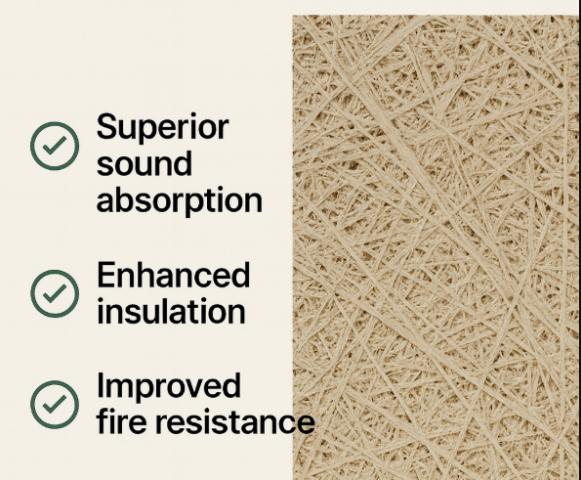
- Fire resistance: Most fiberglass acoustic panels meet Class A fire rating standards without additional treatment, a critical requirement in commercial, hospitality, and healthcare specifications.
- Finish versatility: The panel core accepts fabric wrapping, spray finishes, perforated facings, and decorative overlays, giving designers almost unlimited aesthetic latitude from a single base material.
- Longevity: Properly installed fiberglass panels do not sag, compress, or degrade in acoustic performance over time, the way softer materials can.
- Sustainability gains: The industry has made significant advances in the recycled glass content of fiberglass panels, with leading manufacturers now achieving cores composed of 50 percent or more recycled material.
These are not marginal differences. They are the reasons a material that has been a technical staple for decades is now being embraced as a design material of choice.
Trend 1
The Wrapped Wall as an Architectural Feature
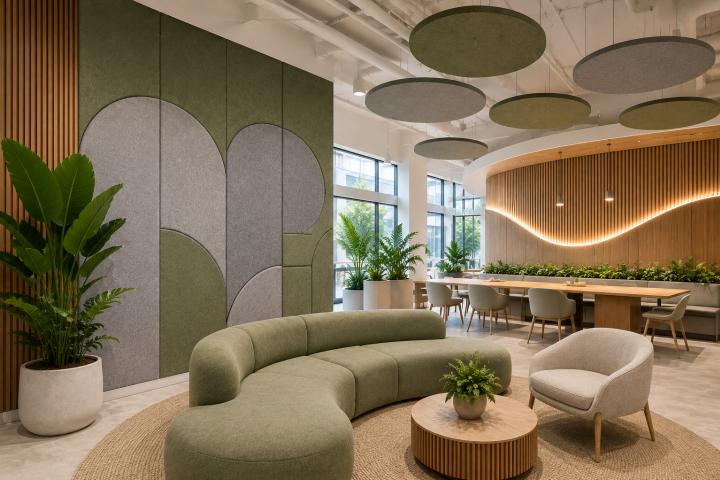
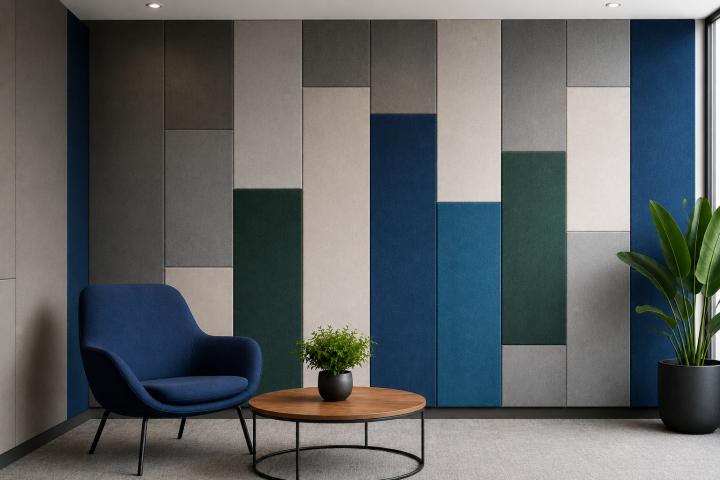
The single most dominant trend featuring fiberglass acoustic panels in 2026 is what designers are calling the wrapped wall: an entire wall surface, or a significant portion of it, treated as a unified acoustic and visual element. Where previous generations of acoustic treatment sought to be invisible, the wrapped wall is intentionally the room's focal point.
The execution varies enormously, but the logic is consistent. A fiberglass panel core, typically 50mm to 75mm thick for optimal broadband absorption, is wrapped in a fabric selected not just for acoustic transparency but for its role in the room's complete material story. Bouclé weaves. Textured linens. Velvet in deep, considered tones. The result is a surface that is simultaneously a high-performance acoustic treatment and a piece of applied textile craft.
What makes this trend particularly significant in 2026 is how it is being deployed across sectors that previously would never have considered it:
- High-end residential living rooms where the acoustic panel wall replaces the gallery wall as the dominant feature.
- Boutique hotel lobbies use full-height wrapped fiberglass panels to create an immediate sensory contrast with the street noise outside.
- Private dining rooms in which wrapped panel walls create the intimate acoustic envelope that fine dining demands.
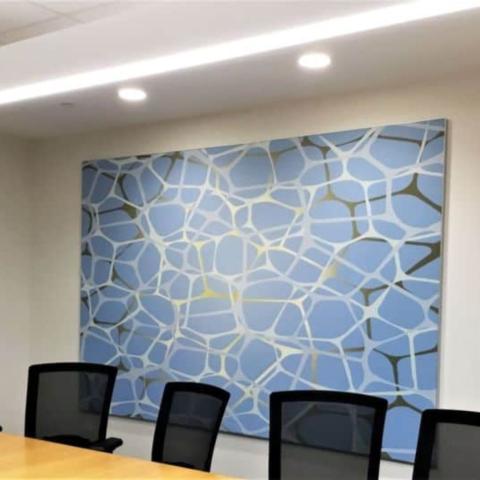
- Executive boardrooms where the wrapped wall signals both aesthetic authority and a commitment to acoustic privacy.
- The wrapped wall has become a shorthand for a certain kind of considered luxury. Clients who specify it understand that it communicates something about how seriously they take the experience of their space.
Trend 2
Geometric Relief and Three-dimensional Panel Systems
Flat panel installation is no longer the default. In 2026, some of the most visually arresting applications of the fiberglass acoustic panel involve three-dimensional configurations that turn the wall into a study in light, shadow, and form.
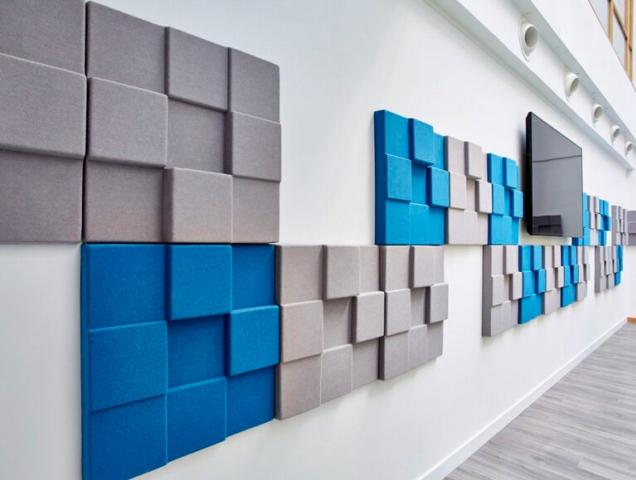
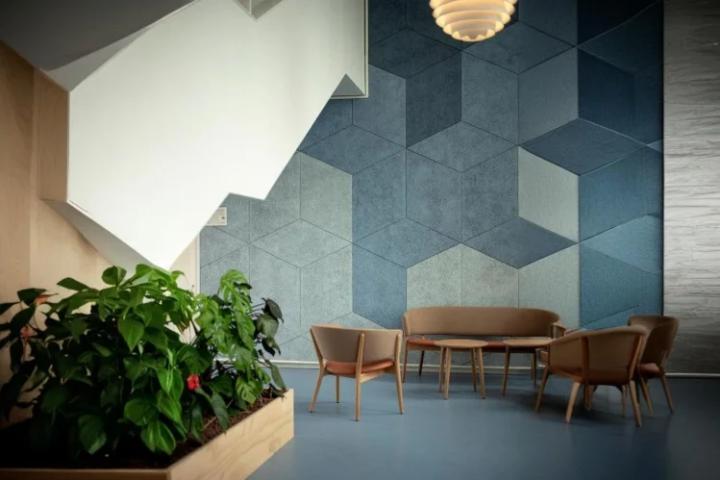
Modular geometric systems, where individual fiberglass panels are shaped, angled, or arranged in repeating patterns that create depth across a surface, are appearing with increasing frequency in commercial interiors. The acoustic logic is sound: a relief surface increases the effective absorption area per square metre, scatters sound more evenly across the room, and reduces the risk of acoustic flutter between parallel flat surfaces. The design logic is equally compelling. A wall that changes appearance as the ambient light shifts throughout the day is a wall that keeps revealing itself.
The geometric directions gathering the most momentum include:
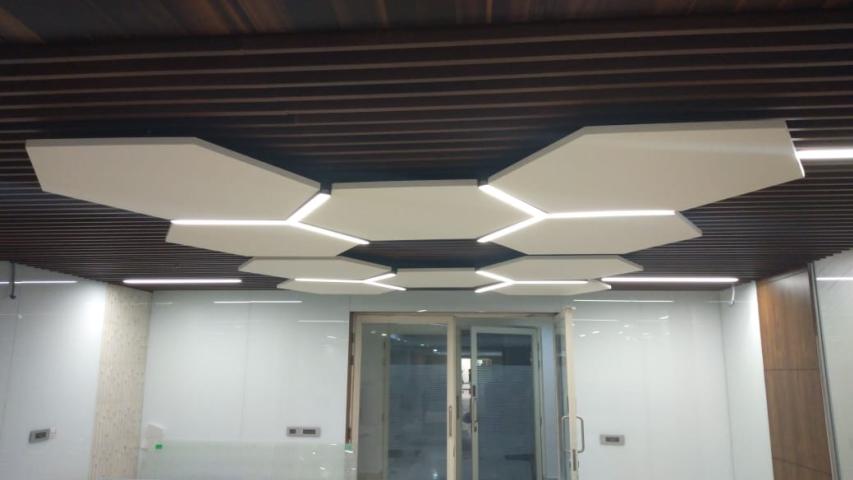
- Faceted hexagonal systems: Individual hexagonal fiberglass panels installed at varying depths to create a honeycomb relief that reads as both geometric and organic.
- Diagonal blade configurations: Fiberglass panels cut into elongated parallelogram forms and mounted on angled supports, creating a surface that looks entirely different depending on where in the room you are standing.
- Stepped and layered grids: Rectangular panels of varying projection depths installed in grid patterns that introduce a pixel-like dimensionality to large wall surfaces.
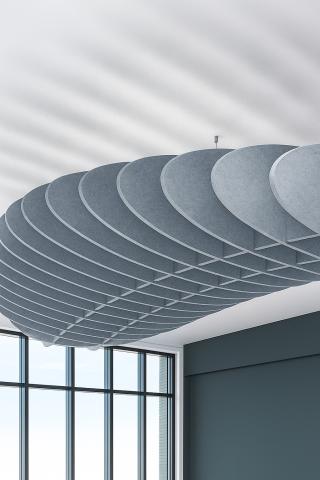
- Curved and arched panels: Fiberglass, unlike many acoustic materials, can be formed over curved substrates, enabling panel installations that follow the architectural geometry of a room rather than imposing a flat plane upon it.
The best of these installations is designed in close collaboration between acoustic consultants and interior designers, with the three-dimensional form serving both the aesthetic intent and the acoustic brief simultaneously.
Trend 3
Colour as Acoustic Strategy
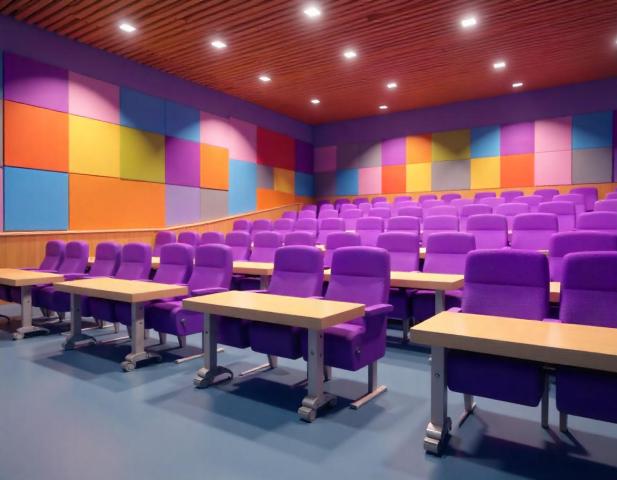
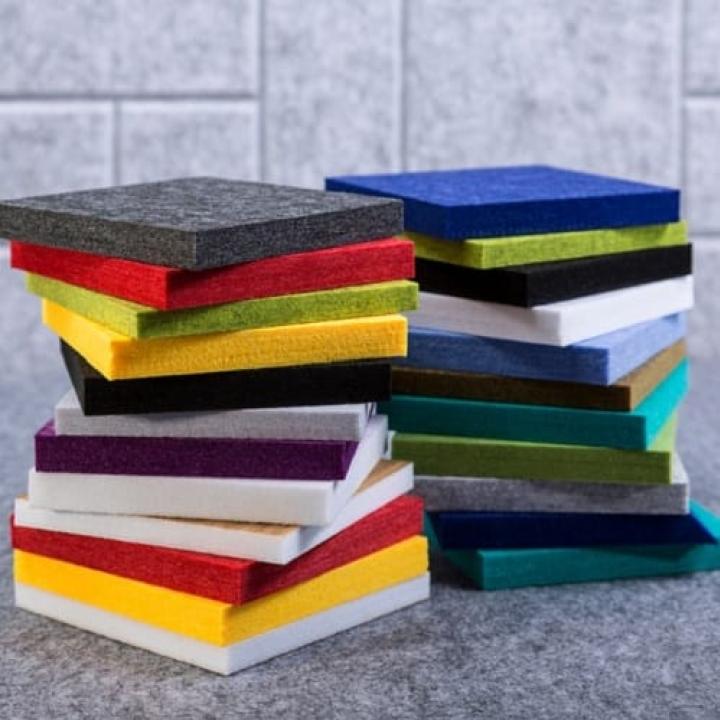
For most of the acoustic panel history, colour was an afterthought. Beige. Off-white. The occasional corporate grey. In 2026, colour is a primary design driver in fiberglass acoustic panel specification, and the results are transforming how entire rooms feel.
The shift has been enabled partly by fabric manufacturers developing acoustic-transparent textiles in ever-wider colour and texture ranges, and partly by a design culture that has grown deeply comfortable with bold, considered colour in interior spaces. Deep terracotta fiberglass panels anchoring a living room.
Forest green panels lining a podcast studio. A monochromatic tonal installation where six slightly different shades of the same colour create a surface of extraordinary depth and subtlety.
The colour trends most actively driving fiberglass panel specifications in 2026 include:
- Deep, saturated earth tones: Ochre, clay, burnt sienna, and warm charcoal reflecting a broader return to grounded, natural-adjacent palettes.
- Tonal monochromes: Single-colour rooms where the fiberglass panel wall is a darker or lighter expression of the room's dominant hue, creating depth without contrast.
- Unexpected darks: Near-black panel walls in spaces where the design brief calls for drama, intimacy, or sensory intensity.
- Soft, chalky pastels: In healthcare, children's environments, and wellness spaces, dusty sage, muted blush, and pale clay fiberglass panels create acoustic comfort without clinical coldness.
The critical technical point that makes this possible is the acoustic transparency of the fabric: the colour and texture of the facing material are entirely a design decision, as long as the weave allows sound to pass through to the fiberglass core.
Designers are learning, through experience and through suppliers like Tranquil Global, exactly where that boundary sits and how much creative latitude it genuinely allows.
Trend 4
Acoustic Panels in Unexpected Residential Spaces
Commercial interiors were always the early adopters of fiberglass acoustic treatment. What is genuinely new in 2026 is the pace at which residential designers are bringing the fiberglass acoustic panel into spaces within the home that were never previously considered candidates for acoustic treatment.
The drivers are partly cultural. More people work from home than at any previous point. More homes contain dedicated media rooms, home studios, and spaces for online content creation. And a generation of homeowners who grew up in beautifully designed but acoustically hostile rental flats are, now that they own their spaces, making very deliberate choices about how those spaces sound.
The residential spaces seeing the fastest growth in fiberglass acoustic panel specification include:
- Home offices and study rooms: Where acoustic panels reduce the reverberant echo that makes extended video calls fatiguing and voice recordings unusable.
- Primary bedrooms: Particularly in urban environments, where fiberglass panels on the wall behind the bed reduce both internal reverberation and the perception of external noise.
- Children's playrooms and nurseries: Where acoustic treatment reduces the stress on parents and the overstimulation that hard, reflective surfaces create for young children.
- Home cinemas and listening rooms: Where fiberglass panels work in concert with bass traps and diffusers to create a controlled acoustic environment genuinely competitive with professional installations.
- Open-plan kitchen and living areas: The hardest acoustic environment in any home, and increasingly one where homeowners are willing to invest in solutions that address the problem without compromising the design.
To know more about fiberglass acoustic panel, read this: Beyond Insulation: How Fiberglass Panels Boost Productivity & Comfort
Trend 5
The Sustainability Specification
No survey of 2026 design trends is complete without an honest account of where sustainability sits in the specification conversation. For fiberglass acoustic panels, the story is more positive than it was five years ago, and designers are noticing.
The advances worth understanding include:
Recycled glass content: Leading fiberglass panel manufacturers have significantly increased the proportion of post-consumer recycled glass in their products, reducing the embodied carbon of the material substantially.
Formaldehyde-free binder systems: The binder resins that hold fiberglass panels together have been reformulated by most major suppliers to eliminate or dramatically reduce formaldehyde, addressing a long-standing concern about indoor air quality in panel-dense environments.
Longevity as sustainability: A fiberglass acoustic panel correctly installed and maintained does not need replacing for decades. In lifecycle terms, a material that lasts 30 years has a very different environmental profile from one that degrades and requires replacement every five years.
Recyclability at end of life: Panel take-back and recycling programmes are emerging among specialist manufacturers, closing a loop that the industry had previously left open.
For designers working under LEED, BREEAM, WELL, or Green Star frameworks, these improvements translate into genuine points and credits. But beyond certification, they represent something more important: a material that designers can specify with confidence that it aligns with values their clients increasingly share.
Tranquil Global and the Future of Fiberglass Acoustic Design
At Tranquil Global, we have watched the fiberglass acoustic panel move from a specification tool used reluctantly to one specified with enthusiasm and pride. The projects we are involved in today treat acoustic quality as a founding principle of the design brief, not a late-stage consideration. That shift represents everything we believe good design should be about.
The trends outlined here are not predictions. They are observations from active projects, from conversations with designers and architects who are specifying fiberglass acoustic panels at the centre of their most ambitious work. The material has earned its moment. The question now is simply what designers will do with it.
If 2026 is any indication, the answer is: something remarkable.
FAQs
What thickness of fiberglass acoustic panel is best for most interior applications?
A 50mm panel offers excellent broadband absorption for most commercial and residential applications. For spaces with lower-frequency noise problems or very high reverberation requirements, 75mm to 100mm panels deliver significantly improved low-frequency performance.
Can fiberglass acoustic panels be installed in humid environments like bathrooms?
Yes, with the right facing material and edge treatment. Moisture-resistant fabric facings and sealed edges allow fiberglass panels to perform in areas with elevated humidity. Confirm humidity and moisture ratings with your supplier before specifying in wet zones.
How are fiberglass acoustic panels typically fixed to walls?
The most common methods include impaling clip systems, adhesive mounting, timber batten frameworks, and Z-clip systems that allow panels to be removed for access. The right method depends on the wall substrate, panel weight, and whether future access to the wall is required.
Are fiberglass acoustic panels safe for indoor air quality?
Modern fiberglass acoustic panels manufactured to current standards use low-VOC, formaldehyde-free binder systems and are safe for occupied indoor environments. Look for products with third-party indoor air quality certifications when specifying for schools, healthcare, and residential projects.
What is the lifespan of a professionally installed fiberglass acoustic panel?
A correctly installed fiberglass acoustic panel in a typical commercial or residential environment will maintain its acoustic performance and structural integrity for 20 to 30 years or more, making it one of the most cost-effective long-term acoustic investments available.
Transform Your Space with the Panel that Professionals Trust Most
At Tranquil Global, our fiberglass acoustic panels are engineered for spaces where performance and design cannot be separated. Whether you are specifying for a commercial fit-out, a hospitality project, or a considered residential renovation, we have the materials, the expertise, and the design range to help you get it right.