Startup articles: launches, insights, stories

What Is a Combiner Box and Why Solar Arrays Need One

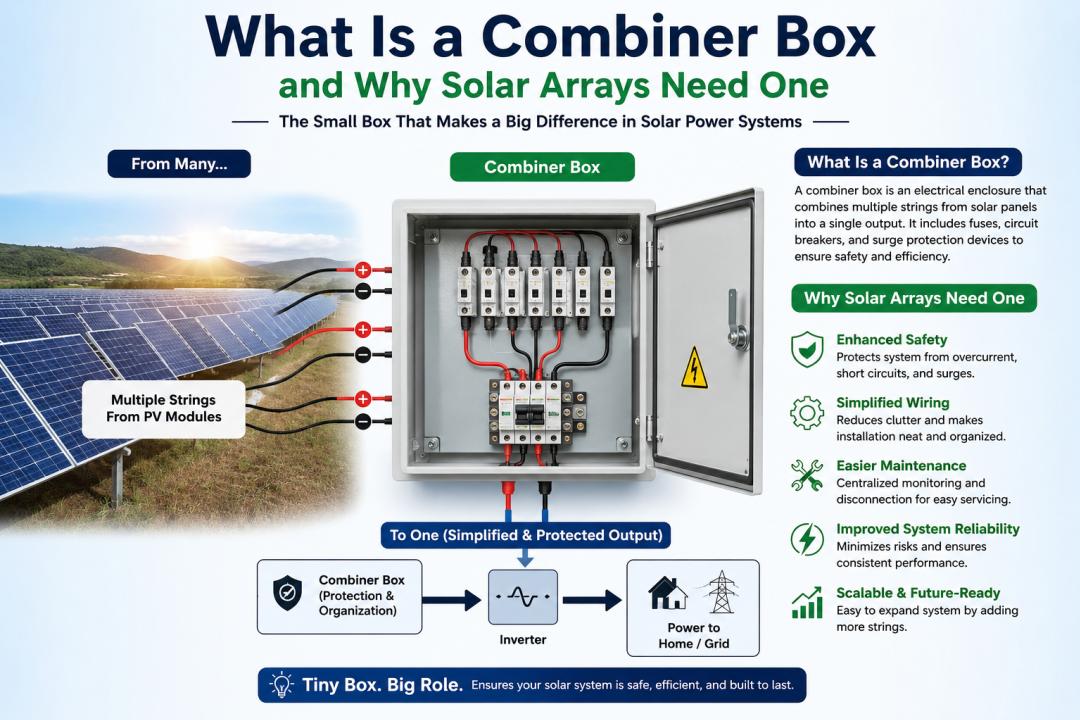
Every solar array with more than a couple of strings eventually needs a way to bring all those individual DC circuits together safely before they reach the inverter. That's the job of a combiner box — a component that rarely gets discussed with buyers but plays a central role in how safely and reliably a system operates.

What a Combiner Box Actually Does

A combiner box takes the DC output from multiple solar strings and merges them into a single output circuit that feeds the inverter. But "combining wires" undersells what it actually provides. A properly specified combiner box performs several distinct functions at once: aggregating string current, protecting against overcurrent faults, absorbing transient voltage surges, providing a safe isolation point for maintenance, and — on more advanced units — monitoring the performance of each individual string in real time.

That last function matters more than it sounds. Without string-level monitoring, a single underperforming string — caused by a failed panel, localized shading, dirt buildup, or a loose connection — can be difficult to isolate without manually testing each string one at a time. With a monitored combiner box, that same fault shows up immediately as a flagged string, letting a technician go straight to the problem instead of troubleshooting the entire array.

The Core Components Inside

Regardless of manufacturer, most combiner boxes are built around the same core set of components:

  • Input terminals — where the positive and negative conductors from each string connect into the box.
  • Fuses or DC circuit breakers — the primary overcurrent protection, isolating a faulty string before it can damage the rest of the system.
  • A surge protection device (SPD) — protects the array and inverter from voltage spikes, most commonly caused by nearby lightning activity.
  • A DC isolator switch — allows the entire combiner box, or individual strings, to be safely disconnected for maintenance without shutting down the whole system.
  • A busbar and ground connection — aggregates the protected string outputs into a single circuit and ties the enclosure into the system's grounding.
  • A weatherproof enclosure — since combiner boxes are almost always installed outdoors and need to withstand sun, moisture, dust, and temperature swings without compromising the components inside.

    Combiner Box vs Junction Box: Not the Same Thing

    These two terms get used interchangeably in casual conversation, but they refer to genuinely different components. A junction box is a simple pass-through enclosure — commonly the small box already integrated into the back of a solar panel — with no active protection built in. A combiner box is a much larger, separately installed component containing active protection devices: fuses, surge protection, and an isolator switch. When someone in the industry refers to a "combiner box," they mean this larger, actively protective component — not the panel's built-in junction box.

    Does Every System Need One?

    Not necessarily. For small residential systems with only two or three strings, many inverters can accept the strings directly at their input terminals, making a separate external combiner box unnecessary. Some modern inverter designs — particularly certain string inverters with built-in multiple MPPT inputs — effectively integrate combiner functionality internally, removing the need for a standalone box entirely.

    Where a combiner box becomes genuinely necessary is in larger systems: commercial rooftops, industrial installations, and utility-scale arrays with four or more strings. At that scale, the benefits — centralized protection, safe isolation points, and consolidated monitoring — outweigh the added cost and complexity of an external box.

    Why This Matters for System Reliability

    A combiner box that's properly specified and correctly wired does more than tidy up an installation. It's a genuine safety and reliability component: it isolates faults before they cascade into bigger problems, it gives maintenance staff a clear, safe disconnection point instead of having to work on a live array, and — where monitoring is included — it turns troubleshooting from a manual, time-consuming process into something that can be diagnosed remotely or at a glance.

    Skipping or under-specifying this component on a system large enough to need it is a common mistake — and one that tends to surface later as harder-to-diagnose faults, rather than as an obvious problem at commissioning.

    The Practical Takeaway

    A combiner box isn't just a wiring convenience — it's a protection, isolation, and monitoring layer that becomes essential once a solar array grows past a handful of strings. Understanding what it does, and what components it should contain, helps buyers and installers make sure a system's safety and reliability infrastructure is genuinely matched to its scale, rather than treated as an afterthought.

    Written by electricbuytrd 1 day ago

    Related articles:

    Solar Energy: Why It Matters Today and Why Awareness Is Essential

    Solar energy has moved from being an alternative option to becoming one of the most important energy solutions of our time. With power consumption increasing, electricity rates rising, and environmental..

    10 Interesting Facts and Powerful Reasons to Switch to Solar Energy in 2026

    If 2024 and 2025 were the years of solar awareness, then 2026 is shaping up to be the year of solar action. Across Kerala and the world, more homeowners, businesses,..

    10 AWG Solar PV Multi Conductor Tray Cable: What It Is

    The designator “10 AWG solar PV multi conductor tray cable” is a mouthful no matter how you slice it, and the slice is going to be big. But what does..

    Understanding Solar Panel Degradation Rates Over Time

    Every solar panel loses a small amount of output capacity every year it operates — this isn't a defect, it's a normal, well-documented characteristic of how photovoltaic cells age. The..

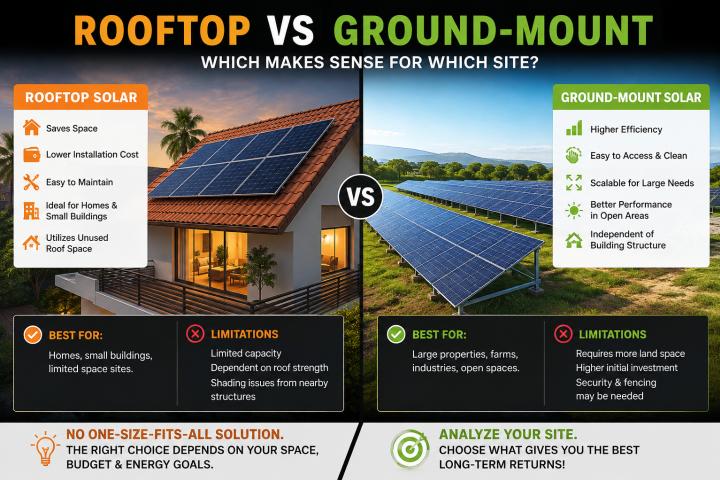
    "Rooftop vs Ground-Mount Solar: Which Makes Sense for Which Site" — practical comparison, no standards citation needed.

    When a client or dealer asks whether a project should go on the roof or on the ground, the honest answer is: it depends on the site, not on which..

    Choosing the Right EPC Partner for Large Infrastructure Projects

    Large infrastructure projects are the foundation of economic growth, industrial expansion, and sustainable development. Whether developing utility-scale solar parks, transmission networks, substations, manufacturing facilities, or power distribution systems, successful project..

    Solar Earthing Failures Nobody Talks About

    Solar installers spend most of their attention on panel efficiency, inverter brands, and mounting angles. Earthing rarely makes it into the conversation — until something fails. And when it does..

    How Snow Load Affects Rooftop Solar Mounting Design

    If you've ever watched snow pile up on a roof and wondered whether the solar array underneath could actually hold that weight, you're asking the right question. Every winter, installers..

    How Wind Can Lift and Damage Panels Without Proper Perimeter Skirting

    IntroductionA rooftop solar array that has survived two hurricane seasons without issue can still fail in a moderate 45 mph gust if the array's edges are left exposed. Most homeowners..

    "Rooftop vs Ground-Mount Solar: Which Makes Sense for Which Site" — practical comparison, no standards citation needed.

    When a client or dealer asks whether a project should go on the roof or on the ground, the honest answer is: it depends on the site, not on which..

    How San Francisco Tech Startups Build MVP Apps in 2026: A Step-by-Step Guide

    San Francisco has long been associated with startup experimentation, rapid product development, and technology-driven business models. In 2026, however, launching a digital product is no longer simply about getting an..

    Machine Learning in E Commerce: How Intelligent Retail is Transforming Online Shopping

    IntroductionThe ecommerce industry has entered an era where customer expectations are evolving faster than ever. Shoppers no longer want generic product catalogs or one-size-fits-all experiences. They expect online stores to..

    Top 5 SEO Companies to Help Grow Your Business

    Hiring the right SEO company can help your business appear in front of people who are already searching for your products or services. Whether you run a small local business,..

    The Role of Artificial Intelligence in Modern IoT Development

    The Internet of Things (IoT) has become one of the most transformative technologies of the digital age, connecting billions of devices across industries and enabling seamless data exchange. From smart..

    Why Google Rankings Change Frequently and What Businesses Should Understand About SEO

    Many businesses become frustrated when their website rankings suddenly increase, drop or fluctuate without warning. One month a website appears on the first page of Google and the next month..

    How a Custom ERP System Improves Operational Efficiency

    Running a growing business without the right systems in place can feel like trying to hold water in your hands — exhausting, wasteful, and never qui—exhausting,your teams are juggling disconnected..

    AI vs Traditional Marketing: What Works Better in 2026?

    Marketing has changed dramatically over the last decade. Businesses that once depended entirely on newspaper ads, television commercials, billboards, cold calls, and manual campaigns are now shifting toward AI-powered digital..

    Agentic RAG Implementation in Enterprise: The Next Big Shift in Enterprise AI

    Enterprise AI is evolving faster than ever before. A few years ago, businesses were excited about chatbots that could answer customer questions or automate basic workflows. Today, enterprises want something..