Software as a Service (SaaS) has transformed how businesses deliver technology. Instead of one-time purchases and complex installations, modern companies offer continuous value through cloud-based subscription platforms.
But building a successful SaaS product requires far more than launching an app. It demands strategic planning, scalable architecture, seamless user experience, and long-term operational thinking.
Below is a structured guide to what SaaS development really involves — and how to approach it strategically.
What Is SaaS Development?
SaaS development is the process of designing, building, deploying, and maintaining cloud-based software applications that are accessed via the internet.
Unlike traditional software, SaaS products must support:
Recurring subscription models
Continuous updates without downtime
Multi-tenant architecture
Real-time data access
High availability and scalability
SaaS is not just a technical solution — it’s a recurring revenue business model. Every architectural and product decision directly impacts customer retention and long-term profitability.
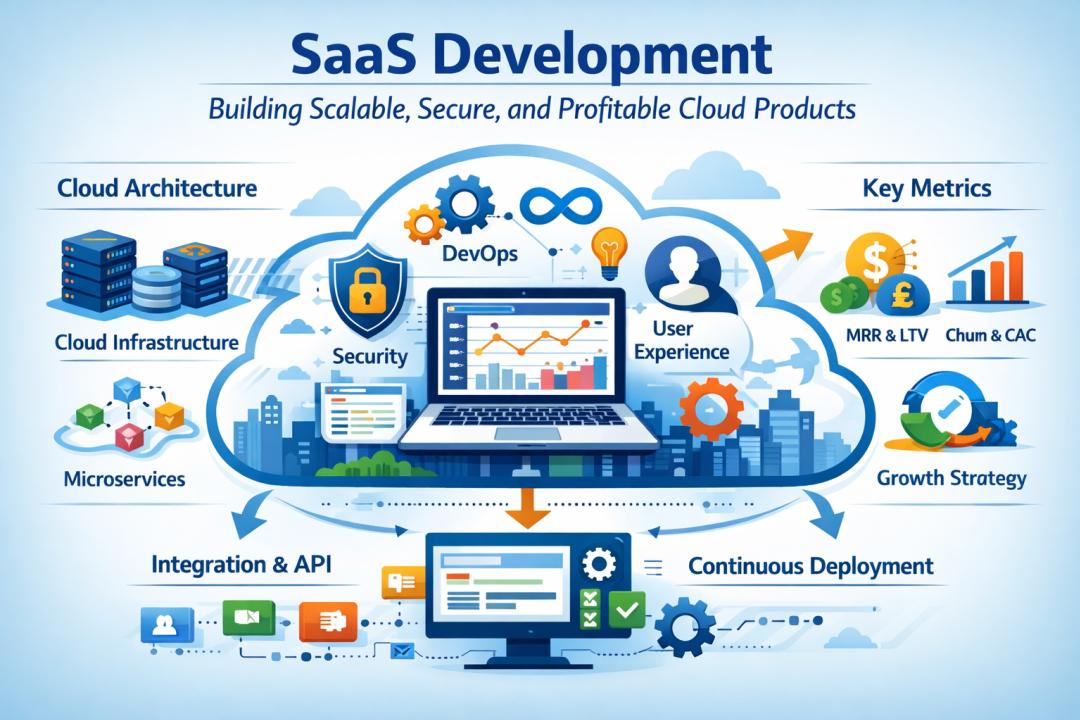
Core Architecture of a Scalable SaaS Platform
A strong technical foundation determines whether a product can scale smoothly or struggle under growth pressure.
Cloud Infrastructure
Most SaaS platforms rely on cloud providers such as AWS, Azure, or Google Cloud. Cloud infrastructure enables:
Elastic scaling
Global availability
Managed services
Cost optimization
Backend Design
An API-first approach ensures flexibility and integration readiness. Teams typically choose between:
A structured monolith for early-stage efficiency
Microservices architecture for larger, scaling systems
The right choice depends on product maturity and development resources.
Database & Performance Optimization
As user data grows, database performance becomes critical. Proper indexing, caching strategies, and load balancing help prevent slowdowns that can increase churn.
User Experience and Onboarding
Technology alone does not guarantee adoption. Many SaaS platforms fail because users never experience the core value.
Strong SaaS development integrates UX strategy from the beginning:
Intuitive onboarding flows
Guided product tours
Clear setup instructions
Frictionless registration process
Transparent pricing structure
The faster users reach their “aha” moment, the higher the activation and retention rates.
Security and Compliance in SaaS
Security is foundational in cloud software development. Since SaaS platforms manage user data, protecting that data is essential for trust and compliance.
Key security measures include:
Data encryption (in transit and at rest)
Multi-factor authentication
Role-based access control
Regular vulnerability testing
GDPR and regional compliance readiness
Security should be proactive, not reactive. Retrofitting protection later is costly and risky.
DevOps and Continuous Delivery
One of the defining features of SaaS products is continuous improvement.
Modern SaaS development relies on:
CI/CD pipelines
Automated testing
Staging environments
Infrastructure as code
Real-time monitoring
Frequent, stable releases reduce downtime and improve user satisfaction. Launching a SaaS product is not the end of development — it’s the beginning of an ongoing cycle of iteration.
Metrics-Driven Product Development
SaaS businesses operate on recurring revenue, which makes performance metrics central to product strategy.
Key SaaS metrics include:
Monthly Recurring Revenue (MRR)
Customer Acquisition Cost (CAC)
Lifetime Value (LTV)
Churn rate
Activation rate
Development priorities should align with these metrics.
For example:
If churn is rising, focus on usability improvements.
If activation is low, optimize onboarding.
If LTV is weak, enhance feature depth and integrations.
Feature development without data alignment leads to bloated roadmaps and inefficient resource allocation.
Integration and Ecosystem Strategy
Modern SaaS platforms rarely operate in isolation. They connect with:
Payment gateways
CRM systems
Marketing tools
Communication platforms
Analytics solutions
Strong API design and integration capabilities increase product stickiness and reduce customer churn. The more embedded your solution becomes in user workflows, the harder it is to replace.
In-House Development vs External Expertise
Founders often face a critical decision: build internally or collaborate externally.
Building in-house provides full control but requires significant hiring investment and operational overhead.
Partnering with experienced SaaS development companies can accelerate time-to-market and provide architectural expertise that early-stage teams may lack. The right partner helps define scalable architecture, anticipate growth bottlenecks, and align technical decisions with business strategy.
However, product vision and roadmap ownership should always remain with the core team.
Long-Term Sustainability and Technical Debt
SaaS success depends on long-term thinking.
Sustainable platforms prioritize:
Clean and maintainable code
Regular refactoring
Monitoring of technical debt
Infrastructure upgrades
Continuous user feedback integration
Short-term shortcuts often create long-term scaling problems. Investing in maintainability ensures smoother growth.
Conclusion
SaaS development blends engineering precision with business strategy. It requires scalable architecture, thoughtful UX design, robust security, and metrics-driven decision-making.
Successful SaaS platforms are not simply built — they are continuously evolved. Whether developed in-house or with external partners, the focus must remain on delivering consistent value, improving user experience, and building a resilient infrastructure for growth.
In today’s competitive market, SaaS success is defined not by launch speed alone, but by the ability to scale sustainably and retain customers over time.