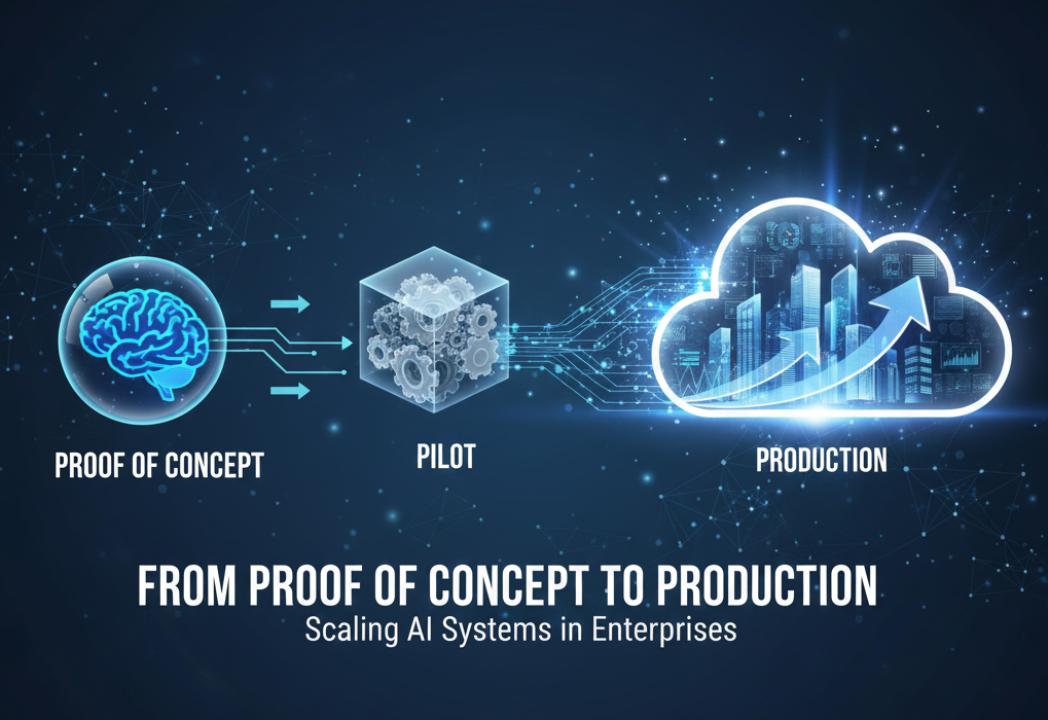
Across global enterprises and high-growth startups, artificial intelligence has moved from experimentation to expectation. Many organizations already have proof-of-concept models that validate feasibility and early business value. Yet only a fraction succeed in transforming those prototypes into production-grade AI systems that operate reliably, securely, and at scale.
The gap between proof of concept and enterprise deployment is where most AI initiatives slow down. Technical complexity, infrastructure limitations, governance concerns, and unclear ownership often delay progress. This is why structured AI Development Services are now a strategic requirement rather than a technical add-on.
This article explores how enterprises scale AI from pilot to production, what challenges emerge along the way, and how the right AI Development Company helps organizations reach sustained business impact.
Why Proof of Concept Success Does Not Guarantee Production Readiness
A proof of concept is designed to answer a simple question. Can this AI idea work under controlled conditions. It typically uses limited datasets, temporary infrastructure, and simplified workflows. That makes it ideal for validation but unsuitable for real operating environments.
Production systems introduce new realities:
- Large and continuously changing data volumes
- Integration with legacy platforms and enterprise software
- Real-time or near real-time decision requirements
- Strict security and compliance standards
- Performance and uptime expectations
Without addressing these factors early, AI projects often stall after pilot success. Industry studies report that more than half of enterprise AI initiatives never progress beyond experimental deployment due to scaling complexity and lack of operational planning.
Enterprises that succeed treat proof of concept as the starting checkpoint, not the finish line.
Establishing a Scalable AI Foundation
Scaling AI begins with strong architectural foundations. This foundation consists of three pillars.
1. Enterprise-Ready Data Architecture
AI systems rely on consistent, governed, and accessible data. Enterprises must build:
- Automated data ingestion pipelines
- Data validation and cleansing layers
- Secure storage environments
- Versioned datasets for model retraining
Without data governance, models drift and results lose reliability over time.
2. Flexible Infrastructure Planning
Production AI workloads require infrastructure that can scale computing resources based on demand. Many enterprises adopt hybrid or multi-cloud environments to balance performance, cost, and security. Infrastructure must support:
- Model training workloads
- Low-latency inference
- Monitoring services
- Backup and disaster recovery
3. Deployment and Lifecycle Pipelines
Continuous deployment pipelines ensure models move from development to production safely. This includes automated testing, rollback mechanisms, and version control for both models and data.
Full-Stack AI Development capabilities are critical here. They unify data engineering, model development, backend services, and user-facing systems into one coherent production ecosystem.
Transforming Prototype Models Into Enterprise Systems
Prototype models are often built by small research teams. Production systems require collaboration across engineering, operations, compliance, and business units.
This transition involves several steps.
- Model optimization
Models must be refined to reduce latency, improve inference efficiency, and manage compute costs. - Expanded training cycles
Production data often differs from pilot datasets. Retraining with real operational data improves accuracy and stability. - System integration
AI outputs must connect with ERP systems, CRM platforms, dashboards, and customer interfaces through APIs and workflow automation. - Security and compliance alignment
Enterprises must implement encryption, access controls, audit logging, and regulatory compliance frameworks.
These requirements make Custom AI Development Services essential. Each enterprise has unique infrastructure, risk policies, and technology stacks. Custom engineering ensures solutions fit existing environments rather than forcing costly internal restructuring.
Operationalizing AI Through Monitoring and Governance
Deploying an AI model is not the final step. Production AI systems require continuous oversight.
Monitoring frameworks track:
- Prediction accuracy
- Data drift
- Response latency
- System uptime
- Resource utilization
Automated alerts notify teams before issues impact operations. Periodic retraining ensures models remain aligned with evolving data patterns.
Governance frameworks add transparency and accountability. They define who owns model performance, who approves updates, and how decisions are audited. This is especially important in regulated industries.
Enterprise surveys show that organizations investing in AI governance and monitoring are significantly more likely to sustain measurable returns from AI initiatives.
Aligning AI Scaling With Business Outcomes
Scaling AI without business alignment leads to wasted investment. Enterprise decision-makers focus on outcomes, not experiments.
Successful organizations define measurable goals such as:
- Reduced operational costs
- Increased customer retention
- Faster decision cycles
- Improved risk management
- Higher revenue per customer segment
AI Development Services focused on ROI ensure every technical milestone connects to business value. Performance dashboards link model outputs directly to key performance indicators. This makes progress visible to executives and strengthens long-term program sponsorship.
Managing Organizational Change and Adoption
AI scaling is not only a technology initiative. It is a shift in how teams work and make decisions.
Enterprises that scale successfully invest in:
- Cross-functional collaboration between data, IT, and business teams
- Training programs for non-technical stakeholders
- Clear communication of AI system capabilities and limitations
- Human oversight processes for critical decisions
This approach builds trust in AI systems and accelerates adoption across departments. A capable AI Development Company often supports this transformation through roadmap planning, team enablement, and governance advisory.
Choosing the Right AI Development Partner
Selecting an external partner is a strategic decision for enterprise leaders.
A strong partner provides:
- End-to-end Full-Stack AI Development expertise
- Experience with enterprise security and compliance
- Scalable infrastructure design capabilities
- Custom AI Development Services tailored to existing systems
- Long-term support and optimization planning
This helps ensure alignment between technical execution and enterprise-scale requirements.
The Enterprise Path From Experimentation to Impact
AI adoption across industries will continue to accelerate. Yet the organizations that achieve lasting advantage will be those that master scaling, not just experimentation.
Building strong data foundations, deploying resilient infrastructure, integrating AI into business systems, and maintaining continuous oversight separates short-term pilots from long-term transformation.
With the right AI Development Services and a trusted AI Development Company, enterprises can move confidently from proof of concept to production. The result is not just functional AI systems, but measurable gains in efficiency, intelligence, and competitive position.
The journey requires investment and planning. The payoff is sustained enterprise readiness for a data-driven future.