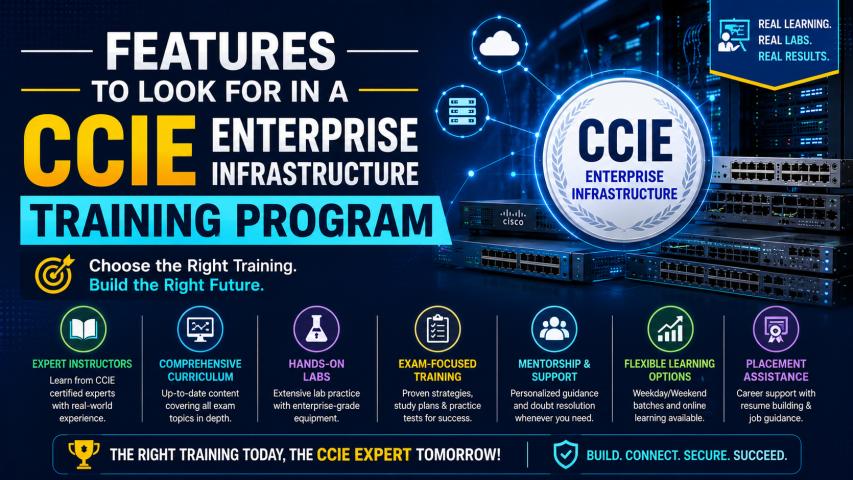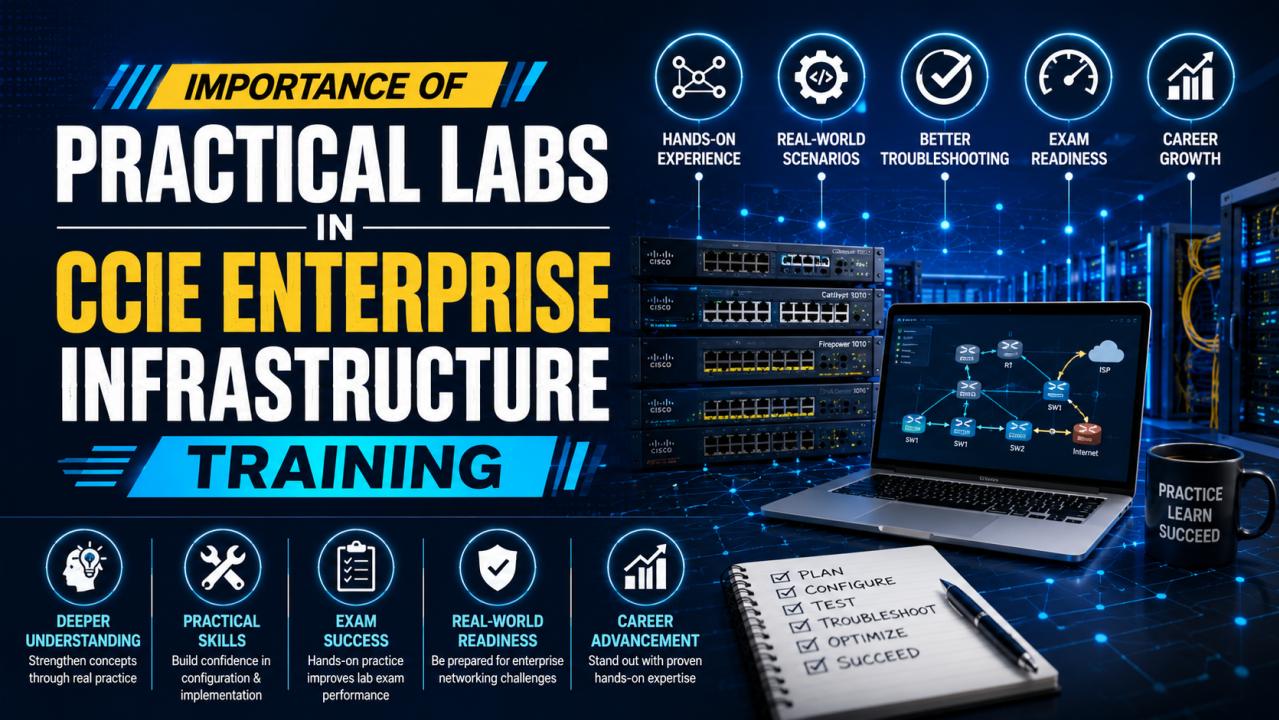
The networking industry is evolving rapidly, with organizations seeking professionals who can deploy, manage, and troubleshoot complex enterprise networks efficiently. Achieving the CCIE Enterprise Infrastructure certification is one of the best ways to validate expert-level networking skills and demonstrate the ability to solve real-world infrastructure challenges. While theoretical knowledge forms the foundation of learning, practical lab experience is what truly prepares candidates for success in both the certification exam and professional environments.
Why Practical Labs Are Essential in CCIE Enterprise Infrastructure Training
The CCIE Enterprise Infrastructure certification emphasizes practical problem-solving rather than memorizing concepts. Candidates are expected to configure, optimize, and troubleshoot enterprise network environments within a limited timeframe. Practical labs recreate these scenarios, allowing learners to develop the technical expertise required for real-world networking tasks.
Hands-on practice bridges the gap between theory and implementation, making it easier to understand how networking technologies interact in enterprise environments.
The Difference Between Theory and Practical Learning
Reading about routing protocols or automation concepts helps build foundational knowledge, but configuring them in a live environment develops confidence and technical accuracy.
Practical labs enable learners to:
Configure enterprise network devices
Validate network behavior
Identify and resolve configuration errors
Understand protocol interactions
Improve troubleshooting efficiency
These experiences are difficult to gain through textbooks or video tutorials alone.
Developing Real-World Networking Skills
Enterprise networks are dynamic environments where multiple technologies work together. Practical labs expose learners to scenarios similar to those encountered in production networks.
Skills Developed Through Hands-on Practice
Candidates gain experience in:
Enterprise routing
Layer 2 and Layer 3 switching
Wireless networking
SD-WAN implementation
SD-Access deployment
Network automation
High availability
Infrastructure security
Repeated practice strengthens both technical understanding and operational confidence.
Building Confidence for the Lab Exam
The CCIE Enterprise Infrastructure Lab Exam evaluates practical implementation skills under strict time constraints.
Simulating Exam Conditions
Practical labs allow candidates to:
Work within time limits
Prioritize configuration tasks
Verify network functionality
Correct configuration mistakes
Practice structured troubleshooting
Regular exposure to timed exercises helps reduce exam anxiety and improves overall performance.
Strengthening Troubleshooting Abilities
Troubleshooting is one of the most valuable skills tested during the certification process.
Why Troubleshooting Matters
Enterprise networks frequently experience issues related to configuration, connectivity, routing, switching, and automation. Employers expect engineers to identify and resolve these problems quickly.
Practical labs teach candidates how to:
Analyze network behavior
Interpret device logs
Verify protocol operation
Identify configuration mismatches
Restore normal network functionality
These skills remain valuable long after certification.
Mastering Enterprise Routing Technologies
Routing forms the backbone of enterprise communication.
Practical Routing Topics
Lab sessions typically include:
OSPF Configuration
Candidates practice:
Area design
Route summarization
Authentication
Neighbor troubleshooting
EIGRP Implementation
Students learn:
Route advertisement
Load balancing
Authentication
Route filtering
BGP Deployment
Hands-on exercises cover:
Path selection
Route policies
Prefix filtering
Peer establishment
Practical implementation helps learners understand how routing protocols operate under real-world conditions.
Final Thoughts
Practical labs are the foundation of successful CCIE Enterprise Infrastructure preparation because they transform theoretical concepts into real-world networking skills. Through consistent hands-on practice, candidates develop expertise in routing, switching, SD-WAN, SD-Access, automation, wireless networking, troubleshooting, and high availability while improving confidence and time management. Enterprise-grade lab environments also prepare learners to handle the complex challenges encountered in production networks and the certification exam. Choosing a training program that emphasizes extensive practical experience, expert guidance, and realistic lab scenarios can significantly improve both technical proficiency and career readiness. Investing in CCIE Enterprise Training provides aspiring network professionals with the practical knowledge and confidence needed to achieve certification success and excel in today's enterprise networking industry.