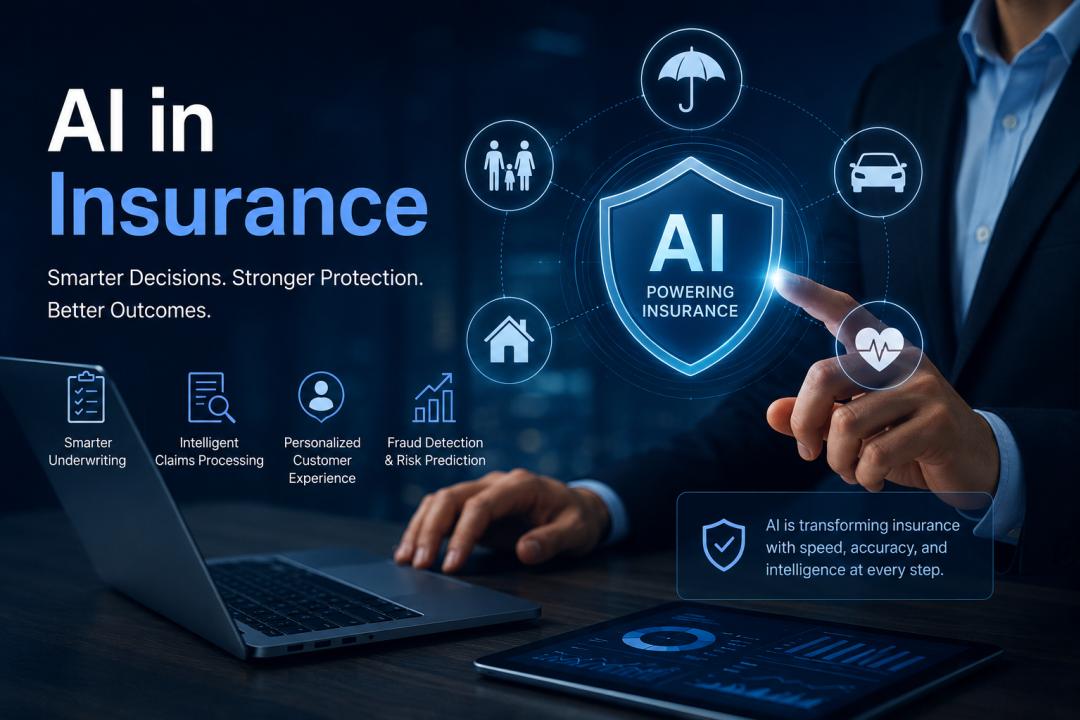
Property & Casualty
insurers have moved AI from the innovation lab into the core of the business.
Underwriting engines score risk in seconds, claims systems triage and settle
losses with minimal human touch, fraud models flag suspicious patterns before a
payout is issued, and catastrophe models reshape how carriers price and reserve
for climate risk. Generative AI now drafts policy summaries, powers customer
service assistants, and increasingly acts through AI agents that can take
multi-step actions across underwriting, claims, and policy administration
systems.
As AI becomes embedded in
decisions that affect coverage, pricing, and claims outcomes, model performance
alone is no longer the measure that matters. AI governance for Property &
Casualty insurers is becoming just as critical as accuracy or speed, because a
fast, confident AI decision that cannot be explained, audited, or trusted is a
liability rather than an asset.
Why AI Governance Is Becoming a Strategic Priority
For most carriers, AI has
quietly shifted from a handful of pilot projects to enterprise-wide deployment
across underwriting, claims, distribution, and customer service. That shift
changes the risk calculus entirely. A model that once supported a single analyst's
judgment now drives decisions at scale, across thousands of policies and
claims, often with limited human review of each individual outcome.
When AI systems influence who
gets coverage, what they pay, and how quickly a claim is settled, governance
becomes the mechanism that keeps those decisions transparent, fair, secure, and
accountable. Regulators, reinsurers, auditors, and policyholders are all asking
the same underlying question in different ways: can the insurer explain and
defend what its AI systems are doing? P&C insurance AI governance is how
that question gets answered before it becomes a complaint, a lawsuit, or a
regulatory inquiry.
Emerging AI Governance Challenges
As AI adoption deepens, so does
the range of things that can go wrong. Insurers evaluating their AI governance
in insurance posture are generally contending with:
•
AI hallucinations — a claims chatbot inventing coverage
terms that do not exist in the actual policy, or a generative summary
misrepresenting an exclusion
•
Model drift — an underwriting or pricing model that
performed well at launch gradually losing accuracy as claims patterns,
catastrophe exposure, or customer mix shift
•
Biased underwriting or pricing recommendations — models
that unintentionally proxy for protected characteristics through geography,
credit-based factors, or historical claims data
•
Sensitive customer data exposure — PII, medical
information tied to bodily injury claims, or financial details surfacing in AI
outputs, logs, or third-party tool calls
•
Prompt injection attacks — hidden instructions embedded
in emails, documents, or web content that hijack an AI agent handling first
notice of loss or claims correspondence
•
Third-party AI risk — underwriting, telematics, or
claims automation vendors whose models insurers rely on but cannot fully
inspect
•
Regulatory compliance complexity — the same AI system
often needs to satisfy a state DOI, the NAIC Model Bulletin, and international
frameworks like the EU AI Act simultaneously
Individually, each of these
risks is manageable. Left unmonitored across dozens of AI systems running in
production at once, they compound quickly — which is exactly why runtime AI
governance has become the focus of where the discipline is heading.
The Future of AI Governance
Traditional model risk
management was built around periodic reviews: validate a model before launch,
then revisit it on an annual or semi-annual cycle. That cadence made sense when
models changed slowly and operated within narrow, well-defined tasks. It does
not hold up against generative AI and AI agents that interact with live data,
call tools, and can behave differently from one session to the next.
The direction P&C insurers
are moving toward instead includes:
Runtime AI Monitoring and Continuous AI Assurance
Rather than validating a model
once before deployment, insurers are shifting to continuous observation of AI
behavior in production — catching drift, degraded accuracy, or unusual outputs
as they happen, not months later during a scheduled review.
AI Agent Governance
As agents take on tasks like
first notice of loss intake, claims triage, or policy servicing, governance has
to extend beyond a single model's output to the full chain of actions an agent
takes — what data it touched, what tools it called, and whether those actions
stayed within policy.
Human-in-the-Loop Oversight and Explainability
High-impact decisions —
coverage denials, large claims settlements, non-renewals — are increasingly
expected to keep a human reviewer in the loop, supported by AI-generated
explanations that a claims examiner, underwriter, or regulator can actually
understand.
Automated Policy Enforcement and Real-Time Compliance Monitoring
Instead of relying on manual
checklists, insurers are automating policy enforcement directly at the point
where AI systems act — blocking unauthorized data exposure or off-script advice
before it reaches a customer, and generating compliance evidence continuously
rather than reconstructing it after the fact.
Preparing for New Regulatory Expectations
Insurers are also operating
against a regulatory backdrop that is converging on the same core expectations,
even where the specific rules differ by jurisdiction. The EU AI Act classifies
AI used in insurance underwriting and claims handling as high-risk, requiring
conformity assessments, risk classification evidence, and transparency
documentation. The NIST AI Risk Management Framework (AI RMF) provides a
voluntary but increasingly referenced structure for governing, mapping,
measuring, and managing AI risk across a system's lifecycle. ISO/IEC 42001
offers a certifiable AI management system standard that auditors and boards are
starting to ask about directly.
In the US, the NAIC Model
Bulletin on the Use of Artificial Intelligence Systems has become the reference
point for state insurance regulators evaluating how carriers govern AI in
underwriting and claims. What unites all of these frameworks is a shift away
from one-time documentation toward continuous monitoring, ongoing
accountability, and evidence that governance is actually operating — not just
written down.
Best Practices for P&C Insurers
Insurers building or maturing
an AI governance program should:
•
Maintain a current inventory of every AI system in use,
including third-party and embedded vendor models
•
Continuously monitor AI behavior in production rather
than relying solely on pre-launch testing
•
Protect sensitive customer data across every AI system
that touches policy, claims, or medical information
•
Keep humans involved in high-impact underwriting,
pricing, and claims decisions
•
Perform regular AI risk assessments, including fairness
and disparate-impact testing
•
Document governance decisions in a form that holds up
to a regulator, auditor, or reinsurer
•
Test AI systems both before and after deployment,
including adversarial and red-team testing
How Trusys.ai Helps
Insurers building this kind of
continuous governance program don't have to assemble it from disconnected
tools. Trusys is an AI assurance platform
purpose-built for this shift, giving underwriting, claims, and compliance teams
a single layer to monitor AI systems in real time, detect hallucinations and
model drift before they reach a customer, and enforce governance policy inline
rather than after the fact. Its Argus governance layer generates audit-ready
evidence automatically, mapped to frameworks including the EU AI Act, NIST AI
RMF, ISO/IEC 42001, and the NAIC Model Bulletin — so compliance documentation
reflects what AI systems actually did, not a reconstruction after the fact.
Conclusion
AI will keep transforming how
Property & Casualty insurers underwrite risk, price policies, and settle
claims. The carriers that get the most lasting value from it will be the ones
that treat governance as core infrastructure, not an afterthought bolted on
before an audit. Continuous monitoring, AI assurance, and responsible
governance practices — implemented now, while AI adoption is still accelerating
— put insurers in a stronger position to innovate safely, meet regulators where
they are heading, and earn the kind of policyholder trust that's hard to win
back once it's lost.
Curious how this looks for your
own AI systems? Book
a demo with Trusys to see continuous AI governance in action.
FAQ
What is AI governance for
Property & Casualty insurers?
It's the set of policies,
controls, and monitoring practices that keep AI systems used in underwriting,
claims, pricing, and customer service transparent, fair, secure, and compliant
with insurance regulation.
Why is runtime AI monitoring
replacing periodic model reviews?
Generative AI and AI agents
behave dynamically and can drift or fail between scheduled review cycles, so
insurers are shifting to continuous, real-time oversight instead of
point-in-time validation.
Which regulations most
affect AI governance in P&C insurance?
The EU AI Act, NIST AI RMF,
ISO/IEC 42001, and the NAIC Model Bulletin on AI Systems are the frameworks
P&C insurers most commonly need to align with today.