When students start looking for an engineering college, the first things they usually notice are the course names, admission details, fees, and location. Those details matter, but they do not tell the whole story. Four years of engineering education involves much more than attending classes and completing examinations. The way students learn, work on projects, use laboratories, interact with others, and explore their interests can make a noticeable difference to their college experience.
Understanding Engineering Education from a Different View
Engineering has changed considerably over the years. Alongside established disciplines such as Civil, Mechanical, Electrical and Electronics, and Electronics and Communication Engineering, students can now study areas connected with artificial intelligence, data science, machine learning, and VLSI.
This wider range gives students more possibilities, but it also makes the selection process slightly more complicated. A student interested in software development may look for a different academic environment from someone interested in construction, manufacturing, electronics, or electrical systems.
The course title is therefore only a starting point. Looking at the subjects, laboratory work, projects, technical activities, and opportunities available during the programme can provide a clearer picture.
A Mix of Established and Emerging Programmes
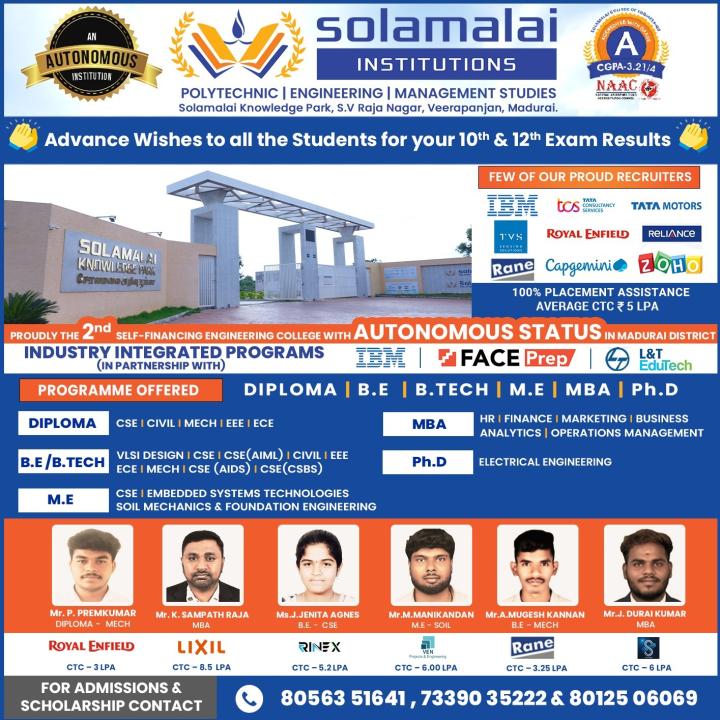
Solamalai College of Engineering in Madurai offers programmes covering several areas of engineering and technology. Its undergraduate courses include Computer Science and Engineering, Artificial Intelligence and Data Science, Artificial Intelligence and Machine Learning, Civil Engineering, Computer Science and Business Systems, Electrical and Electronics Engineering, Electronics and Communication Engineering, Mechanical Engineering, and VLSI Design. The institution also offers postgraduate programmes and an MBA.
The variety is useful because engineering students do not necessarily have the same interests. Someone fascinated by software and intelligent systems may be drawn towards AI and Data Science, while another student may prefer the physical and design-oriented aspects of Mechanical or Civil Engineering.
Computer Science and Business Systems is another example of how engineering education is expanding beyond a single technical discipline. The programme combines computer science subjects with areas such as management, analytics, machine learning, cloud computing, and IoT.
Technology Is Becoming Part of Everyday Learning
Students entering engineering are likely to encounter technologies that were not part of mainstream engineering education a decade ago. Artificial intelligence, cloud computing, robotics, data analytics, additive manufacturing, and automation are now appearing across different branches.
The important point is not simply having access to a technology. Students benefit when they have opportunities to understand how it works and where it can be applied.
At Solamalai College of Engineering, initiatives include an e-Yantra Robotics Lab supported by IIT Bombay and Centres of Excellence associated with areas such as Cloud Computing and Digital Manufacturing. The institution also records value-added programmes in areas including 3D printing, CNC programming, additive manufacturing, and smart manufacturing.
Such exposure can help students move from simply knowing about a technology to experimenting with it.
Projects Can Change the Way Students Learn
Project work is another useful part of an engineering programme. It requires students to deal with questions that do not always have an answer directly available in a textbook.
A project may begin with a simple problem. Students then have to understand the requirement, collect information, decide on an approach, divide responsibilities, test their work, identify mistakes, and explain the final outcome. Even when a project does not work as originally planned, the process itself can provide useful learning.
For this reason, students comparing engineering institutions can look at how much scope there is for project-based and experiential learning rather than concentrating only on examination-oriented education.
Industry Exposure Adds Context
There is a noticeable difference between knowing a concept and understanding how that concept is used in an organisation.
Industry visits, internships, guest sessions, collaborative programmes, and technical interactions can help students see this connection. They may also introduce students to workplace expectations, professional communication, teamwork, and the technologies used in particular sectors.
Solamalai College of Engineering states that it works with professional and industry-oriented bodies for value-added programmes and initiatives intended to connect academic learning with industry requirements.
For a student, these experiences can be useful when deciding whether a particular field genuinely interests them.
Innovation Does Not Always Mean Starting a Company
Innovation is sometimes associated only with entrepreneurship or start-ups. In an engineering classroom, however, it can be much simpler.
It may involve finding a better way to solve a problem, modifying an existing design, reducing unnecessary steps, building a prototype, or using technology in a different setting.
Solamalai Foundation for Start-up Incubation provides an avenue connected with developing innovative ideas into potential business propositions. The institution also identifies skill-development and innovation activities among its initiatives.
Not every student will become an entrepreneur, and that is not the point. Exposure to innovation can encourage students to think about problems from different angles.
What Students Can Check Before Applying
There is no single checklist that works for every student. Priorities depend on the course and the individual's plans.
Before applying, students can look at:
- The branches and specialisations available
- Subjects included in the curriculum
- Laboratory and project facilities
- Internship and industry interaction opportunities
- Technical clubs and student activities
- Value-added or skill-development programmes
- Opportunities for higher studies and research
- Campus facilities and learning resources
- Admission eligibility and fee details
- The institution's accreditation and approvals
It is also worth reading the actual course information instead of relying entirely on promotional descriptions. Students should understand what they will study, what kind of practical work is involved, and whether the programme fits their interests.