In most conversations about battery durability, cold gets treated as public enemy number one — voltage drops and hard starts in freezing temperatures are visible and intuitive problems. But for fleet operators and equipment owners running gear in places like Riyadh or Jakarta, the real threat to battery life isn’t extreme cold. It’s sustained heat, and it tends to hide behind a spec sheet that looks perfectly respectable.
The Same Cell Can Lose 30–40% of Its Cycle Life Between 25°C and 45°C
Most standard-grade LFP cells have their cycle-life rating measured at 25°C room temperature — and at that temperature, “2,000+ cycles” looks like a solid number. The problem is that equipment deployed in hot-climate markets doesn’t operate at a comfortable 25°C. It runs at 45°C or higher, day after day, as its normal operating condition.
When that same cell is forced to run continuously at 45°C, real-world cycle life often drops by 30–40%. In other words, a spec sheet that says “2,000 cycles” tells you almost nothing useful if the test temperature doesn’t match your actual deployment environment — it tells you how long the cell survives in an ideal room, not how long it survives in your customer’s warehouse, fleet, or job site.
LiTrue Answer: Validate at the Temperature the Cell Will Actually See
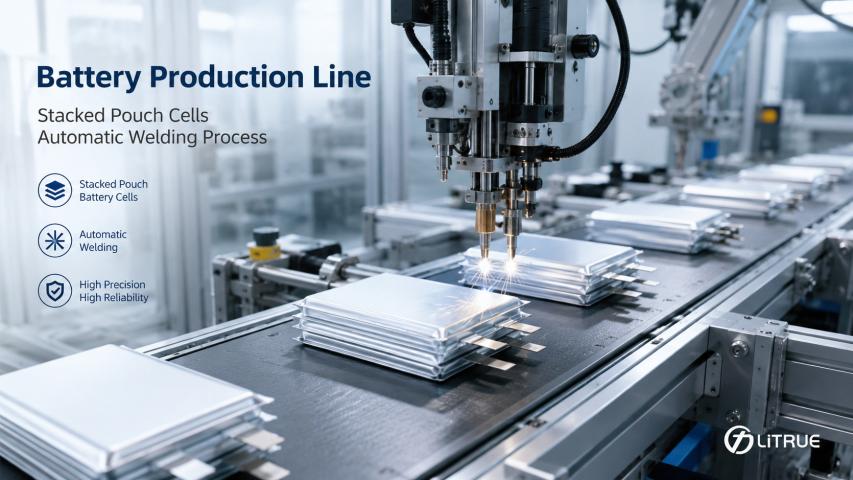
LiTrue Power Technologies Co., Ltd. built its 20Ah & 46Ah High-Temperature LFP Pouch Battery Cell Series (PC20F-T and PA46F-C) specifically around this problem, without assuming the cells would ever run in a mild climate. The standout spec on this series is a 2,000–2,500 cycle-life rating measured at 45°C — not the room-temperature number most comparable products lead with. For fleet operators running equipment long-term in hot-climate markets like Riyadh or Jakarta, that’s the only cycle-life figure that’s actually meaningful. Full technical detail on this validation approach is available in LiTrue’s article, What Is a Pouch Cell Lithium Battery?
Beyond high-temperature cycle life, the series has another advantage that’s easy to overlook: the PC20F-T supports 7C pulse discharge (with a 4C continuous max) — uncommon for an LFP pouch cell, since most LFP products keep discharge rates low to protect cycle life and cost. The stacked-electrode structure also gives these high-performance pouch cells lower internal resistance and better cell-to-cell consistency than wound-cell competitors, and LFP chemistry itself holds a more stable thermal profile across a wider operating range than NMC. Together, those three factors are what the series is actually built to solve. See LiTrue broader cell lineup for related high-rate and wide-temperature options.
Who This Cell Isn’t For
PC20F-T and PA46F-C aren’t a universal cell for every use case. They’re not the right fit for hobbyist or low-volume builds, for applications that need energy density above 200Wh/kg (where NMC chemistry is the better trade-off), or for equipment that only ever operates in temperate climates, where standard-grade LFP already meets cycle-life requirements. This series is purpose-built for one job: equipment that has to run continuously at 45°C or higher, year after year.