As
enterprise data centers evolve to support cloud-native applications, hybrid
architectures, and increasingly sophisticated cyber threats, traditional
perimeter-based security models are no longer sufficient. Modern security
strategies now focus on Zero Trust—an approach that assumes no implicit
trust anywhere in the network. For enterprises operating at scale and
professionals aligned with CCIE Data Center expertise, Cisco ACI
micro-segmentation has become a practical and effective way to implement Zero-Trust
principles inside the data center.
This
SEO-optimized blog explains how Cisco ACI micro-segmentation enables Zero-Trust
data center designs and why it has become a core security strategy for modern
enterprises.
Why Traditional Data Center Security Models Fall
Short
Traditional
data center security often relies on:
- Network perimeters protected
by firewalls
- VLAN-based segmentation
- Broad access policies within
trusted zones
While
these approaches worked in earlier environments, they struggle with today’s
realities:
- East–west traffic dominates
application communication
- Workloads are dynamic and
frequently move
- Insider threats and lateral
movement risks have increased
- Hybrid and multi-cloud
environments blur network boundaries
Zero
Trust addresses these gaps by enforcing security controls everywhere,
not just at the edge.
Understanding Zero Trust in the Data Center Context
Zero
Trust is not a single product—it is a design philosophy built on three core
principles:
- Never trust, always verify
- Least-privilege access
- Assume breach and limit
blast radius
In data
centers, this means:
- No workload is trusted by
default
- Every communication path is
explicitly allowed
- Security policies follow
workloads, not network locations
Cisco ACI
provides the technical framework to enforce these principles natively within
the fabric.
What Is Cisco ACI Micro-Segmentation?
Micro-segmentation
in Cisco ACI allows administrators to define granular security policies at the
application and workload level rather than relying on IP addresses or VLANs.
Key
elements include:
- Endpoint Groups (EPGs): Logical groupings of
workloads
- Contracts: Explicit rules that define
allowed communication
- Filters: Protocols and ports
permitted between EPGs
- Policy Enforcement: Distributed across the
fabric
This
policy-driven model makes it possible to secure traffic between workloads, even
when they reside on the same subnet.
How Cisco ACI Enables Zero-Trust Data Centers
1. Default Deny Between Workloads
In a
Zero-Trust ACI fabric, communication between EPGs is denied by default. Traffic
is only allowed when explicitly defined by contracts. This eliminates implicit
trust and significantly reduces lateral movement risk.
2. Application-Centric Policy Design
ACI
policies are built around applications rather than network constructs. This
allows security teams to:
- Define communication based
on application intent
- Maintain consistency across
environments
- Simplify audits and
compliance reporting
Security
policies remain intact even as workloads scale or move.
3. Fine-Grained East–West Traffic Control
Micro-segmentation
enables precise control of east–west traffic, which is where most modern
attacks propagate. Each application tier communicates only with approved
services, limiting exposure during a breach.
4. Distributed Policy Enforcement
Unlike
centralized firewalls, ACI enforces policies at the fabric level. This
distributed enforcement:
- Improves performance
- Eliminates bottlenecks
- Scales efficiently across
large data centers
Security
does not come at the cost of latency or throughput.
Design Patterns for Zero-Trust with Cisco ACI
Tier-Based Application Segmentation
Applications
are divided into tiers (web, application, database), each mapped to separate
EPGs with tightly controlled contracts.
Environment-Based Segmentation
Production,
staging, and development environments are isolated, preventing accidental or
malicious cross-environment access.
Tenant Isolation
Different
business units or customers are isolated within tenants, supporting strong
multi-tenancy and compliance requirements.
These
patterns are commonly combined to achieve layered Zero-Trust enforcement.
Operational Benefits Beyond Security
Cisco ACI
micro-segmentation delivers benefits that extend beyond security:
- Reduced blast radius during
incidents
- Faster application
onboarding with reusable policies
- Improved visibility into
application communication flows
- Simplified troubleshooting
and policy audits
Security
becomes an integrated part of operations rather than an external control layer.
Common Challenges and How Enterprises Address Them
Policy Complexity
Without
proper planning, policies can become difficult to manage. Successful
enterprises:
- Standardize EPG and contract
templates
- Enforce naming conventions
- Use automation for policy
deployment
Cultural Shift
Zero
Trust requires collaboration between network, security, and application teams.
Organizations that align these teams early see faster adoption and better
outcomes.
Why Micro-Segmentation Is Critical for Modern
Workloads
AI
platforms, containerized applications, and hybrid cloud services significantly
increase east–west traffic. Micro-segmentation ensures that even as
applications scale and change, security policies remain consistent and
enforceable.
This
makes Cisco ACI micro-segmentation especially relevant in enterprise
environments where uptime, compliance, and data protection are critical.
Why Zero-Trust Design Matters for Data Center
Engineers
Enterprises
increasingly expect data center professionals to:
- Design security into the
fabric
- Understand application
communication patterns
- Balance protection with
performance
- Support audits and
compliance requirements
These
expectations align closely with advanced enterprise and architect-level roles.
Conclusion
Building
Zero-Trust data centers is no longer optional for modern enterprises, and Cisco
ACI micro-segmentation provides a proven, scalable way to enforce Zero-Trust
principles within the data center fabric. By implementing default-deny
policies, application-centric security, and distributed enforcement,
organizations can significantly reduce risk without sacrificing performance or
agility. In conclusion, developing the architectural knowledge and hands-on
expertise required to design and operate Zero-Trust ACI environments is best
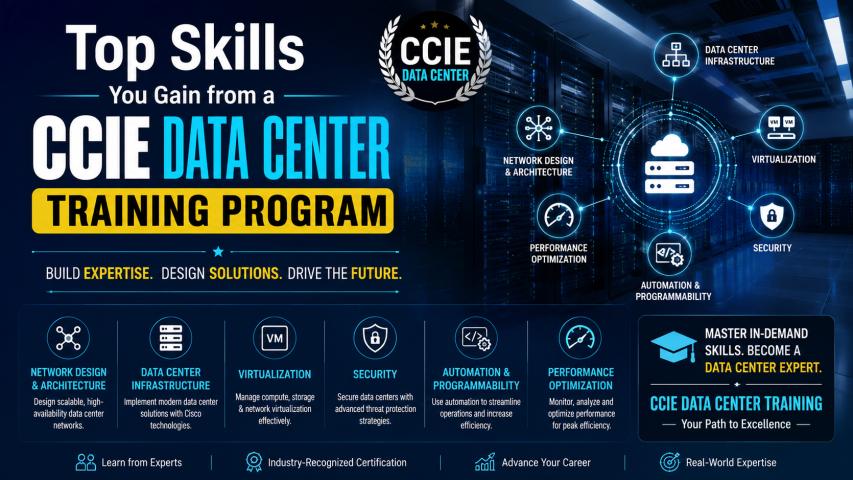
achieved through structured learning and real-world practice offered by CCIEData Center Training, which prepares professionals for secure,
enterprise-grade data center deployments.