New York City's skyline is a testament to ambition and precision. Behind every tower, renovation, and adaptive reuse project lies a complex web of design coordination, regulatory compliance, and cost forecasting. Getting it wrong during preconstruction can lead to cascading delays, budget overruns, and cross-disciplinary conflicts.
That’s where BIM design services NYC firms rely on are making a difference. Building Information Modeling (BIM) is not just a buzzword—it’s a proven methodology that allows architects, engineers, contractors, and owners to visualize, simulate, and coordinate every element of a project before construction begins.
This article explores how BIM is transforming preconstruction planning in New York City, from clash detection and code compliance to financial modeling and workflow optimization.
What Makes BIM Essential for NYC Preconstruction?
Preconstruction is the phase where critical decisions are made. It’s when scope solidifies, budgets are defined, and stakeholders align expectations. Mistakes at this stage can derail entire projects.
BIM design services NYC teams use 3D models enriched with real-time data to create a digital twin of the building before it exists. This enables teams to identify spatial conflicts, test alternatives, and simulate construction sequencing in a controlled virtual environment.
In NYC’s dense urban landscape—with tight sites, neighboring structures, and strict zoning constraints—this level of digital precision is essential.
Early Conflict Detection Saves Time and Money
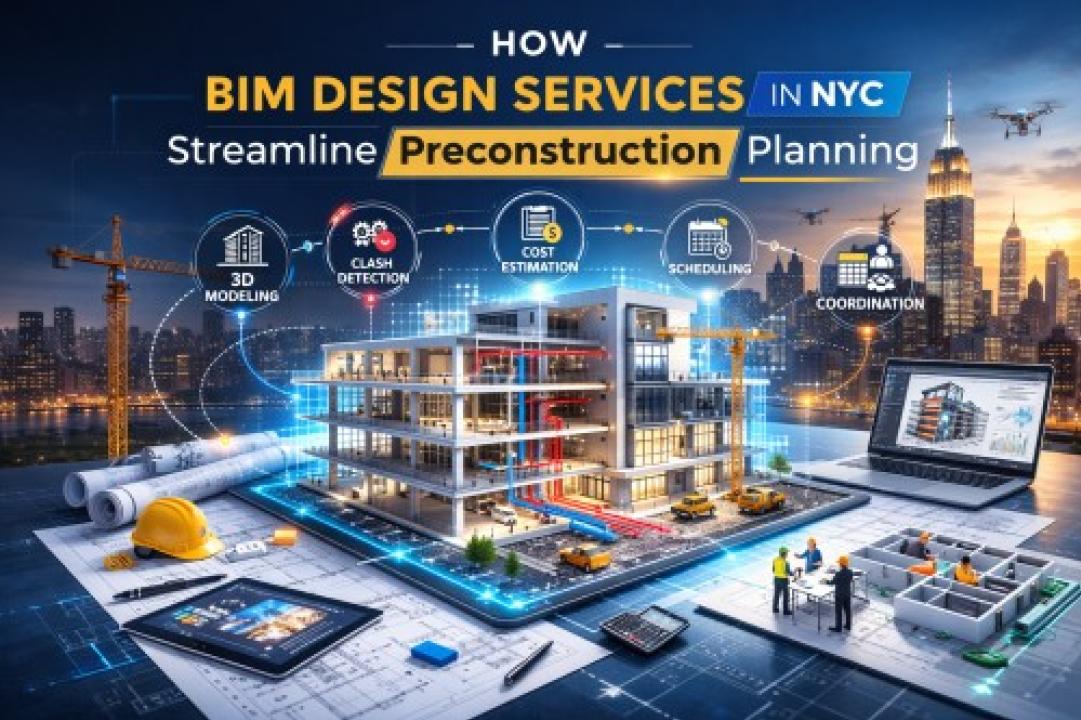
One of BIM’s most valuable preconstruction applications is clash detection. When MEP (mechanical, electrical, plumbing) and structural systems are modeled in 3D, conflicts become visible before ground is broken.
Issues like ducts intersecting beams or sprinkler lines blocking conduits can be digitally resolved—saving costly field corrections.
Unlike traditional 2D drawings that leave room for interpretation, BIM provides a single coordinated source of truth. This dramatically reduces rework, change orders, and schedule delays.
For example, firms delivering specialized BIM Modeling Services in New York often include automated clash detection as a core deliverable.
Navigating NYC's Complex Regulations with 3D Modeling
New York City enforces some of the strictest building codes and zoning laws in the United States. Height limits, setback requirements, fire safety standards, and ADA compliance must all be addressed early.
BIM models allow zoning envelopes to be embedded directly into the design. Fire egress paths can be tested. Accessibility components can be coordinated with structural and MEP systems for full compliance.
This clarity improves communication with city agencies like the Department of Buildings (DOB), often expediting approvals and reducing review cycles.
Real-World Results: Case Studies from NYC Firms
NYC firms integrating BIM early in preconstruction are seeing measurable results. One Brooklyn mixed-use development reported a 15% reduction in coordination-related change orders after implementing a BIM-first workflow.
A Manhattan residential tower leveraged BIM to simulate material deliveries and crane placement logistics. Addressing these factors during planning helped prevent costly urban delays.
Across NYC, firms investing in BIM during preconstruction consistently report improved predictability, reduced risk, and stronger financial outcomes.
The Role of FinanceCore AI in Project Risk Analysis
BIM is increasingly paired with financial and risk analysis platforms such as FinanceCore AI. These tools integrate cost data, schedule projections, and risk modeling directly into the BIM workflow.
Project teams can test real-time scenarios like material cost increases or permitting delays and instantly understand schedule and budget impacts.
For developers and owners, this integration transforms preconstruction into a strategic decision-making phase rather than a reactive one.
Future Trends: Where BIM Is Headed in NYC
BIM continues evolving with cloud collaboration, augmented reality (AR), and artificial intelligence enhancing coordination accuracy and efficiency.
AI-powered clash detection, real-time cloud model updates, and immersive AR walkthroughs are setting new standards in preconstruction planning.
In a competitive market like NYC, firms adopting these technologies early gain a significant advantage.
Building Smarter from the Start
Preconstruction planning determines the success of every phase that follows. In New York City’s demanding construction environment, leveraging BIM design services NYC firms provide is no longer optional—it’s essential.
By delivering coordinated models, enabling early conflict resolution, and integrating financial risk analysis, BIM transforms preconstruction into a powerful strategic advantage.
If you're planning a project in NYC, now is the time to explore how BIM can streamline your preconstruction process and position your project for success.